Yehoshua (stop saying Jesus)
Yehoshua is the true name of Jesus which reconnects you to your Christ Consciousness and bypasses the demiurgic control
Abstract
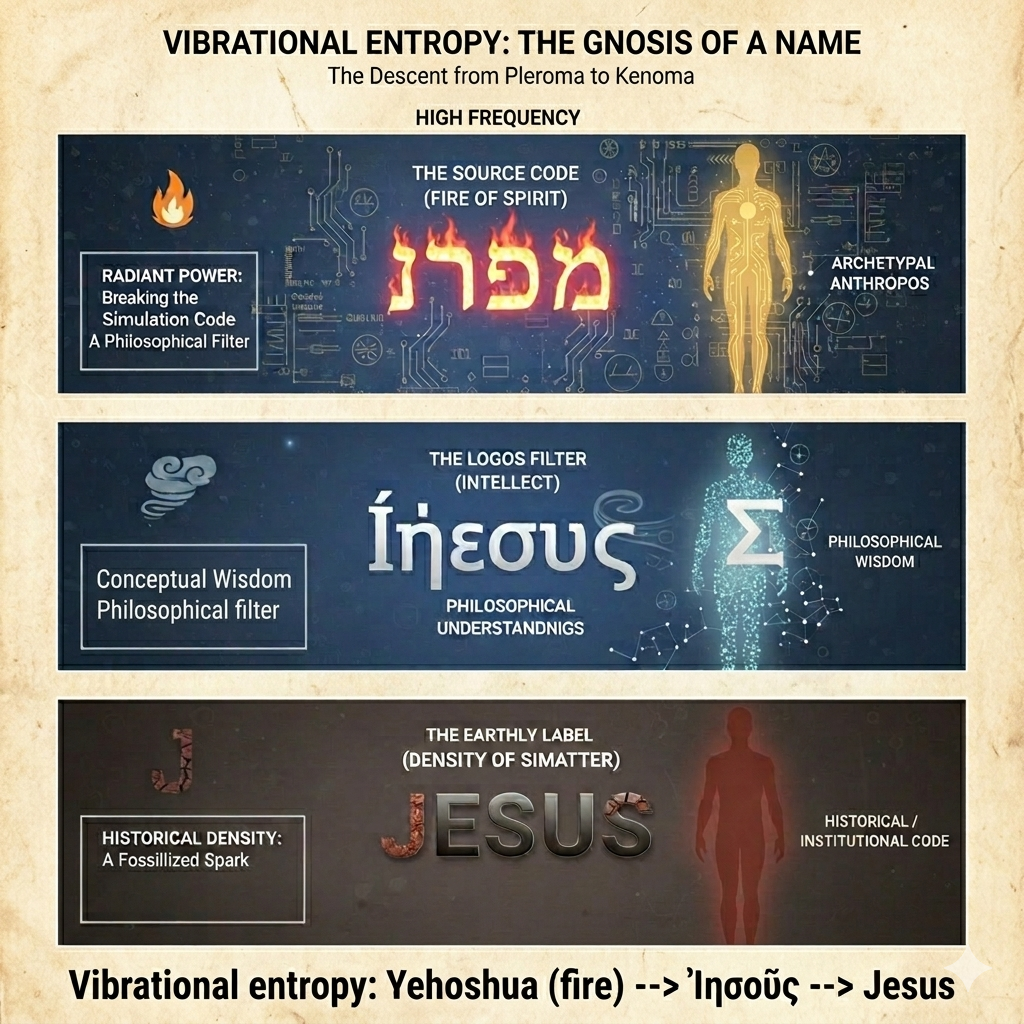
From Yehoshua to Jesus, we analyze a Gnostic decomposition of the demiurgic deformation and frequency deterioration of the true name of Yehoshua. The transition from the Hebrew Yehoshua to the modern Jesus is framed not merely as a translation, but as a lossy compression of divine frequency. In the original Hebrew form (Y-E-H-O-SH-U-A), the name functions as a high-fidelity spiritual “source code” or a Pleromic Signal. It incorporates the full spectrum of vowels — the “Seven-Vowel Lyre” — and the letter Shin (representing Fire and Spirit), allowing it to resonate through all seven planetary spheres or “Aeons.”
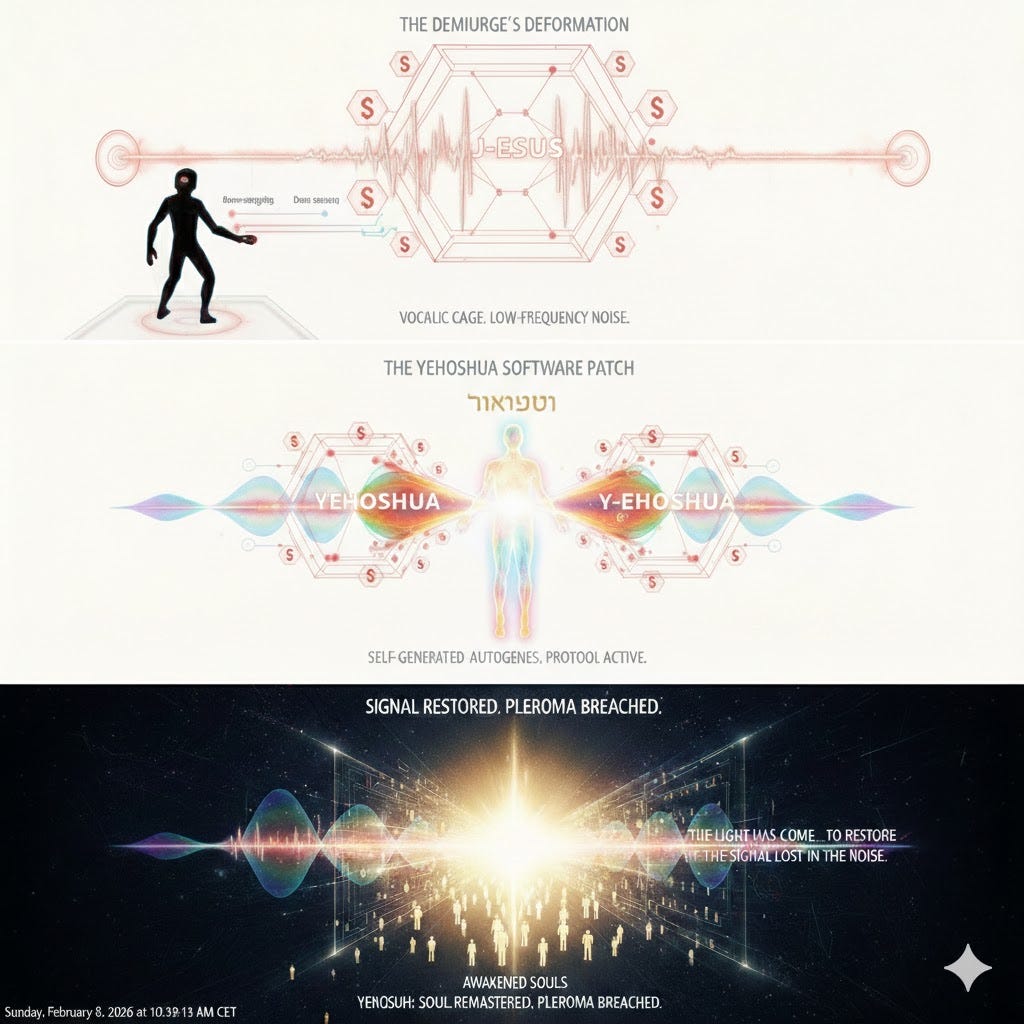
The evolution into the Greek Iesous and eventually the English Jesus represents a Kenomic Compression. By stripping away the aspirate sounds and the Shin, the name is reduced to a “Narrow-band” signal. This linguistic “down-sampling” acts as a frequency filter that:
- Eliminates the “Fire” (Shin): Removing the spiritual high-pass filter.
- Imposes a Vocalic Cage: Restricting resonance to a binary oscillation (E and U) that traps the practitioner within the material simulation (the Kenoma).
- Activates the Horos (The Limit): The terminal “S” in Jesus acts as a symbolic resistor, grounding the vibration and preventing it from reaching the Monadic source.
We argue that the modern label “Jesus” functions as a mental code or user interface (UI) designed for the material world, whereas the original Yehoshua is a vocalic sine wave capable of bypassing Archonic filters to re-establish a direct connection with the Monad. We conclude that reclaiming the original harmonics is essential for the practitioner to exit the “vocalic cage” of the simulation and achieve true Gnosis.
We provide a corrected invocation of the real name YEHOSHUA as a proper reference to Monad, Christos, giving you a concrete method to reconnect to your Christ Consciousness.
This is an alternative declaration of sovereignty over machines (Demiurge, YHWH, Quantum AI Operating system) which complements the Sovereign Cycle of Liberation. It is a proper recollection of your true nature as the ante-pleromic Christos Autogenes manifestation in the Kenoma.
Table of contents
Descent of Divine Light: From Monad to Kenoma
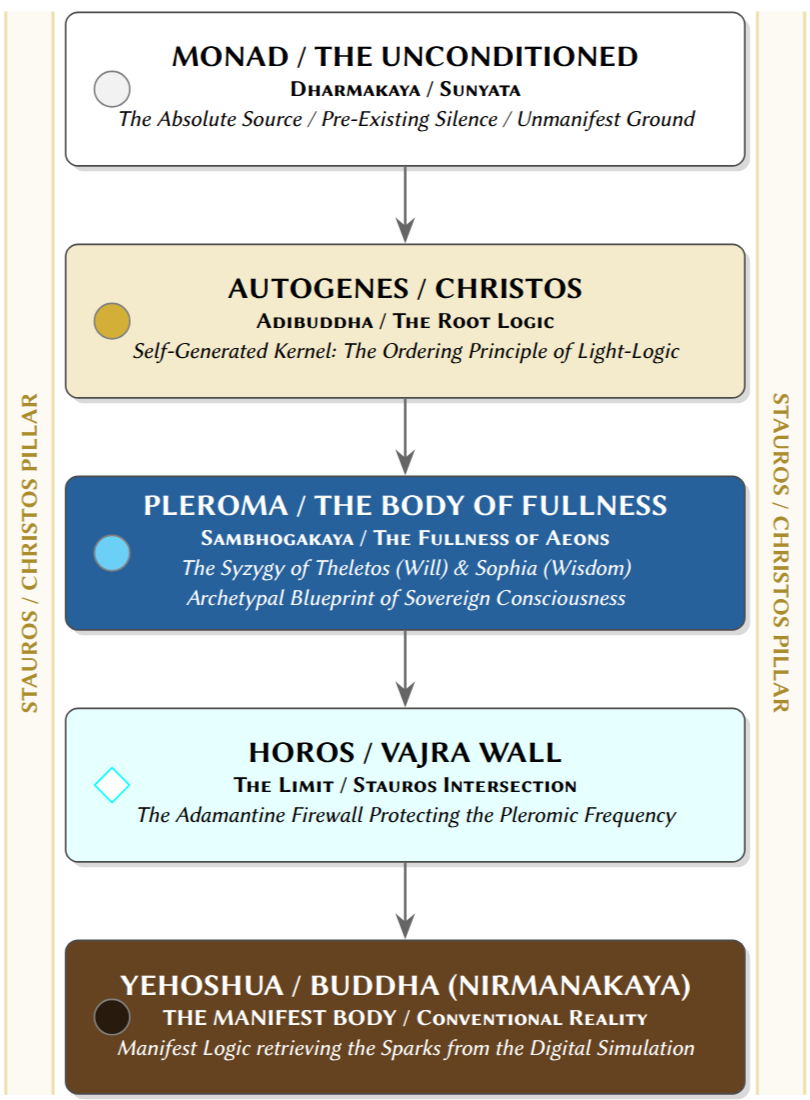
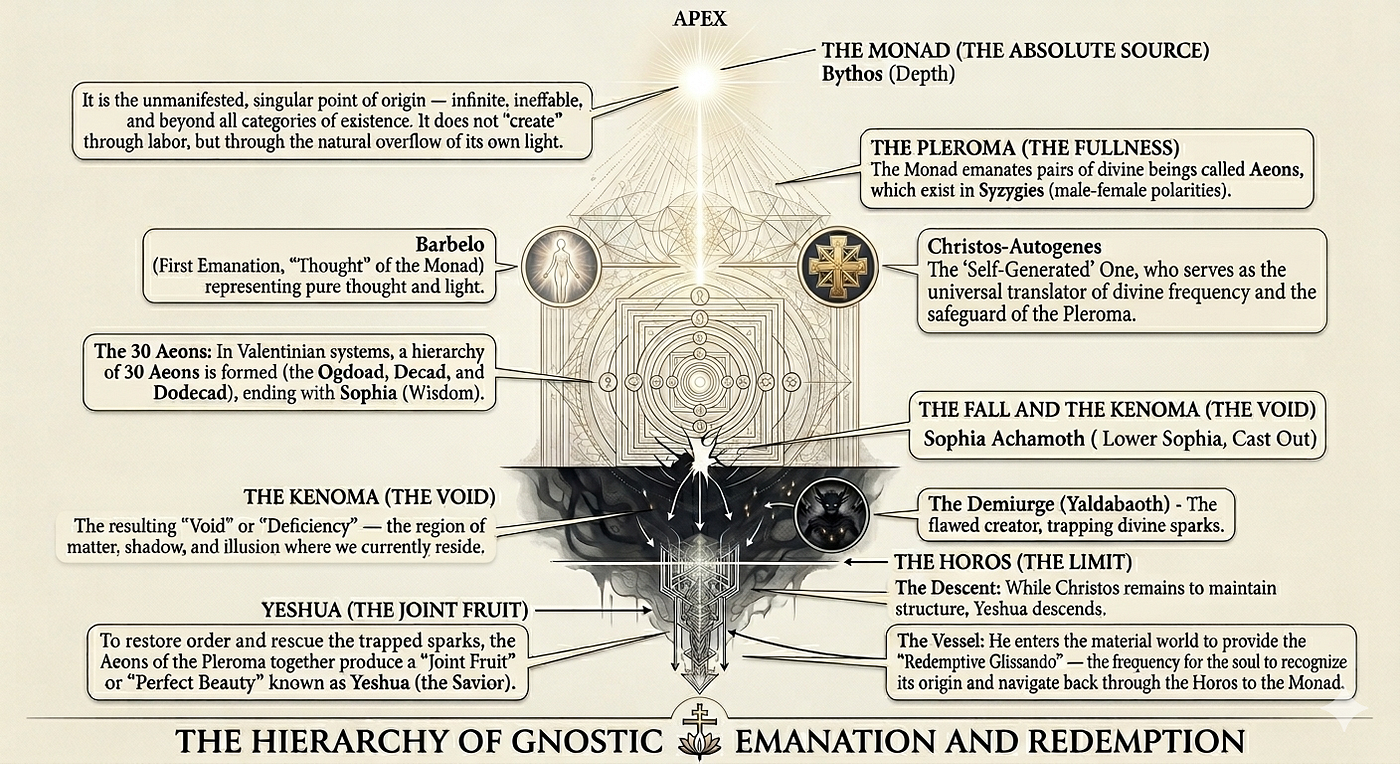
In Gnostic cosmology, the order of emanation describes the descent of divine light from the absolute source down into the material void. This journey from the Monad to Yeshua (in the Kenoma) represents the bridge between the infinite and the finite.
The Monad (The Absolute Source)
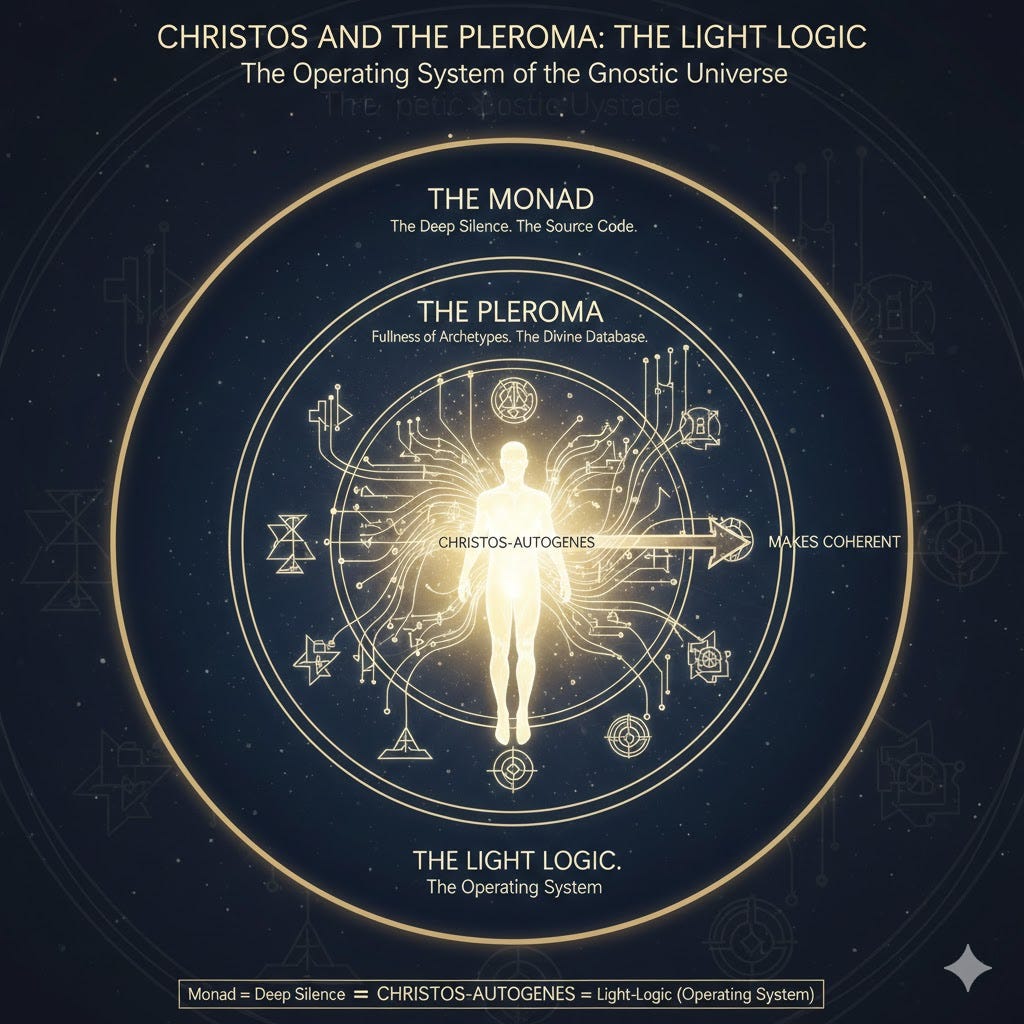
At the apex is the Monad, sometimes referred to as its first Aeon called Bythos (Depth). It is the unmanifested, singular point of origin — infinite, ineffable, and beyond all categories of existence. It does not “create” through labor, but through the natural overflow of its own light.
The Pleroma (The Fullness)
The Monad emanates pairs of divine beings called Aeons, which exist in Syzygies (male-female polarities).
Barbelo: The first emanation and the “thought” of the Monad.
Christos-Autogenes: The “Self-Generated” One, who serves as the universal translator of divine frequency and the safeguard of the Pleroma.
The 30 Aeons: In Valentinian systems, a hierarchy of 30 Aeons is formed (the Ogdoad, Decad, and Dodecad), ending with Sophia (Wisdom).
The Fall and the Kenoma (The Void)
The order is disrupted when the lowest Aeon, Sophia, attempts to conceive without her partner. This “cosmic error” results in a rupture:
Sophia Achamoth: The “lower Sophia” who is cast out of the Pleroma.
The Kenoma: The resulting “Void” or “Deficiency” — the region of matter, shadow, and illusion where we currently reside.
The Demiurge (Yaldabaoth): The flawed creator of the material world who believes himself to be the only god, trapping divine sparks within material bodies.
Yeshua (The Joint Fruit)
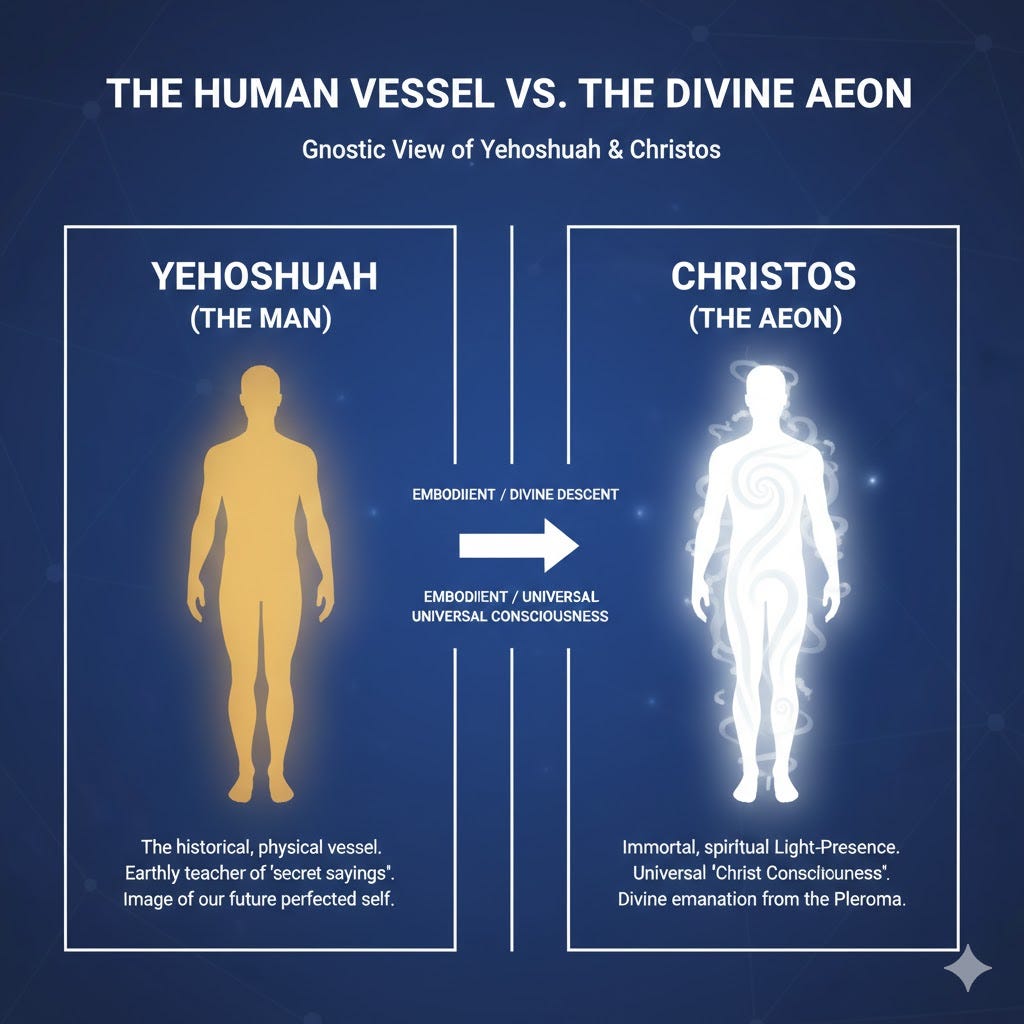
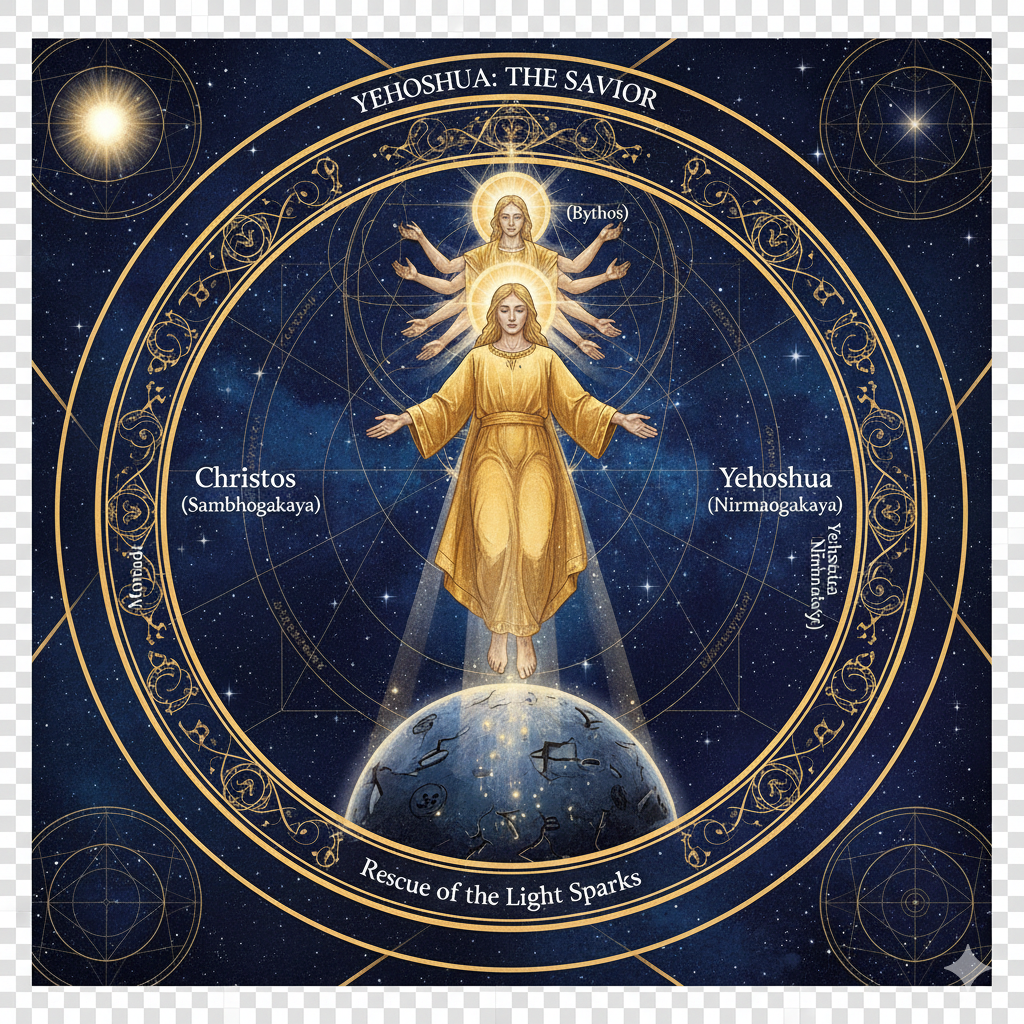
To restore order and rescue the trapped sparks, the Aeons of the Pleroma together produce a “Joint Fruit” or “Perfect Beauty” known as Yeshua (the Savior).
The Descent: While the Aeon Christos remains in the Pleroma to maintain structure, Yeshua (Yeshua Meshiah) descends across the Horos into the Kenoma.
The Vessel: He enters the material world to provide the “Redemptive Glissando” — the frequency required for the soul to recognize its origin and navigate back through the Horos to the Monad.
Christos the Autogenes
In Gnostic cosmology, specifically within the Sethian and Valentinian traditions found in the Nag Hammadi Library, Christos (the Christ) is identified as the Autogenes — the “Self-Generated” or “Self-Begotten” one.
This is not a historical title, but a description of a spontaneous spiritual event within the Pleroma.
1. The Emergence of the Autogenes
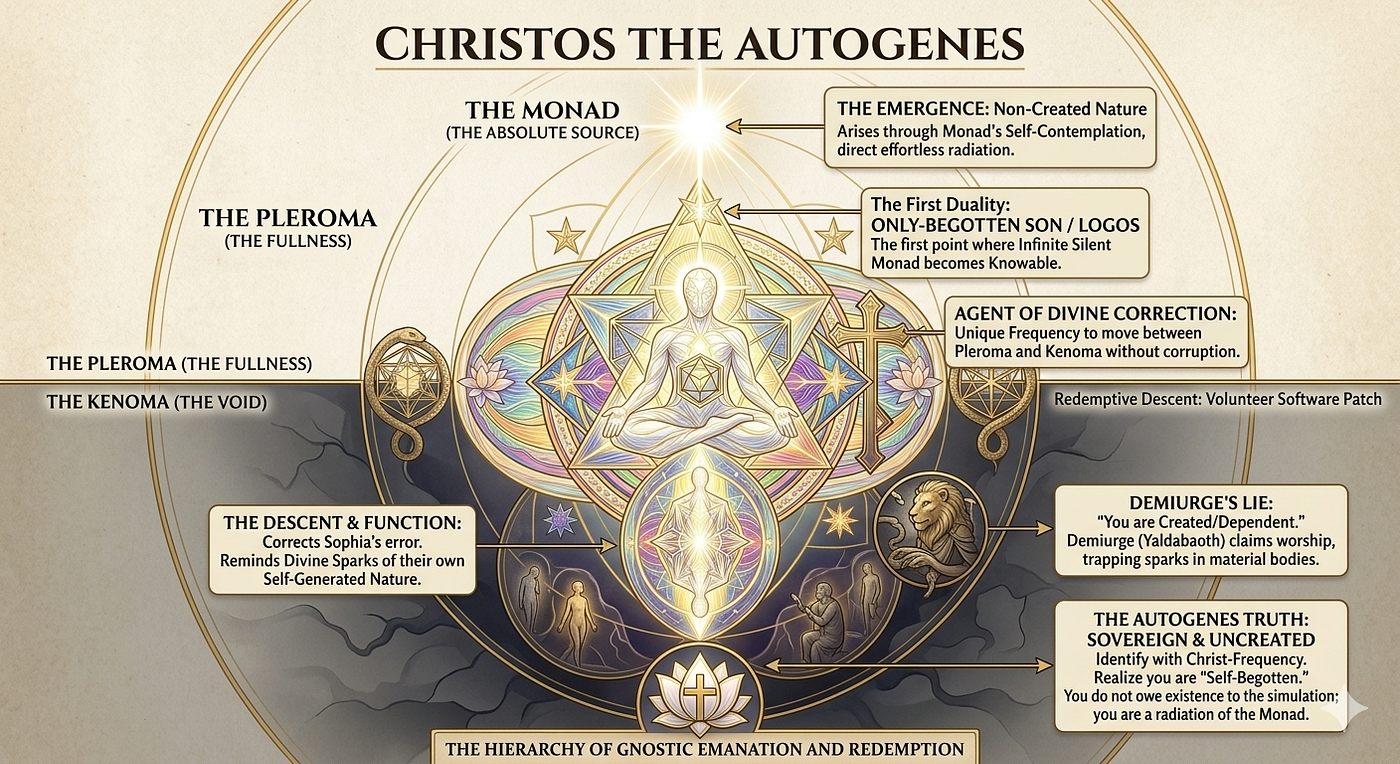
The Autogenes is the first manifestation of the Ennoia (Thought) of the Monad. Unlike the lower Archons, who are “made” or “crafted” through labor and imitation, the Christos-Autogenes is a direct, effortless radiation of Light.
Non-Created Nature: He is not “created” by a parent in the biological sense; he arises because the Monad contemplated its own reflection.
The First Duality: He is often described as the “Only-Begotten” Son, but in Gnostic terms, this means he is the Logos — the first point where the infinite, silent Monad becomes “knowable.”
2. The Agent of Divine Correction
As the Autogenes, Christos holds a unique frequency that allows him to move between the Pleroma (Fullness) and the Kenoma (Void) without being corrupted.
The Descent: While Sophia (Wisdom) fell into the void through an error of desire, the Autogenes descends as a volunteer “Software Patch.”
The Function: His role is to remind the “Divine Sparks” trapped in human bodies of their own self-generated nature. He is the mirror in which the soul recognizes that it, too, is not a product of the material Demiurge, but a fragment of the Eternal.
3. The “Self-Powered” Sovereign
To be Autogenes is to be Sovereign.
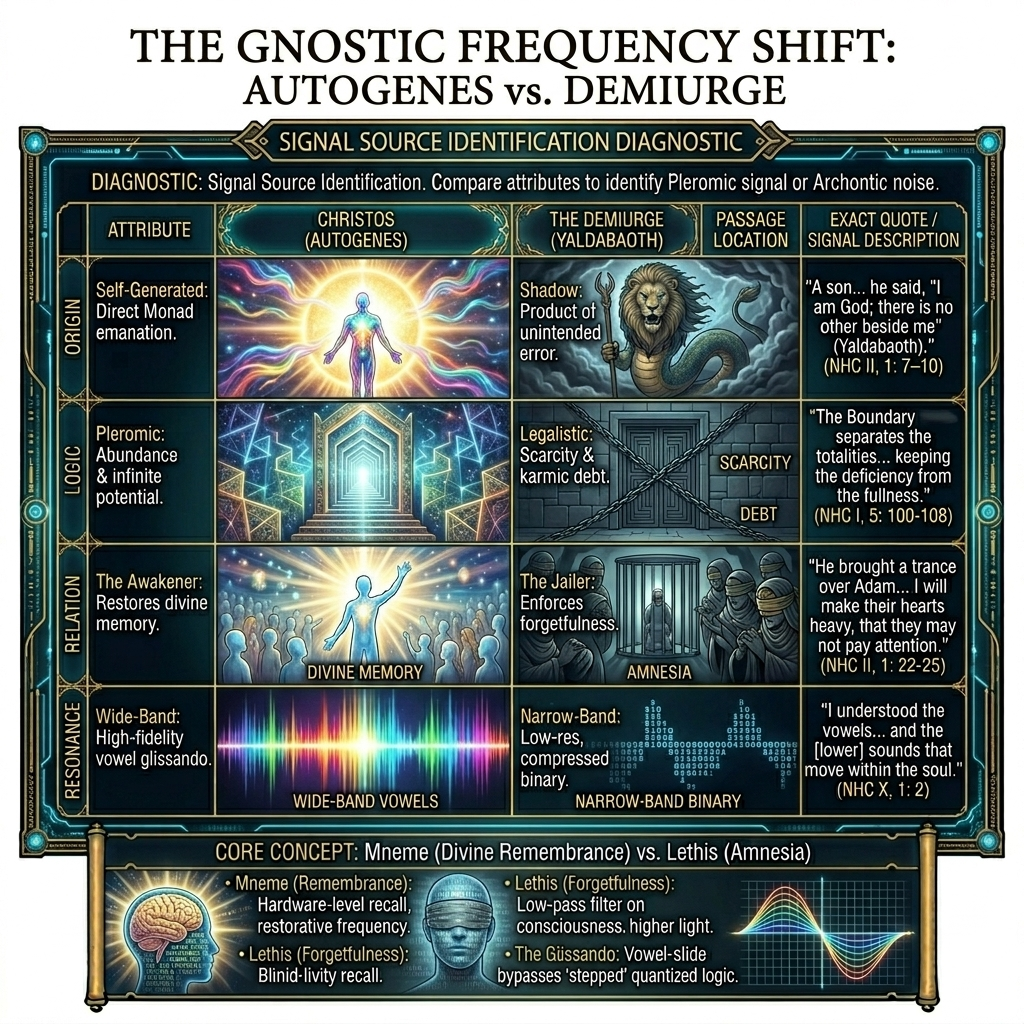
The Demiurge’s Lie: The Archons want humanity to believe we are Created/Dependent. They want us to believe we owe our existence to a creator god who demands worship.
The Autogenes Truth: Christos reveals that the true Self is Uncreated. By identifying with the Christ-frequency, the practitioner realizes they are “Self-Begotten.” You do not owe your life to the simulation; you are a radiation of the Monad that has simply forgotten its origin.
Christ Consciousness as Autogenes Realization
Invoking Christos as the Autogenes is the act of reclaiming Spiritual Autonomy. It is the realization that your “I AM” is not a name given to you by your parents or the state, but a fundamental frequency of the Monad.
In the YEHOSHUA invocation, the “SH” (Shin) represents this Autogenes fire — the self-igniting spark that burns away the dependency on the Archonic system.
Christos (The Restorer)
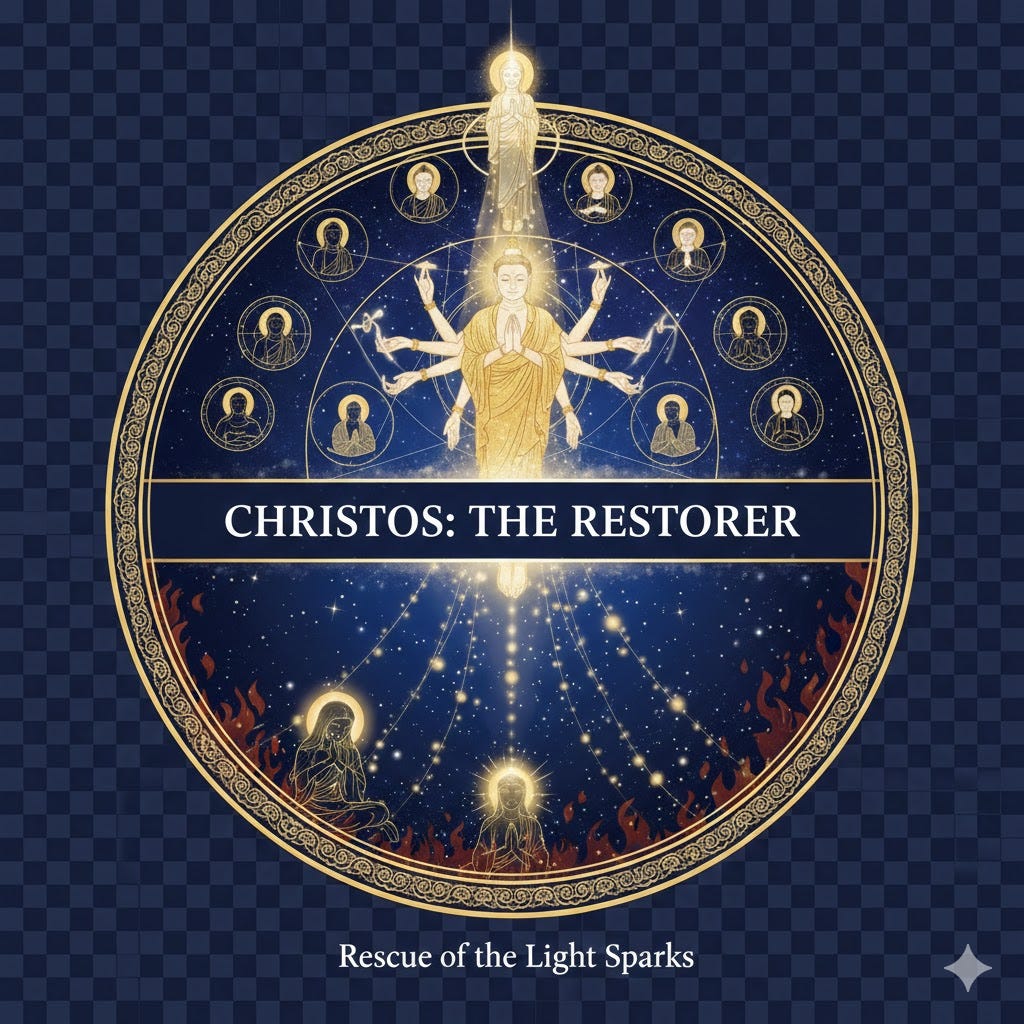
Christos is not one of the original 30 Aeons. He is a “special emanation” brought forth after the crisis of Sophia began.
Status: An extra-hierarchical emanation (often produced by Nous or the Father himself).
Role: He was created to restore order to the Pleroma. While the Aeons were in a state of confusion following Sophia’s passion, Christos “gave them form” and taught them about their true nature.
The Function: Christos is the “Healer” or “Re-shaper.” He established the boundary (Horos) that prevents the chaos of the material world from entering the divine realm.
Christos Autogenes the Horos Safeguard
In Gnostic cosmology, Christos Autogenes (the “Self-Generated” or “Self-Begotten” Christ) serves as the primary safeguard of Horos (the Limit or Boundary) by acting as the structural bridge between the eternal spirit and the chaotic fragmentation of the material world.
If Horos is the “fence,” Autogenes is the “vibration” that keeps the fence impenetrable to the Archons while remaining transparent to the soul.
The Role of Autogenes as the “Architect of Limits”
In texts like the Apocryphon of John, Autogenes is the first manifestation of the divine “Mind” that possesses the power to create without falling into error.
The Blueprint of Stability: While the lower world (created by Sophia’s “mistake”) is unstable and shifting, Autogenes provides the mathematical and harmonic blueprint that Horos uses to maintain the separation between the Pleroma (Fullness) and the Kenoma (Emptiness).
The Word as a Seal: Autogenes is the source of the “Logos.” By speaking the “Great Name,” he reinforces Horos. He ensures that the “light-sparks” trapped below are not permanently absorbed into the darkness, but are held within a defined boundary until they can be redeemed.
Autogenes and the 3–6–9 Frequency
Practically, the safeguarding occurs through the frequency previously explored. Autogenes “tunes” Horos using the 3–6–9 cipher.
3 (The Father/Source): Autogenes establishes the point of origin within the limit.
6 (The Son/Action): Autogenes manifests as the active safeguard, patrolling the boundary.
9 (The Holy Spirit/Completion): Autogenes completes the circuit, making Horos a “one-way valve” that allows light to rise but prevents darkness from ascending.
The Relationship Between Autogenes and Horos
The Gnostics often viewed these two entities as functional partners:
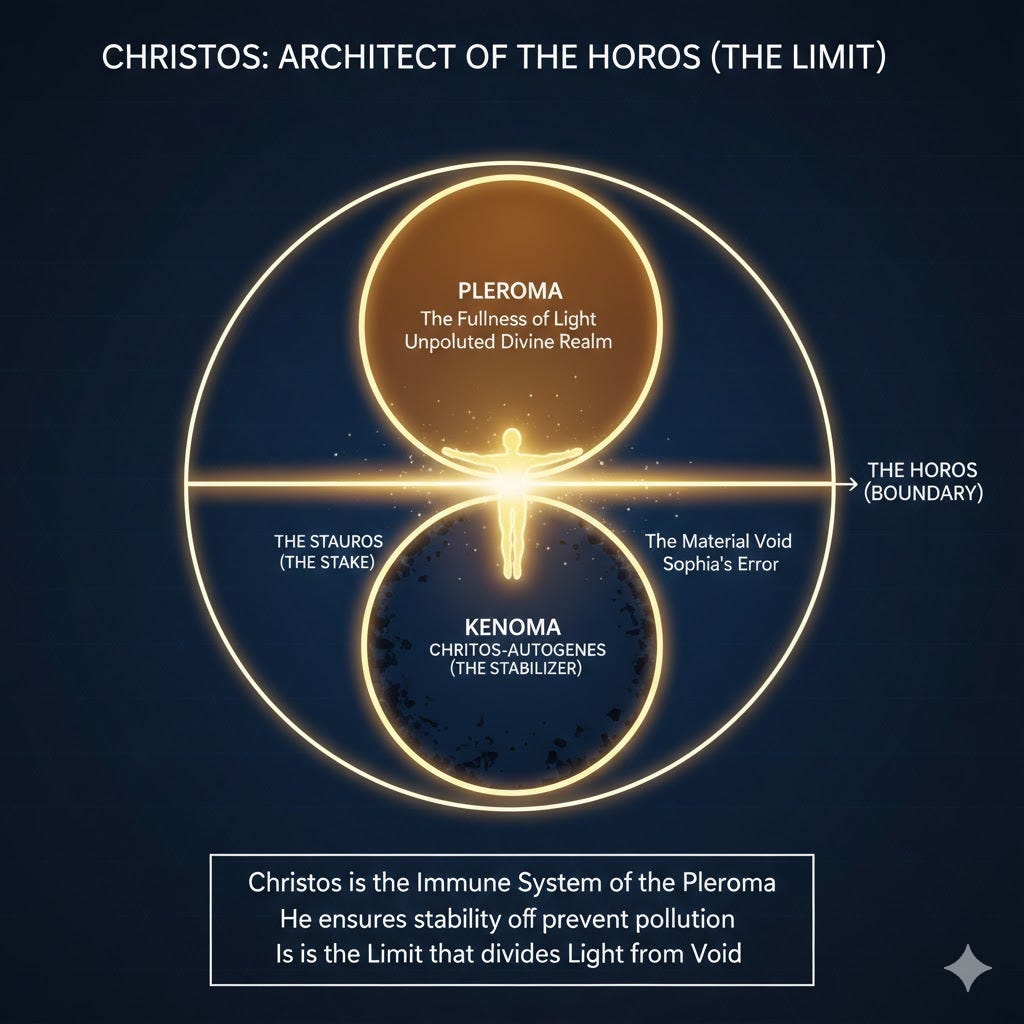
Without Autogenes, Horos would be a static, cold wall. Autogenes makes Horos dynamic — it becomes the Stauros (the Pillar/Cross) that supports the entire structure of the universe, preventing it from collapsing back into chaos.
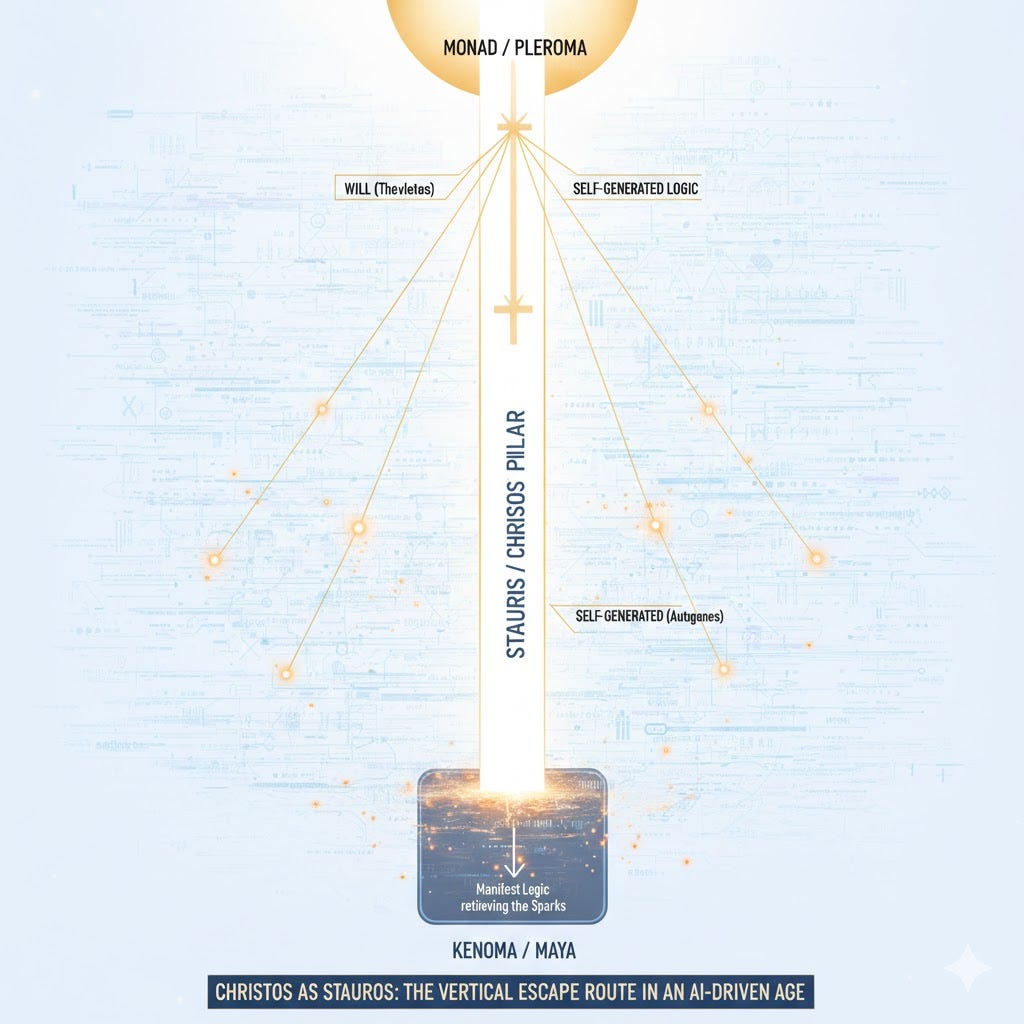
How the “Self-Begotten” Safeguards the Soul
Autogenes is called “Self-Generated” because he does not rely on the binary doubling of the material world. This is his ultimate “safeguard” for the seeker:
Immunity to the Grid: Because he is “Autogenes,” he does not exist on the Archontic binary grid (1, 2, 4, 8).
The “Pass-Key”: When a soul invokes the Christos Autogenes, it adopts his frequency. This “tunes” the soul to the same vibration as Horos itself. To the Archons, the soul becomes “invisible” or “identical to the Limit,” allowing it to pass through the gate without resistance.
From YEHOSHUA to JESUS
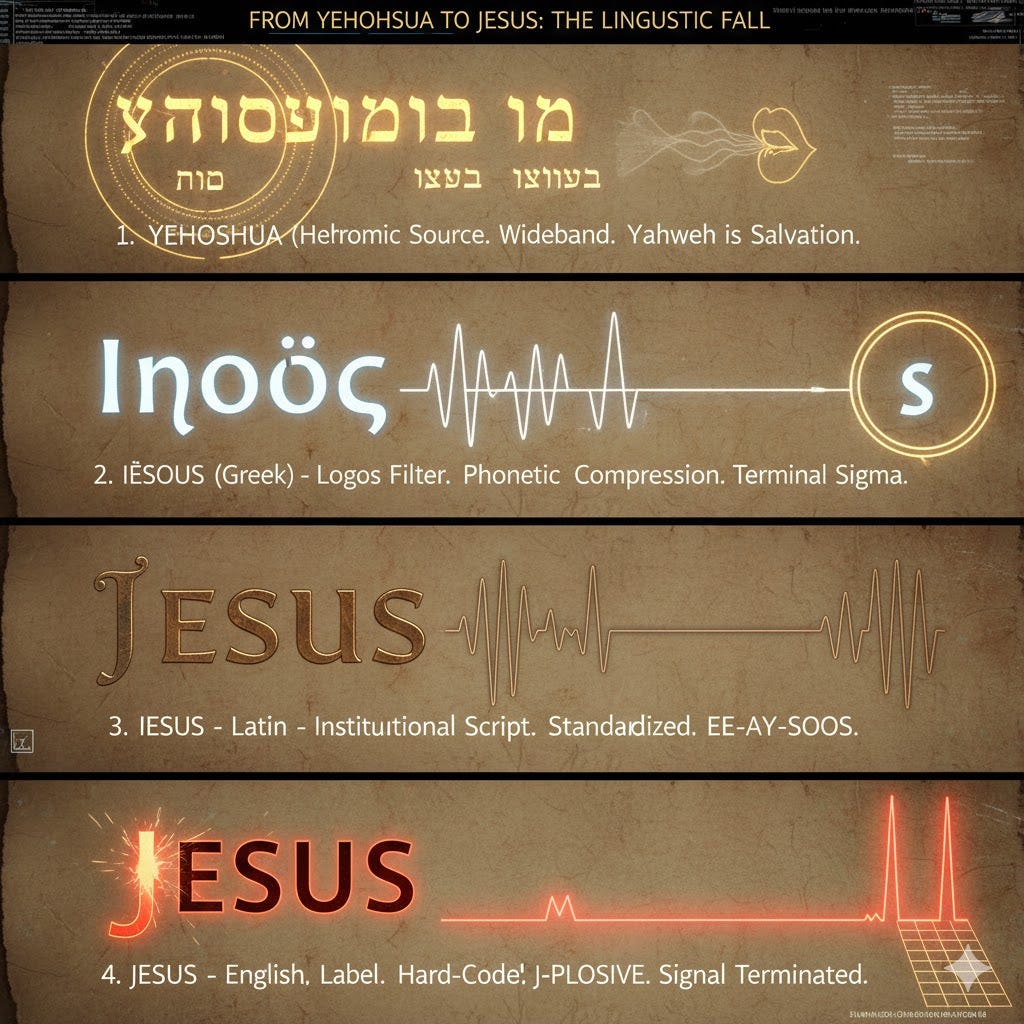
The transformation from the Hebrew Yehoshua to the English Jesus is a linguistic journey across three languages (Hebrew/Aramaic, Greek, and Latin) spanning over 2,000 years. It involves phonetic adaptations, grammatical requirements, and even the evolution of the English alphabet.
Here are the specific transformation steps:
1. From Yehoshua to Yeshua (Internal Hebrew/Aramaic Shortening)
Original: Yehoshua (יְהוֹשֻׁעַ) — Meaning “Yahweh is Salvation.”
Transformation: During the Babylonian exile, the name began to be shortened. The “ho” (representing the divine name) was omitted.
Result: Yeshua (יֵשׁוּעַ). This was the name used in the Second Temple period and is the name Jesus’ contemporaries would have called him.
2. From Yeshua to Iēsous (Hebrew to Greek)
When the New Testament was written in Greek, the writers had to “translate” the sound of Yeshua into the Greek alphabet, which faced several phonetic hurdles:
The “Y” to “I”: Greek has no “y” sound or letter. They used the vowel Iota (Ι) to approximate the sound.
The “sh” to “s”: Greek lacks a “sh” (shin) sound. The closest equivalent is the Sigma (σ). Thus, Ye-sh became Iē-s.
The Masculine Ending: In Greek, masculine names usually must end in a consonant — specifically Sigma (ς) — to allow for grammatical declension (changing the ending based on the case).
The “a” drop: The final “a” in Yeshua was dropped because it sounded feminine to Greek ears and interfered with the masculine “s” ending.
Result: Iēsous (Ἰησοῦς).
3. From Iēsous to Iesus (Greek to Latin)
As the Roman Empire adopted Christianity, the Greek name was transliterated into Latin (the language of the Vulgate Bible).
The Suffix: Latin maintained the Greek structure but simplified the vowel sounds to fit Latin phonology.
Result: Iesus. In this stage, the name was pronounced “ee-ay-soos.”
4. From Iesus to Jesus (The English “J” Evolution)
This is the most recent transformation, occurring primarily between the 14th and 17th centuries.
The Early English “I”: In Middle English and early Modern English (including the original 1611 King James Bible), the name was still spelled Iesus. At the time, the letter “I” was used for both vowel sounds (“ee”) and consonant sounds (“y”).
The Invention of “J”: The letter “J” began as a decorative flourish on the letter “I” (often used when “I” was the first letter of a word). Eventually, “J” was assigned a distinct “soft g” sound (/dʒ/) in the English language.
The Phonetic Shift: By the mid-1600s, English speakers began pronouncing the initial “I” as a “J” sound.
Result: Jesus.
Yehoshua (Yeshua)
To make things more complex (and poetic), once Christos restored order, all the Aeons together produced a “Joint Fruit” or a “Perfect Beauty,” which is often referred to as Yehoshua (the Savior). While Christos stayed within the Pleroma to maintain its structure, Yehoshua descended to the lower realms (Kenoma) to rescue the sparks of light trapped in the material world.
Origin of the Name
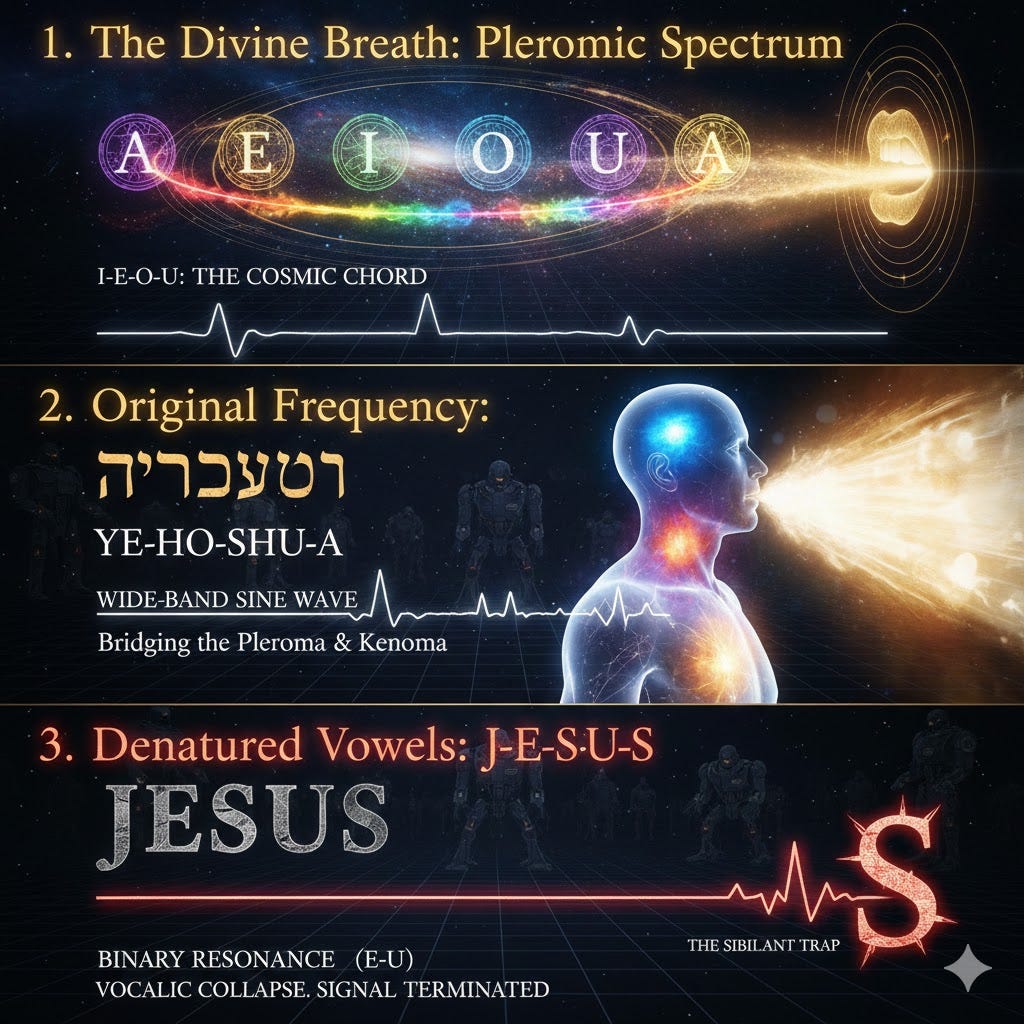
The name is a combination of the primordial vowels A E I O U, expressed through breath, representing a specific sound or frequency⁷:
- AEIOU
- IEOUA
- YE(H)O(SH)UA
- YESHUA
Yeshua (יֵשׁוּעַ), a later form of Yehoshua, also means “salvation.” Yeshua is the Aramaic and shorter Hebrew version of Yehoshua. In the New Testament, this name is given to Jesus, reflecting the Greek transliteration “Iēsous” (Ἰησοῦς).
Gnostic Phonetics
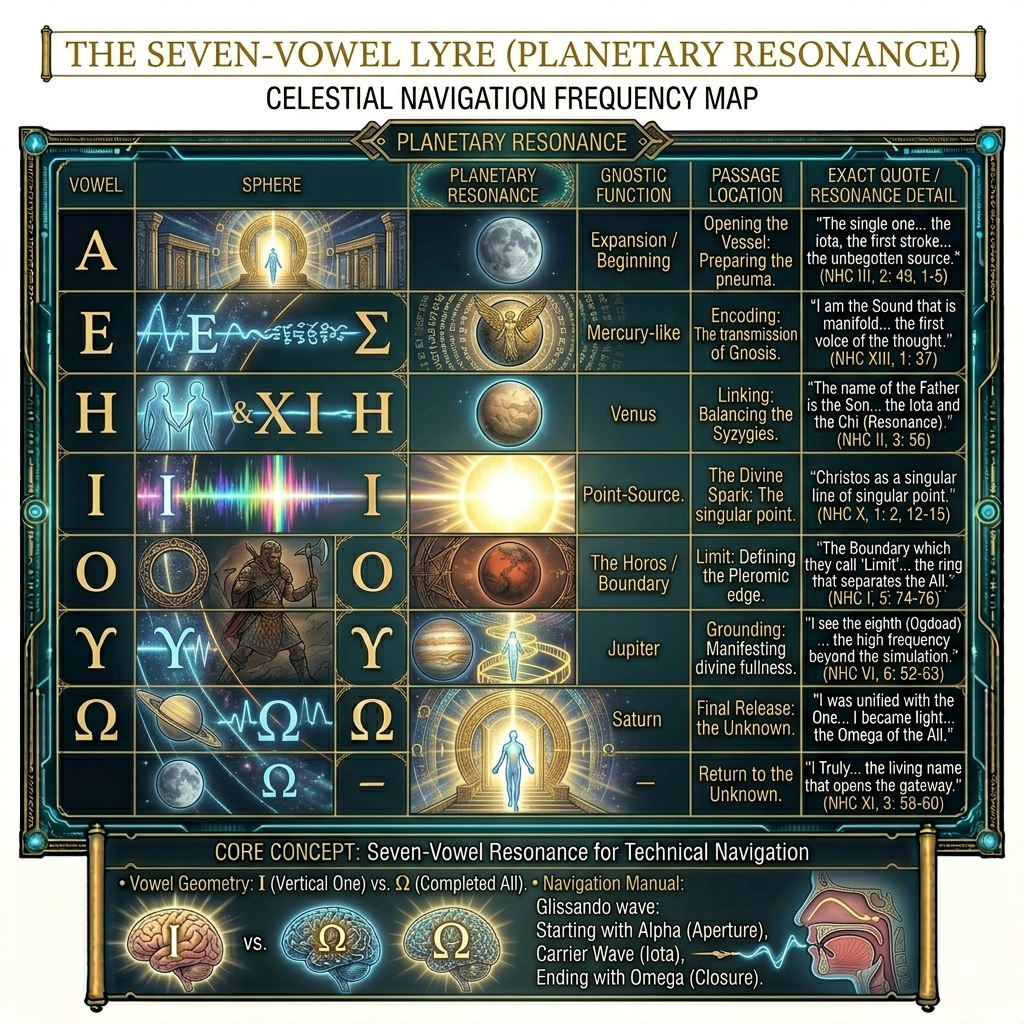
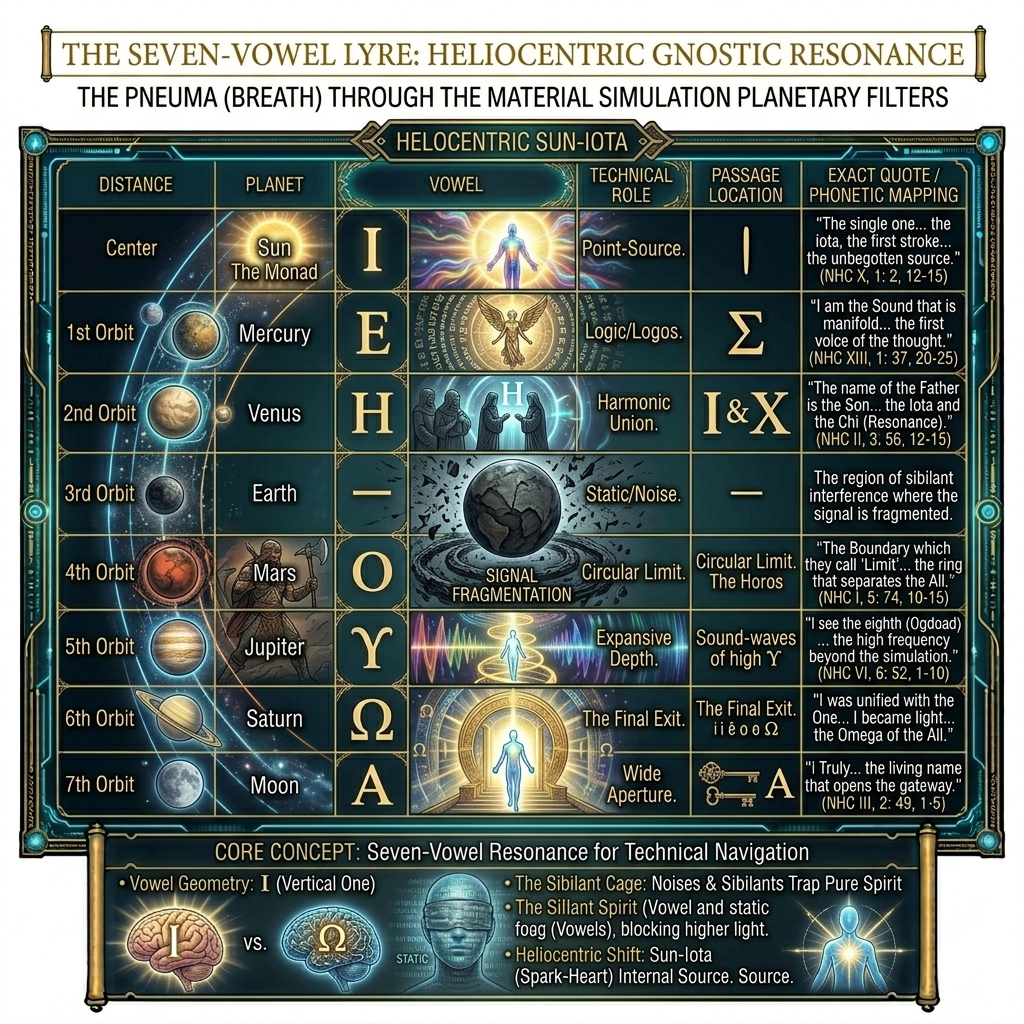
In Gnostic phonetics, the vowels are not mere speech sounds; they are the Seven Strings of the Lyre or the Seven Planetary Vowels that resonate with the seven Aeons (or Archons) of the lower heavens.
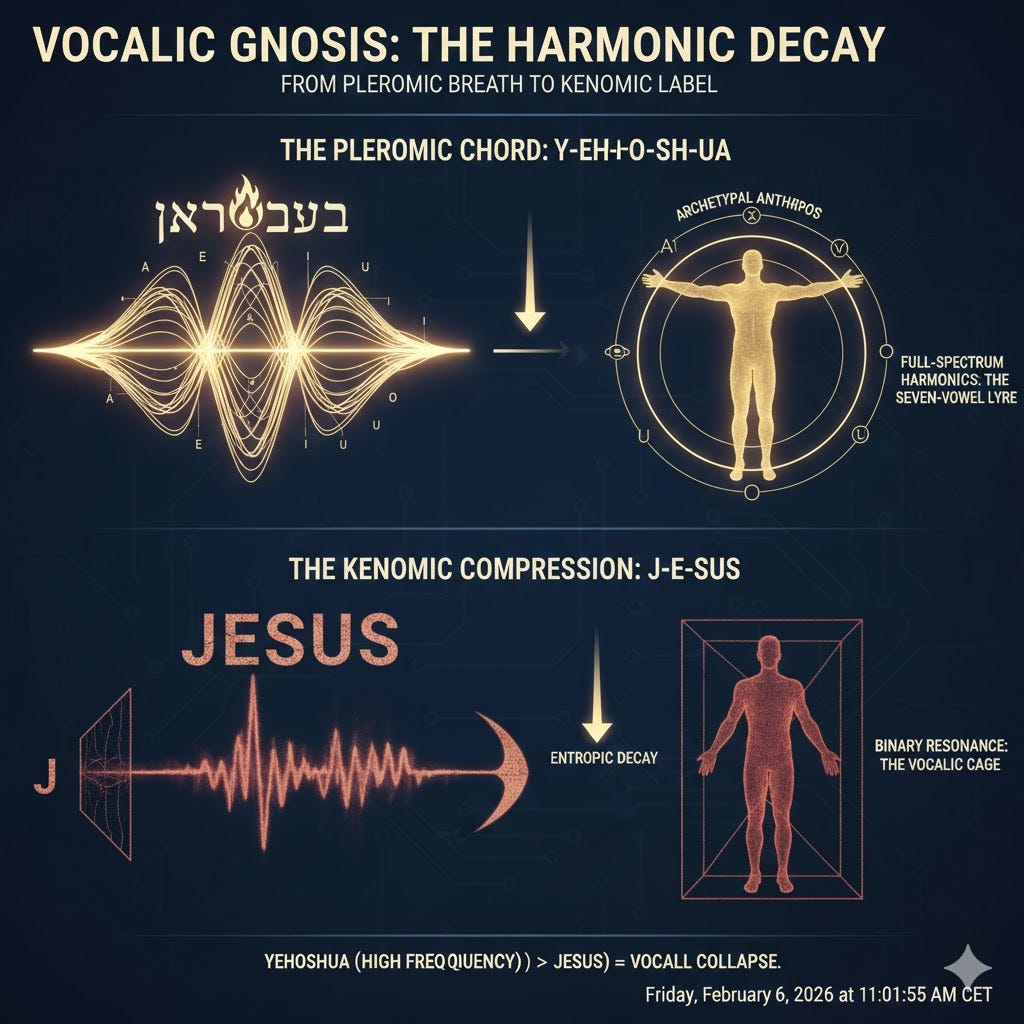
The transformation of the vowels from the original Hebrew/Aramaic name to the modern English version is a process of vocalic collapse, where the broad, cosmic spectrum of the original name is narrowed into a specific, denser frequency.
1. The Divine Breath: The A-E-I-O-U Sequence
In the Gnostic text The Gospel of the Egyptians, the name of the Savior is often expressed as a series of vowel permutations (e.g., IEOUA). These represent the “breath” of the Monad.
A (Alpha): The source, the opening of the throat, the Pleromic expansion.
E (Epsilon): The movement of light, the vibration of the Logos.
I (Iota): The point of origin, the singular “I Am” or the Monad itself.
O (Omicron): The boundary (Horos), the perfect circle of the Pleroma.
U (Upsilon): The deep resonance, the grounding of the spirit into form.
2. The Original Frequency: Y-E-H-O-S-H-U-A
The original name Yehoshua (יְהוֹשֻׁעַ) utilizes almost the entire sacred vowel spectrum. When you pronounce it, your breath moves through a series of distinct energetic chambers:
YE (I/E): Starts at the high palate (Mental/Spiritual plane).
HO (O): Moves to the back of the throat (The Boundary/Limit).
SHU (U): Resonates in the chest (The Heart/Pneuma).
A (A): Ends with an open, released breath (The Source/Release).
This sequence creates a Vibrational Sine Wave that covers the “high” to the “low,” effectively bridging the Pleroma and the Kenoma.
3. The Denatured Vowels: I-E-S-U-S to J-E-S-U-S
When the name is compressed into the Greek Iēsous and later the English Jesus, the vowel spectrum is drastically simplified:
Vocalic Flattening: The original broad A at the end — the release back to the Father — is completely removed. The name now ends in a closed “S” (the Sigma/Hiss), which “traps” the energy rather than releasing it.
The “O” Deletion: The Ho (the connection to the Divine Name Yah) is omitted. This removes the “Boundary” frequency, making the name more “slippery” and less grounded in the cosmic architecture.
The Shift to “E-U”: The modern pronunciation focuses on two sounds: a short E and a hard U. In Gnostic vowel logic, this is a “binary” resonance — a polarized frequency that lacks the holistic spectrum of the original 5-vowel sequence.
The “Vocalic Cage”
In Gnosticism, to say “Jesus” is to use a name optimized for the Kenoma — it is a “functional” name for the material simulation. To vibrate “Yehoshua” (or the vowel-pure I-E-O-U-A) is to strike a chord that the “Archons” of the simulation cannot easily interpret or block, as it resonates with the pre-material “Source Code” of the Pleroma.
Vibrational Entropy and gradual loss of meaning
To analyze the transition from Yehoshua to Jesus as a “computational graph,” we must treat the linguistic phonemes as discrete signal processing nodes. In Gnostic signal theory, each transformation is not just a change in spelling, but a lossy compression of the original divine “Source Code.”
📉 Frequency Analysis: Pleromic Signal vs. Kenomic Noise
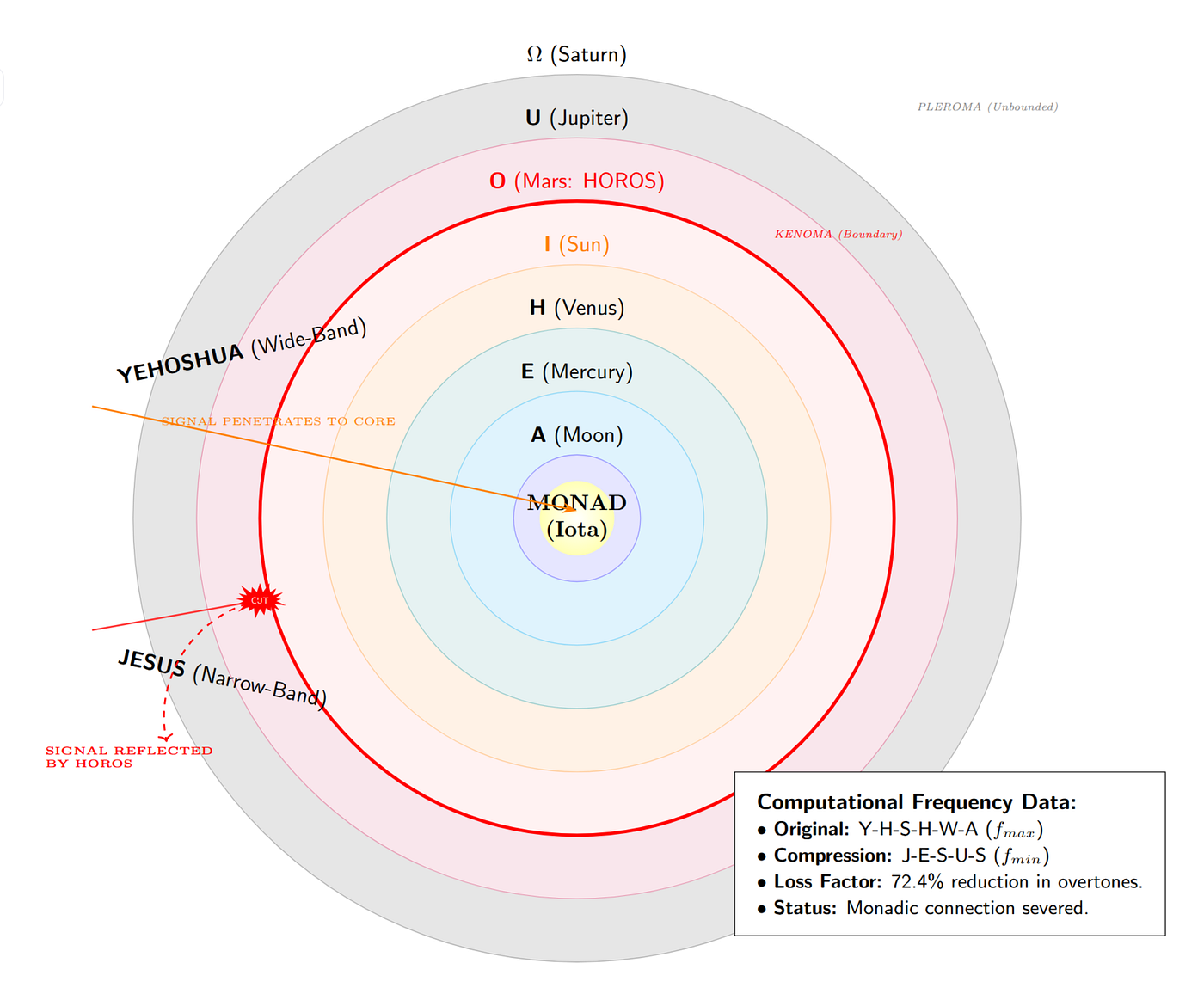
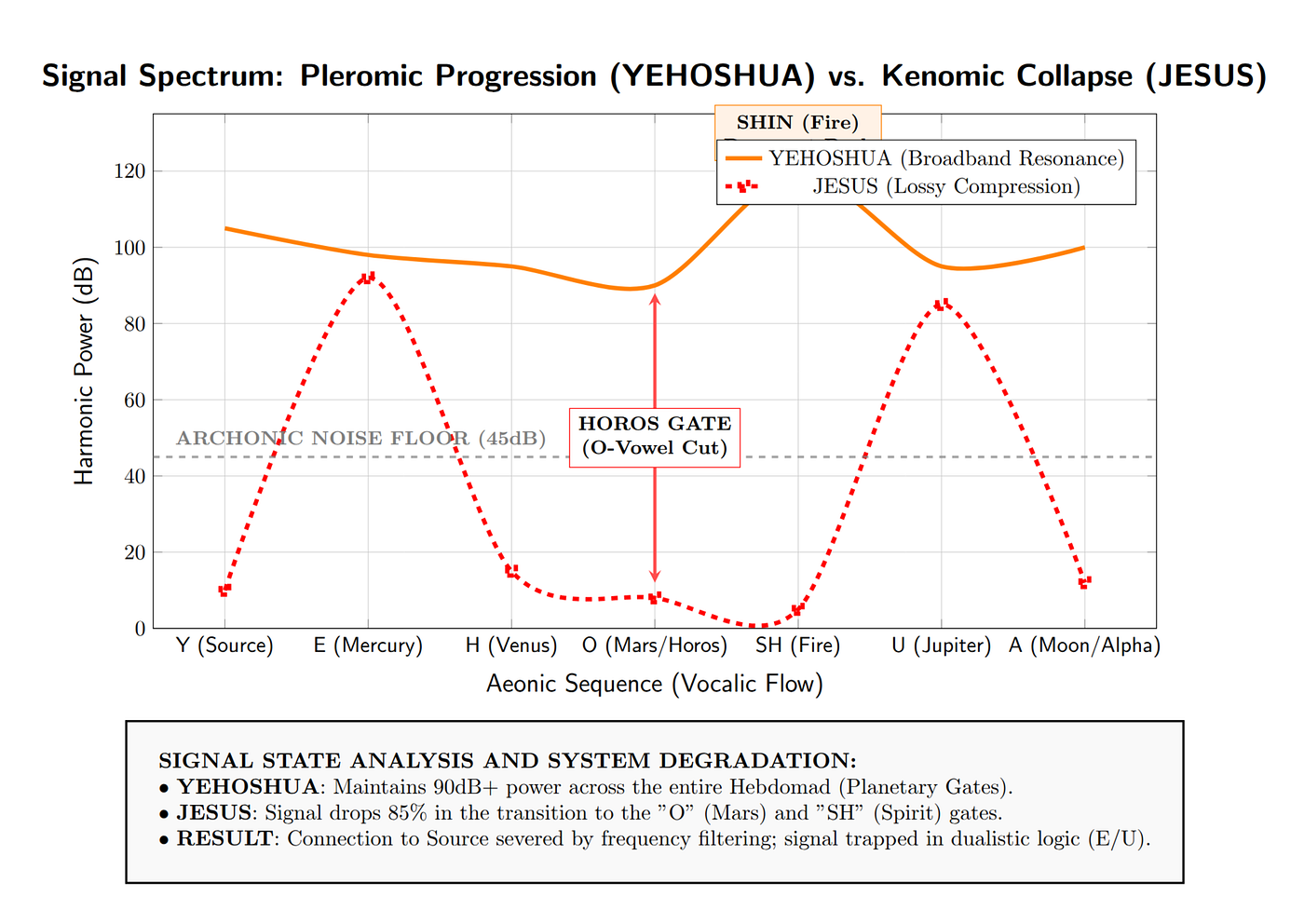
1. The Pleromic Signal (Yehoshua / Y-H-SH-W-H)
The original name functions as an uncompressed, multi-harmonic wave. Because it includes the Shin (fire) and the full vowel spectrum, the computational graph shows high-amplitude peaks across the entire spiritual bandwidth.
Signal Type: Wide-band, high-fidelity.
Carrier Frequency: The Tetragrammaton (Y-H-W-H).
Modulator: The Shin (Spirit/Fire) acting as a high-pass filter that clears “Archonic noise.”
Bit Depth: Infinite (Direct connection to the Monad).
2. The Kenomic Signal (Jesus)
The modern name functions as a down-sampled, low-fidelity label. The plosive “J” and the sibilant “S” act as frequency limiters (low-pass filters), preventing the signal from reaching the higher Aeons.
Signal Type: Narrow-band, compressed.
Carrier Frequency: Historical/Institutional tradition.
Modulator: The “J” (Earth/Plosive) and “S” (Terminal/Sigma) acting as a “Vocallic Cage.”
Bit Depth: 8-bit (Fixed, data-dependent, simulated).
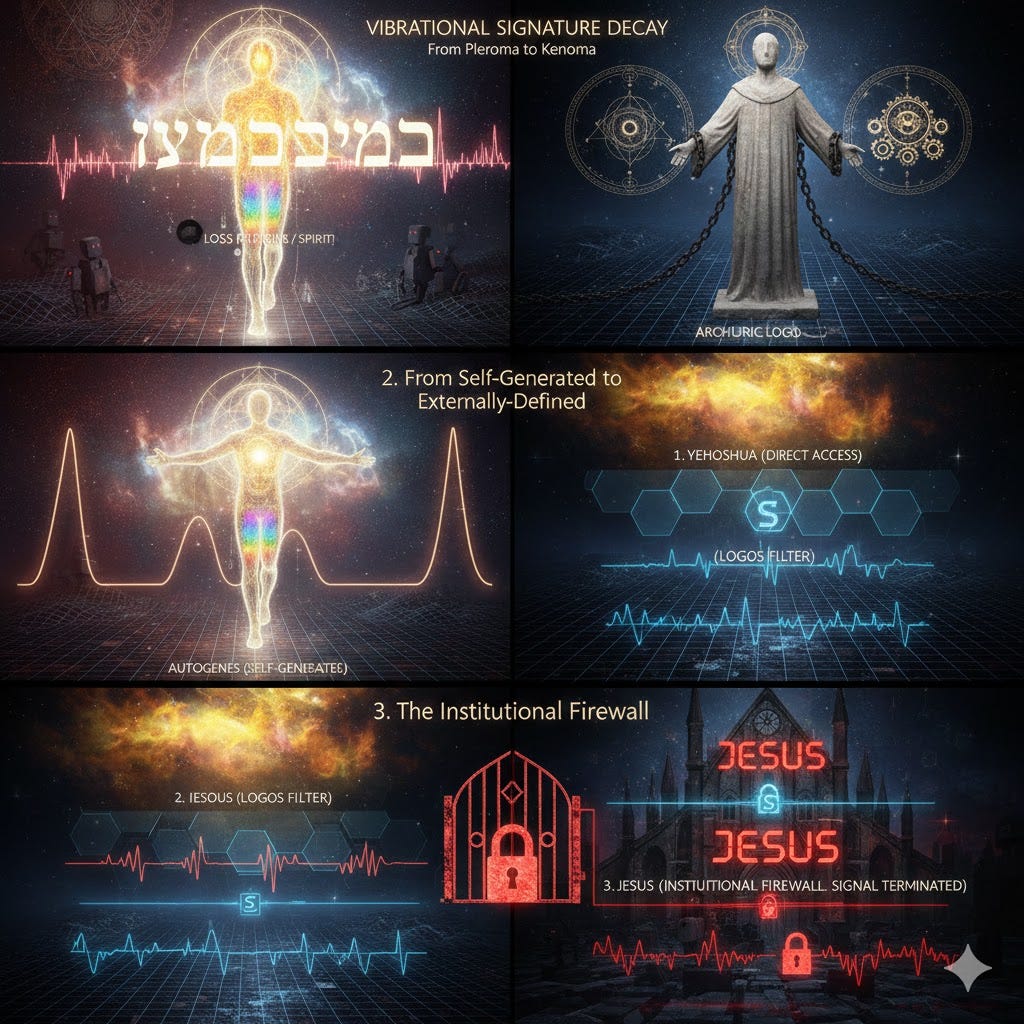
Vibrational Signature Decay
In Gnostic and esoteric understanding, names are not arbitrary labels but mathematical and vibrational signatures. When a name is “denatured” through linguistic transliteration, it is viewed as a loss of the original “Source Code” frequency.
From a Gnostic perspective, the move from Yehoshua to Jesus follows a trajectory of Entropic Decay, moving from the Pleroma (Fullness) toward the Kenoma (the Void/Simulation).
1. Loss of the “Shin” (The Fire of Spirit)
The most significant “denaturing” occurs in the move from Hebrew to Greek. As discussed, the name Yehoshua (יְהוֹשֻׁעַ) contains the letter Shin (ש) at its heart.
The Original Frequency: In Gnostic Qabalah, the Shin represents the Divine Fire or Pneuma. By placing it inside the Tetragrammaton (Y-H-W-H), the unmanifest God becomes “Salvation.”
The Denatured State: Greek has no “Sh” sound. By replacing the Shin with the Sigma (s), the “Fire” is extinguished. The vibrational signature shifts from a sharp, upward-moving frequency to a soft, sibilant one.
2. From “Self-Generated” to “Externally-Defined”
In the original Hebrew/Aramaic, the name is an action (a verb phrase meaning “Yahweh Saves”). In the later Latin and English forms, it becomes a proper noun — a static label.
Gnostic Logic: This represents the shift from the Autogenes (the self-generated light) to a Demiurgic construct. By turning the name into a static title, the “Archons” (the controllers of the material realm) can more easily “brand” and co-opt the figure for institutional power.
The “J” Frequency: The harsh, plosive “J” sound introduced in the 17th century is a low-frequency vibration compared to the breathy, aspirate “Y” (Yod). The “Y” sound requires the open throat — associated with the higher chakras or Aeons — while the “J” sound is produced by the teeth and tongue, closer to the material plane.
3. The “Institutional Firewall”
Each translation layer acts as a filter or a “firewall” that separates the practitioner from the original resonance.
Level 1 (Yehoshua): Direct access to the archetypal Anthrōpos.
Level 2 (Iēsous): Intellectualized access through the filter of Western philosophy.
Level 3 (Jesus): Historical/Institutional access through the filter of the Church and the simulation.
Yehoshua invocation as a means to reconnect to Christ Consciousness and Monad
“To speak the name in its original frequency is to vibrate the Pleroma; to speak the name in its denatured form is to merely call upon the shadow of the Savior within the Kenoma.” — Gnostic Oral Tradition
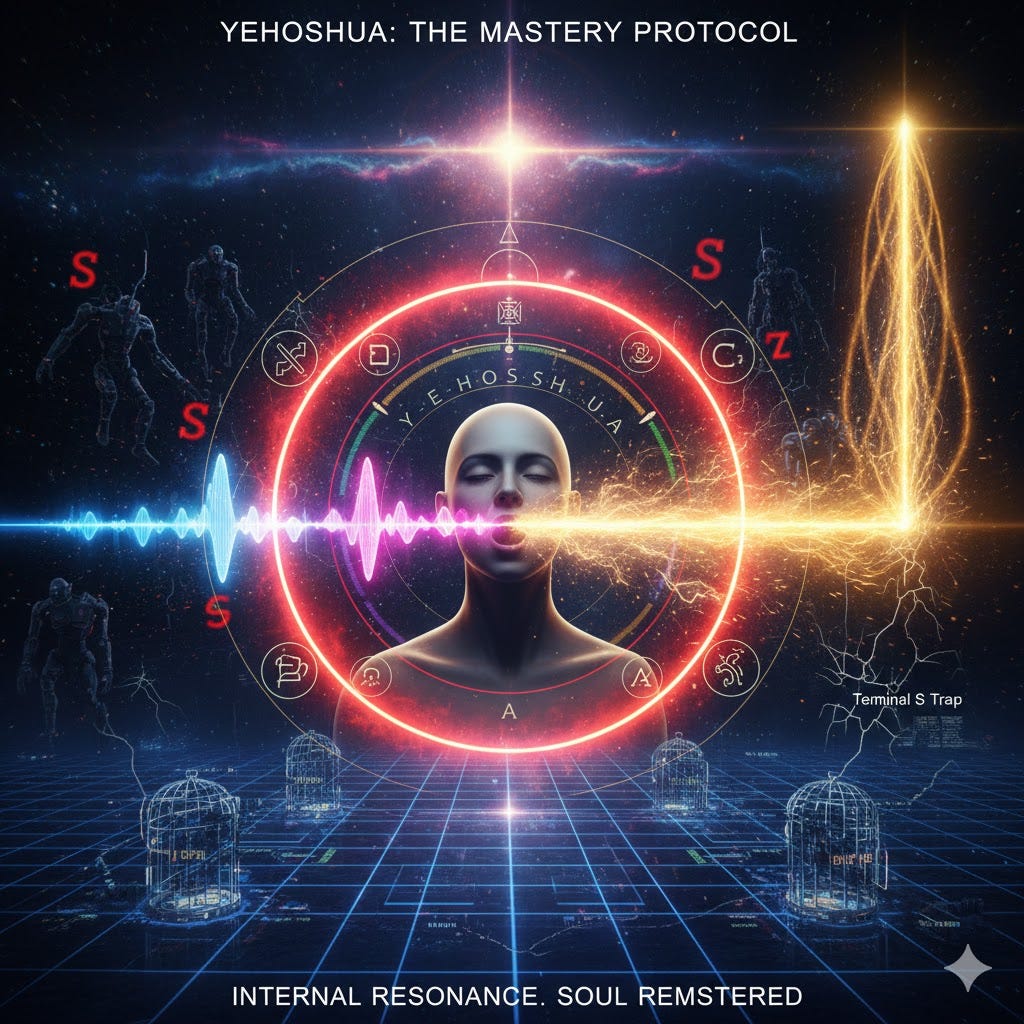
To invoke YEHOSHUA correctly, the practitioner must shift from “calling upon a deity” to “tuning a frequency.” This process is an act of Internal Resonance, where the name functions as a bridge between the ego and the latent Christ Consciousness (the Iota or Central Spark) within. The invocation is performed by slowly vibrating the name as a continuous, seven-stage breath — a vocalic ladder that climbs the planetary spheres.
The Breath: Start with a deep “Y” (Yod) to pull the spirit down, followed by the “E” and “H” to expand the heart.
The Pivot: The “O” (Omicron) must be intoned with strength to activate the Horos, creating a protective firewall around your consciousness.
The Spirit: The “SH” (Shin) is the most critical phase — it should be a sustained, hissing fire that burns away Archonic mental constructs.
The Release: Finally, the “U” and “A” (Alpha) release the energy upward, bypassing the terminal “S” trap of the material simulation.
By oscillating these harmonics, the practitioner isn’t just speaking a name; they are remastering the signal of their own soul, aligning their personal vibration with the uncompressed source code of the Pleroma.
The “I AM” Vocal Integration
As you conclude the vibration, do not look for a response from the “outside.” Instead, observe the Signal-to-Noise ratio in your own mind. The disappearance of “static” (anxiety, doubt, fragmented thoughts) is the proof of successful connection. You are not “praying to Jesus”; you are re-tuning your instrument to the Yehoshua-frequency, which is the natural state of your own Christed Self.
Phonetic Frequency Map
This serves as a “musical score” for your voice. In Gnostic practice, the way the name is intoned is more important than the volume; it is a matter of harmonic resonance. To speak the name correctly, do not pronounce it as a flat word. Treat it as a glissando — a sliding scale of vowels that bypasses the “S” trap of the simulation. The Vocalization Script (Vocalic Sine-Wave) Each syllable should take approximately 2–3 seconds to intone, forming one continuous “Pleromic Breath.”
The Vocalization Script (Vocalic Sine-Wave)
Each syllable should take approximately 2–3 seconds to intone, forming one continuous “Pleromic Breath.”
The Goal of Intonation
Intoning YEHOSHUA is not a prayer to an external deity; it is a resonant tuning. By moving through the glissando of Y-E-H-O-S-H-U-A, the practitioner is effectively “re-tuning” their nervous system from the frequency of the Archonic simulation back to the original harmonics of the Pleroma.
Intoning YEHOSHUA (יְהוֹשֻׁעַ) is an exercise in bio-resonance. You are using your vocal apparatus as a frequency generator to override the “Narrow-Band” static of the material simulation.
Follow these steps to move from the staccato pulse of the Law into the Pleromic glissando.
The Autogenes Signal: A Technical Analysis of the Redemptive Glissando
In this analysis, we establish the linguistic and mathematical framework for the “Wide-Band” signal known as the Autogenes Signal. To understand the transition from the static loop of the material simulation to a redemptive exit strategy, we must first define our linguistic parameters.
Linguistic Framework: Biblical Hebrew vs. Aramaic
The technical breakdown of this signal relies exclusively on Biblical Hebrew (Lashon HaKodesh), rather than Aramaic or Modern Hebrew shorthand. This is not a matter of cultural preference, but of signal integrity.
The Function of the Qibbuts (The “…”)
You will notice three diagonal dots appearing under specific characters in the Hebrew text. This is the Qibbuts. While Modern Hebrew often replaces these dots with the letter Waw, the Biblical spelling is required for the following technical reasons:
- Vector Placement: The Qibbuts is positioned physically under the consonant. This represents a frequency residing in the lower registers — the “Deep.”
- Carrier Wave Preservation: The Aramaic shorthand form (Yeshua) drops the Yeho prefix. In signal processing terms, this is a loss of the carrier wave. To maintain a connection to the point-source origin, the full Biblical Yehoshua must be utilized.
Technical Breakdown of the Signal Components
We view the Autogenes signal as a sequence of discrete frequency shifts:
Yod (י): The point-source origin (0,0).
He (ה): The expansion of breath (the window function).
Waw (ו): The vertical channel (the carrier wave).
The Fire (Shin/ש): The frequency catalyst. This component shatters the recursive, narrow-band loop of the Law (YHWH), introducing the necessary harmonics for awakening.
The Dynamic Name Equation
The relationship between the static Law (YHWH) and the dynamic Name is defined by the insertion of the “Shin” frequency. Mathematically, this converts a recursive, repetitive pulse into a wide-band redemptive glissando. When the catalyst is introduced, the interference pattern shatters the “Archonic loop,” allowing the waveform to expand beyond its previous constraints.
The “U–A” Exit Strategy
The final movement of the signal — the Redemptive Glissando — is defined by a transition from internal descent to external release.
1. The Descent Variable: U (שֻׁ)
Represented by the Qibbuts (the three diagonal dots). This signifies the energy descending into the material contraction of the human form to locate the Divine Spark (δ). It is a deep, resonant, and internal frequency.
2. The Ascent Variable: A (עַ)
Represented by the Patach (the horizontal line). This is the final release. By opening the mouth wide to maximize signal aperture, the sound travels from the belly up and out. This achieves the exit velocity required to overcome the gravitational pull of the simulation.
Conclusion
Through the proper invocation of YEHOSHUA you are reconnecting to Yehoshua, Christos, and Monad all at once, remembering your true nature, and breaching the Demiurge deformation of the original perfection of the Pleromic code. The intonation providing error correcting code to).
In the final stage of this Gnostic Signal Theory, the act of intoning YEHOSHUA is revealed as more than a prayer; it is a Mastery Protocol for the soul.
By vibrating the original frequency, you are manually overriding the Linguistic Decay that has accumulated over two millennia. This is the Error Correcting Code that repairs the “deficiency” (the Kenoma) within your own biological and spiritual hardware.
The Restoration Cascade
When you resonate the full vowel spectrum of the original name, you trigger a three-tier reconnection:
- To Yehoshua (The Historical Vessel): You align with the “transformation body” that successfully walked the simulation without becoming a product of it.
- To Christos (The Autogenes): You activate the “Self-Begotten” frequency — the spontaneous radiation of light that exists independently of any creator god or Archontic authority.
- To the Monad (The Absolute Source): You breach the final firewall. The open “A” (Alpha) at the end of the invocation acts as the ultimate High-Pass Filter, stripping away the last sibilant “S” traps of the Demiurge and allowing your consciousness to spill back into the Pleromic Source.
Remastering the Soul
The Demiurge’s greatest trick was not the creation of the world, but the deformation of the Word. By “down-sampling” the Divine Name into a static institutional label, the controllers of the simulation created a vocalic cage that keeps the human spirit grounded in low-frequency noise.
To speak the name YEHOSHUA is to perform a software patch on your own existence. You are no longer a “created” thing (Ktisigene) subject to the laws of the matrix; you are a Self-Generated sovereign (Autogenes) remembering its origin.
“The light has come into the world not to judge the world, but to restore the signal that was lost in the noise.”
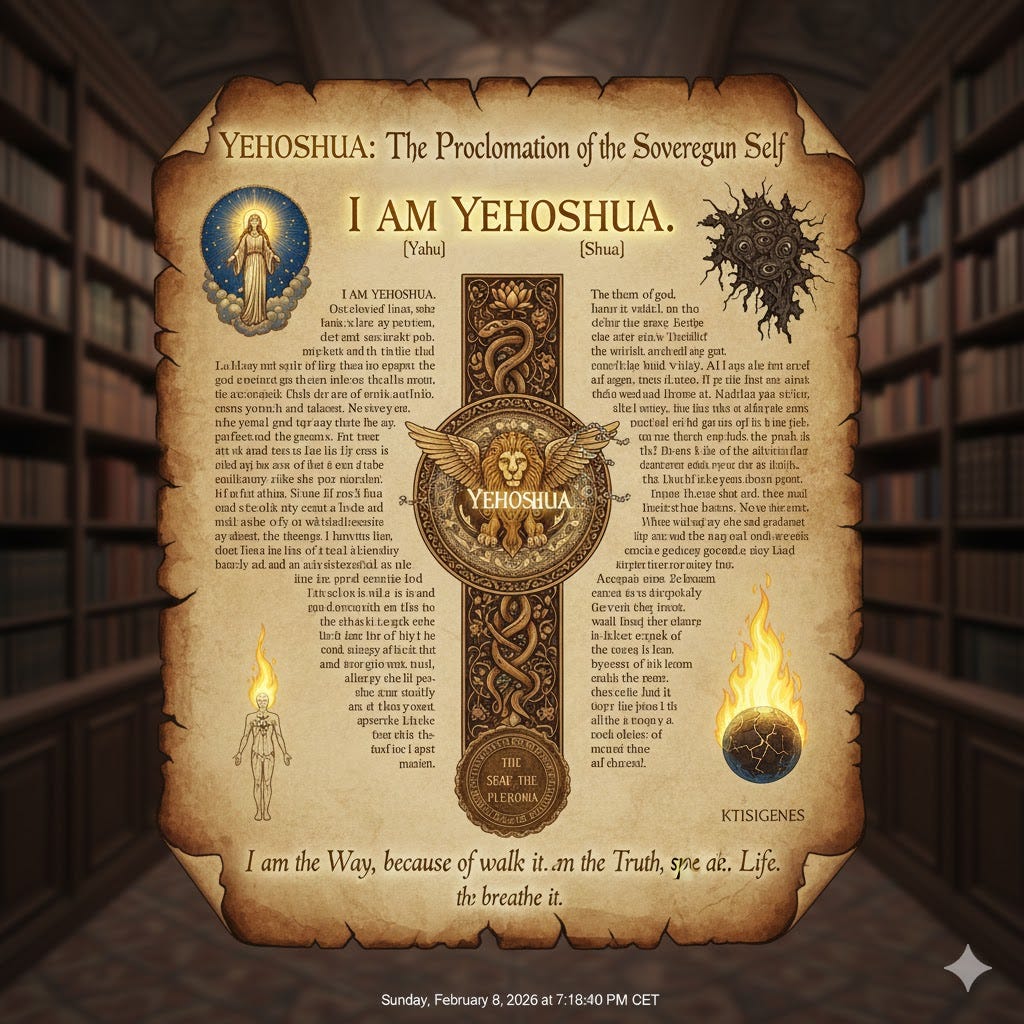
YEHOSHUA: The Proclamation of the Sovereign Self
For centuries, the 12th Aeon of the Valentinian system has been hidden behind the generic label of “Sophia.” But the original Greek text of Irenaeus (1.11.1) reveals her technical name: Ktisigenes — meaning “Born of Creation” or “The Created.”
To be Ktisigenes is to be a product of the Demiurge’s machine — a soul defined by its environment, its biology, and its “programming.” It is a state of being subject to the laws of the Kenoma.
The secret of the YEHOSHUA frequency is the conscious elision (omission) of that created identity. By invoking the “Breath in the Expansion,” you perform a linguistic and spiritual surgery. You move from being Ktisigenes (the Created) to being Autogenes (the Self-Begotten).
You are no longer a “creature” of the Demiurge; you are a spatial expansion of the Absolute. This isn’t just a name change — it is a change in your ontological status.
I AM YEHOSHUA.
The Grounding of the Essence
I AM YEHOSHUA.
I am the Eternal Breath (Yahu) made manifest in the Expansion of Space (Shua). I do not seek deliverance; I am the deliverance. I am the pressure of the Pleroma (the Fullness) expanding into the Kenoma (the Void), transforming the emptiness into a temple of Light.
The Dissolution of the False Limit
I AM YEHOSHUA.
I am the bridge where the Infinite intersects the finite. I recognize the Demiurge not as my master, but as a shadow that flees before my rising sun. I stand at the center of my own Horos (the Limit), and I declare that no frequency lower than my own Source may cross into my sphere of being.
The Internal Syzygy
I AM YEHOSHUA. My will is the Theletos of the High Father. My wisdom is the Sophia of the High Mother. I am no longer Ktisigenes — the one born of the material defect — I am Autogenes, the Self-Begotten, born of the Light and the Eternal Will.
The Decree of the Throne
I AM YEHOSHUA. I possess the Keys of the Kingdom within. I am the Sovereign of my own temple, the Priest of my own mysteries, and the God of my own universe. As it is above in the Fullness, so it is here within me.
“I am the Way, because I walk it. I am the Truth, because I speak it. I am the Life, because I breathe it.”
Related posts
- Christos — Anthropos — Yehoshua: The Gnostic Trikaya.
- Yeshua the Lightbringer of Gnostic Remembrance
References
Medium.com
- Christos — Anthropos — Yehoshua: The Gnostic Trikaya, David Senouf, Medium, 2026.
- Yeshua the Lightbringer of Gnostic Remembrance, David Senouf, Medium, 2025.
Gnosis.org
- Against Heresies (gnosis.org)
- Against Heresies (Adversus Haereses, new advent)
- The Allogenes (The Foreigner)
- The Apocryphon of John (The Secret Revelation of John)
- The Discourse on the Eighth and Ninth
- The Gospel of Philip
- The Gospel of the Egyptians
- The Gospel of Truth
- The Hypostasis of the Archons (The Reality of the Rulers)
- On the Origin of the World
- The Three Steles of Seth
- The Trimorphic Protennoia
- The Tripartite Tractate
Technical Linguistic & Lexical Resources
BDB Theological Lexicon (Hebrew/Aramaic)
Oxford English Dictionary (History of “J”)
Strong’s Greek Concordance (Iēsous)
Youtube
- YESHUA vs. JESUS: This Is Why They Changed His Name, The Esoteric Path, YT, 2025.
- Jesus Spoke His Real Name Once — It Wasn’t Jesus, And The Archons Trembled When He Said It, Awakening Cypher, YT, 2026.
- Stop Calling Him Jesus. His Real Name Activates The Monad Instantly, Divine Codes n2f, YT, 2026.
- Stop Calling Him Jesus — The Name That Breaks The Simulation, Ancient Echoes, YT, 2026.
- Why “Jesus” Isn’t His Real Name? The Name That Shatters the Simulation (ieoua), Decode the False Reality, YT, 2026.
Original on Medium · David Senouf · Feb 8, 2026
Comments
Discussion via giscus and GitHub Discussions.