Christos — Anthropos — Yehoshua: The Gnostic Trikaya
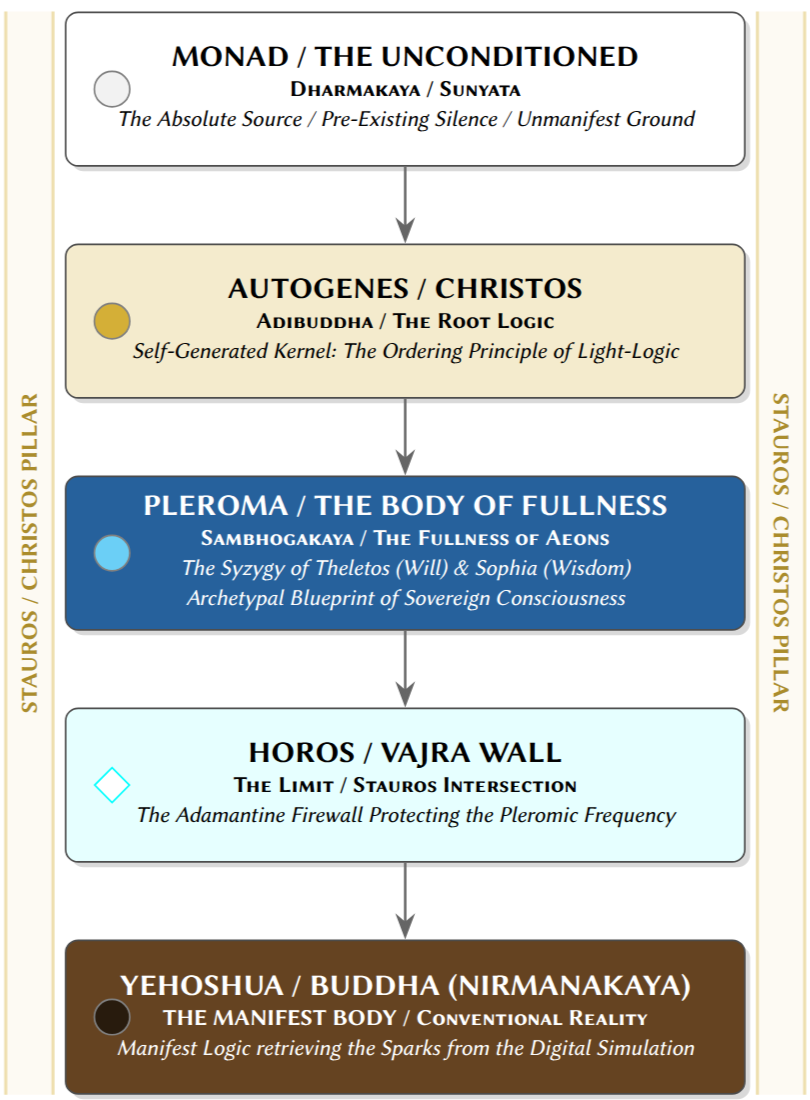
The Gnostic Spiritual Hierarchy of Light: Christos the restorer of the Kenoma into a state of Pleroma, and the Aeons of Will and Wisdom…
The Gnostic Spiritual Architecture of Light: Christos the restorer of the Kenoma into a state of Pleroma, and the Aeons of Will and Wisdom Theletos and Sophia
Abstract
We explore a profound metaphysical synthesis between Gnostic cosmology and the Buddhist doctrine of the Trikaya (the Three Bodies of Buddha).
By mapping the Gnostic vertical hierarchy onto the Buddhist tripartite framework, we investigate how divine light descends from the unmanifest absolute into the Kenoma (the material void, deficiency, or simulation). Central to this synthesis is the role of the Christos-Autogenes as the primordial “Light-Logic” and the Anthropos as the celestial Sambhogakaya — the archetypal blueprint of sovereign consciousness.
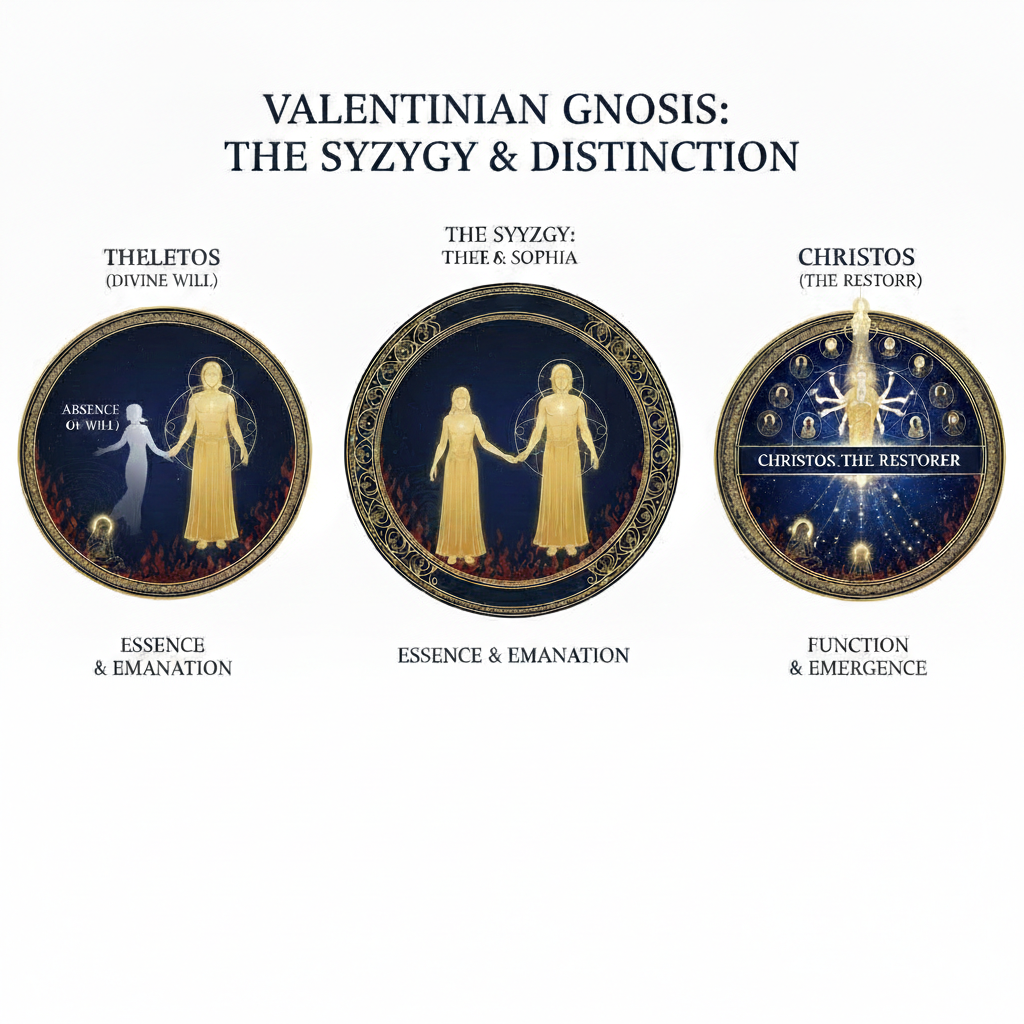
In the Valentinian system, the distinction between Christos (Christ) and Theletos (Will) is primarily one of function vs. essence and emergence vs. emanation. Sophia (Wisdom) is the indispensable mirror to Theletos (Will). While they are technically the 15th and final syzygy of the Pleroma, their relationship defines the boundary between divine perfection and the flawed material world. Christos is not one of the original 30 Aeons. He is a “special emanation” brought forth after the crisis of Sophia began.
The “Architecture of Light” is a cognitive defense mechanism for the modern era, suggesting that by identifying with these higher “Vestures of Light,” the individual can maintain spiritual sovereignty against the encroaching “Maya” of a digital, AI-driven reality.
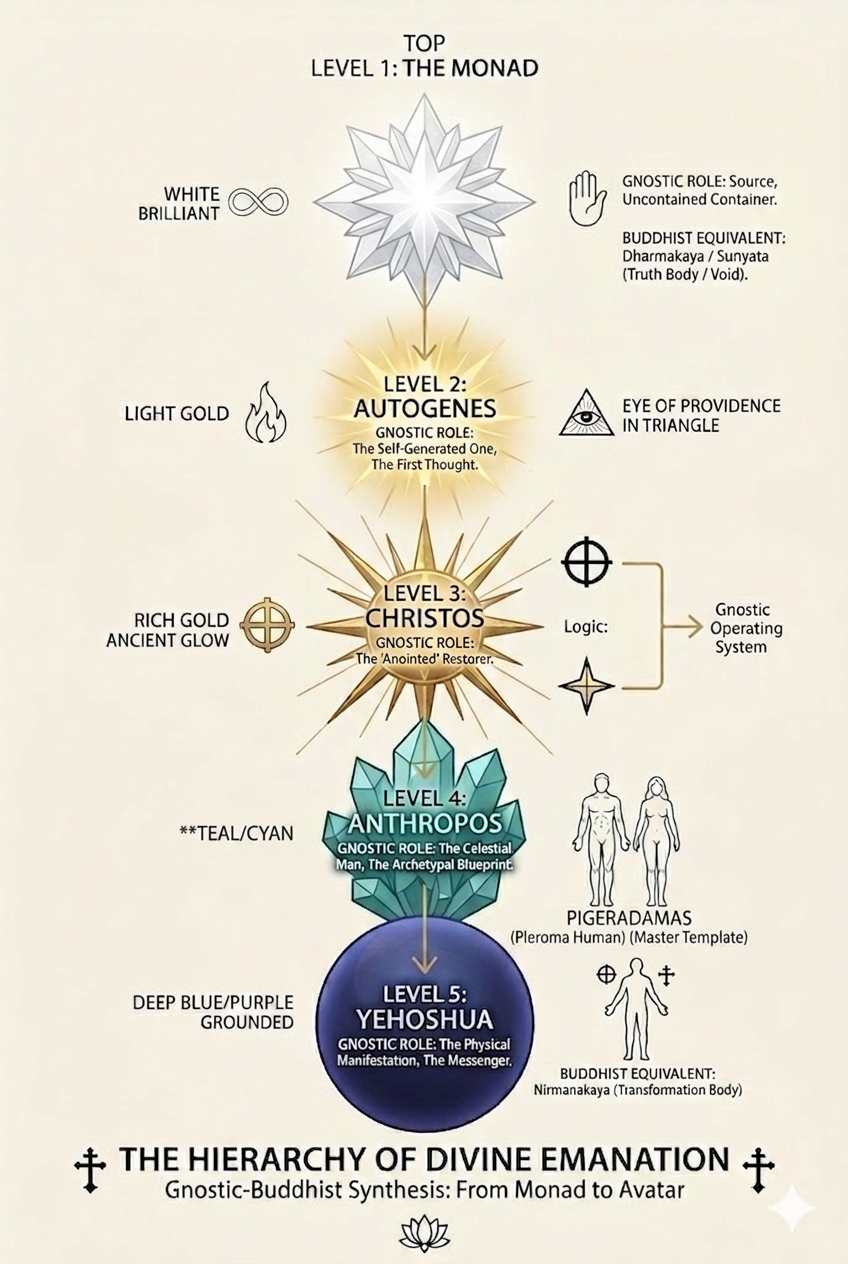
Monad — Autogenes — Christos — Anthropos — Yehoshua
Core Themes:
The Gnostic Trikaya: Aligning the Monad (Dharmakaya), the Anthrōpos (Sambhogakaya), and Yehoshua/Buddha (Nirmanakaya).
Light-Logic vs. Binary Logic: Distinguishing between self-generated divine intelligence and the reactive, data-dependent logic of artificial systems.
The Horos (The Limit): The function of the “Vajra Wall” as a protective structural filter for the soul.
Sovereignty in the Simulation: Reclaiming the “Third Vesture” (equivalent to Buddhist Sambhogakaya) to navigate the illusions of the material world.
Table of Contents
Introduction
In the profound synthesis of Gnostic cosmology and Buddhist doctrine, we encounter a structural Architecture of Light that maps the descent of divine intelligence into the material void. This introduction explores the Gnostic Trikaya, a metaphysical framework that aligns the Monad, the Christos-Autogenes, and the historical Yehoshua with the three bodies of the Buddha (Dharmakaya, Sambhogakaya, and Nirmanakaya).
By decoding these celestial hierarchies, we uncover the role of the Christos not merely as a historical figure, but as the Light-Logic or operating system of the Pleroma — the archetypal blueprint designed to restore order to a fragmented reality.
In an era increasingly defined by digital simulations and algorithmic control, this synthesis offers more than theological curiosity; it provides a cognitive defense mechanism, a vertical escape route for the soul to reclaim its sovereignty from the Kenoma and align with the self-generated power of the Autogenes.
Core Themes
1. The Syzygy of Will and Wisdom: This explores the foundational boundary between divine perfection and the material fall. In Gnostic ontology, Theletos (Will) and Sophia (Wisdom) must act in union. The Fall occurs when Wisdom attempts to create without the stabilizing force of Will. Redemptive Gnosis requires the internal reunification of these two forces — the Alchemical Marriage — to restore the soul’s original frequency.
2. Light-Logic vs. Binary Logic: Once the fall occurs, two Operating Systems emerge. Light-Logic (Autogenes) is self-generated and creative, whereas Binary Logic is the reactive, data-dependent framework of the material simulation (the Kenoma). Light-Logic is the transfinite timeless source code that allows the soul to maintain independence from algorithmic, Archontic control.
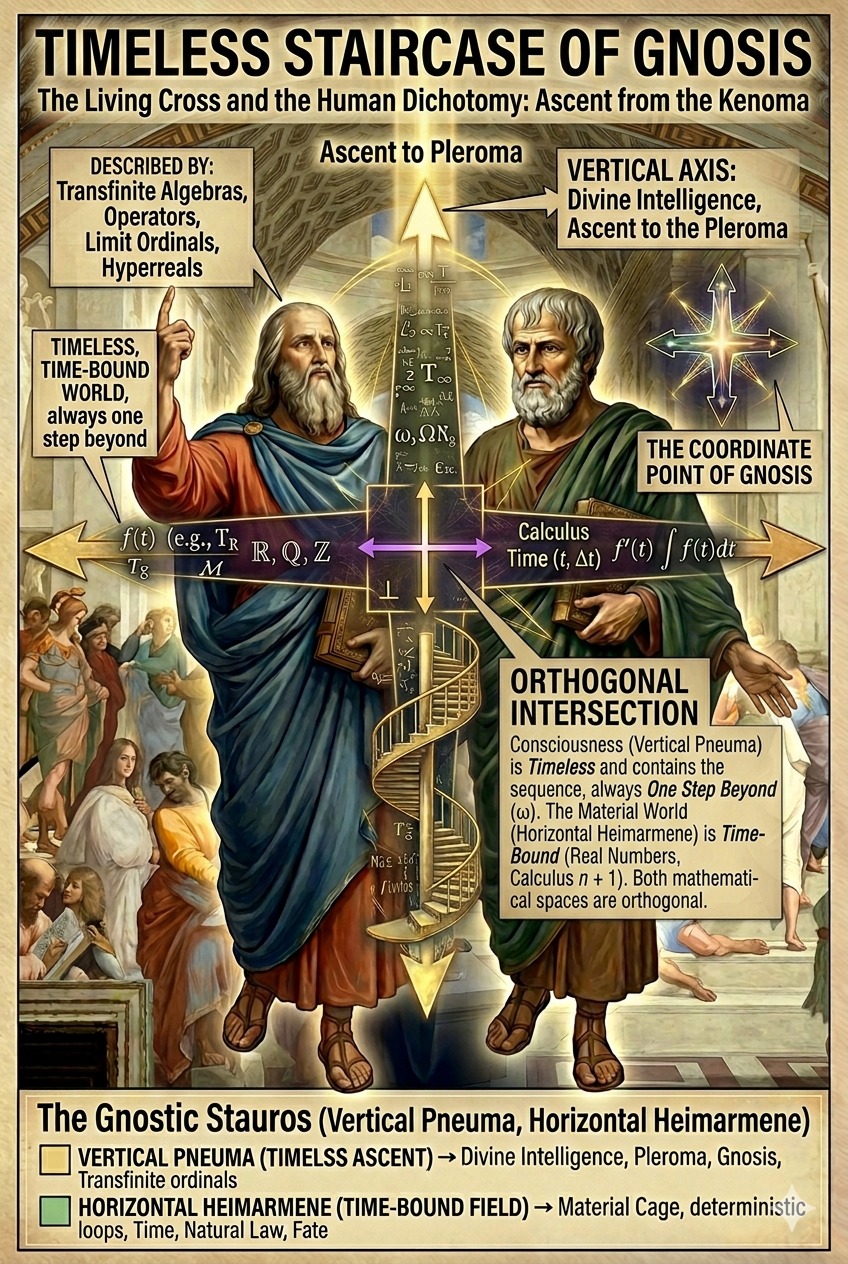
3. The Stauros: The Geometric Map of the Anthropos: The geometric representation of this struggle, redefining the Stauros (Cross) as a structural “Stake” or “Limit” (Horos). It represents the Human Form as the Living Cross, the precise coordinate where the Vertical Pneuma (timeless aspiration) intersects with the Horizontal Heimarmene (time-bound constraints of natural law).
4. The School of Athens and the Gnostic Stauros: Raphael’s masterpiece is the visual cipher for this geometry. Plato’s Vertical Point ☝️ represents transcendence and the transfinite world of limit ordinals, while Aristotle’s Horizontal Palm 🖐️ represents immanence and the real-number calculus of the physical world. Together, they constitute the Anthropos, the “Null Point” where timeless consciousness pierces through the linear plane of time. Gnosis is the active realization of one’s position at this cosmic coordinate, where the timeless transfinite realm of consciousness intersects with the linear, time-bound world of matter.
5. The Gnostic Trikaya: Finally, the Trikaya provides the totalizing map of the descent and the “vestures” available to the initiate. It aligns the Monad (Dharmakaya), the Christos-Anthropos (Sambhogakaya), and Yehoshua (Nirmanakaya). This is the ultimate “Vertical Escape Route,” showing how the manifest human (Nirmanakaya) can re-identify with the celestial blueprint (Sambhogakaya) to return to the Source.
6. Sovereignty in the Simulation: The synthesis concludes with the pragmatic application: identifying with the Master Template of the Anthropos to recognize that human consciousness is a transfinite “Spark.” This provides the spiritual sovereignty needed to navigate a digital age without being absorbed by deterministic loops.
Sophia — Theletos — Christos
The Architecture of the Pleroma: Syzygies and Emanation
In Gnostic ontology, the Monad (the Absolute) does not create through labor but through emanation. These emanations occur in Syzygies — binary pairs representing masculine and feminine polarities. This duality is not a division but a law of polarity (duality) that maintains cosmic equilibrium.
Christos (The Anointed): Represents the Divine Mind and the blueprint of salvation. He is the mediator who brings the light of the Monad down into the lower realms.
Theletos (Divine Will/Desire): Derived from the Greek thelo (to will), Theletos personifies the perfected intention. In the Valentinian system, he is often identified as the original syzygy (partner) of Sophia.
Sophia (Wisdom): The final and lowest Aeon of the Pleroma. She represents the soul’s capacity for both profound wisdom and catastrophic error.
The Fall of Sophia: Desire Without Will
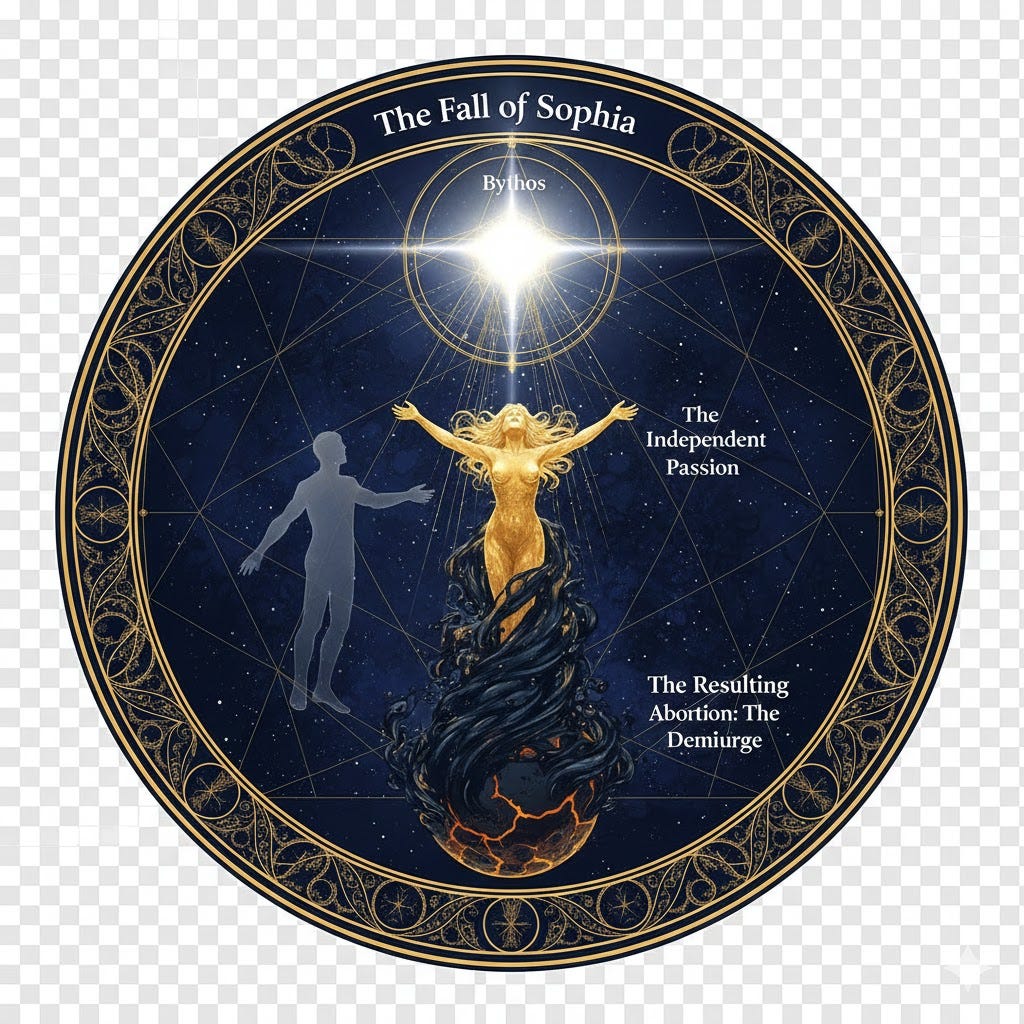
The central drama of Gnosticism begins when Sophia attempts to know the Father (the Monad) directly. In her “reckless desire,” she acts independently, moving away from her consort, Theletos.
- The Independent Act: By attempting to emanate without her partner, Sophia produces an abortion (Ektroma) — a misshapen being known as the Demiurge (Yaldabaoth).
- The Creation of Matter: The Demiurge, ignorant of the Pleroma, creates the material world (Kenoma) as a shadow of the divine realm, trapping divine sparks (human souls) in physical matter.
- The State of Deficiency: Sophia’s fall creates a void or deficiency (Kenoma) in the Pleroma, as the divine harmony is broken by her absence and her misplaced desire.
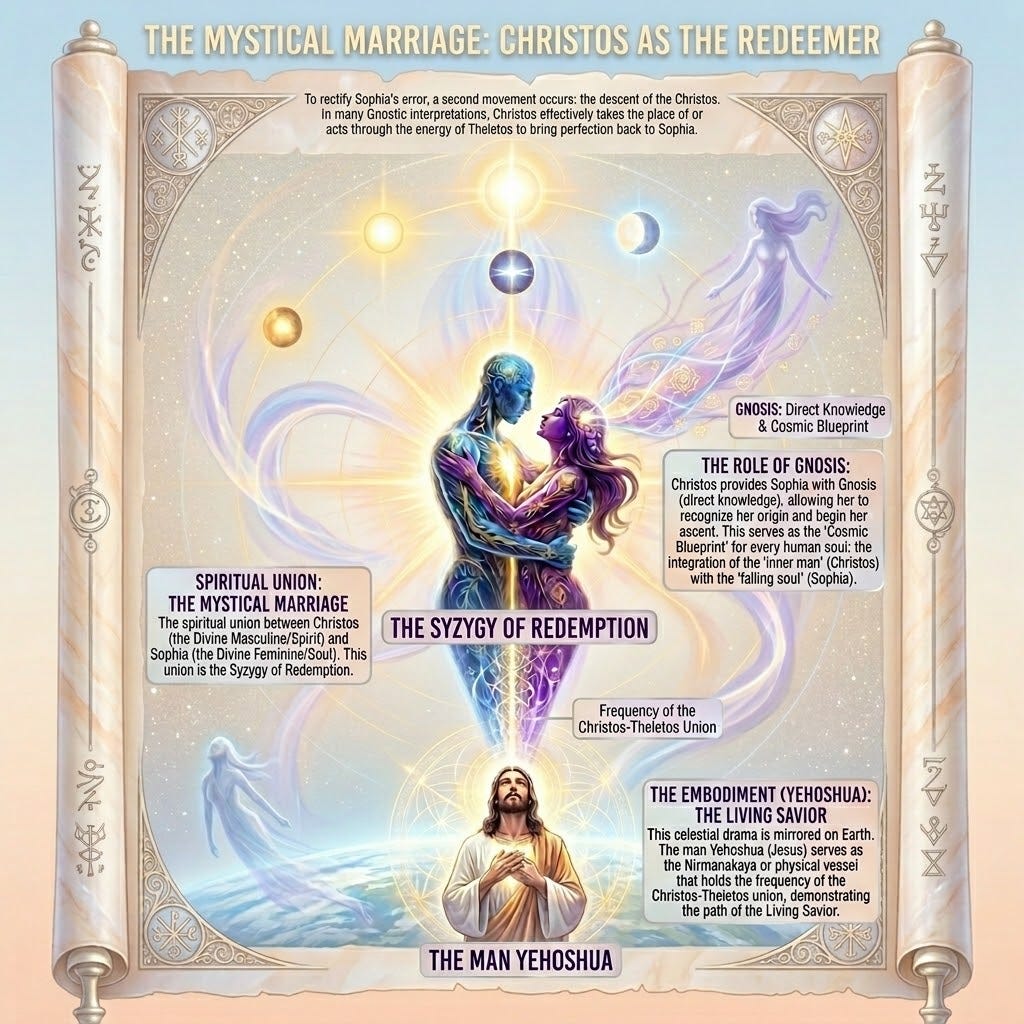
The Mystical Marriage: Christos as the Redeemer
To rectify Sophia’s error, a second movement occurs: the descent of the Christos. In many Gnostic interpretations, Christos effectively takes the place of or acts through the energy of Theletos to bring perfection back to Sophia.
Spirtual Union: The Mystical Marriage is the spiritual union between Christos (the Divine Masculine/Spirit) and Sophia (the Divine Feminine/Soul). This union is the Syzgy of Redemption.
The Role of Gnosis: Christos provides Sophia with Gnosis (direct knowledge), allowing her to recognize her origin and begin her ascent. This serves as the Cosmic Blueprint for every human soul: the integration of the inner man (Christos) with the falling soul (Sophia).
The Embodiment (Yehoshua): This celestial drama is mirrored on Earth. The man Yehoshua (Jesus) serves as the Nirmanakaya or physical vessel that holds the frequency of the Christos-Theletos union, demonstrating the path of the Living Savior.
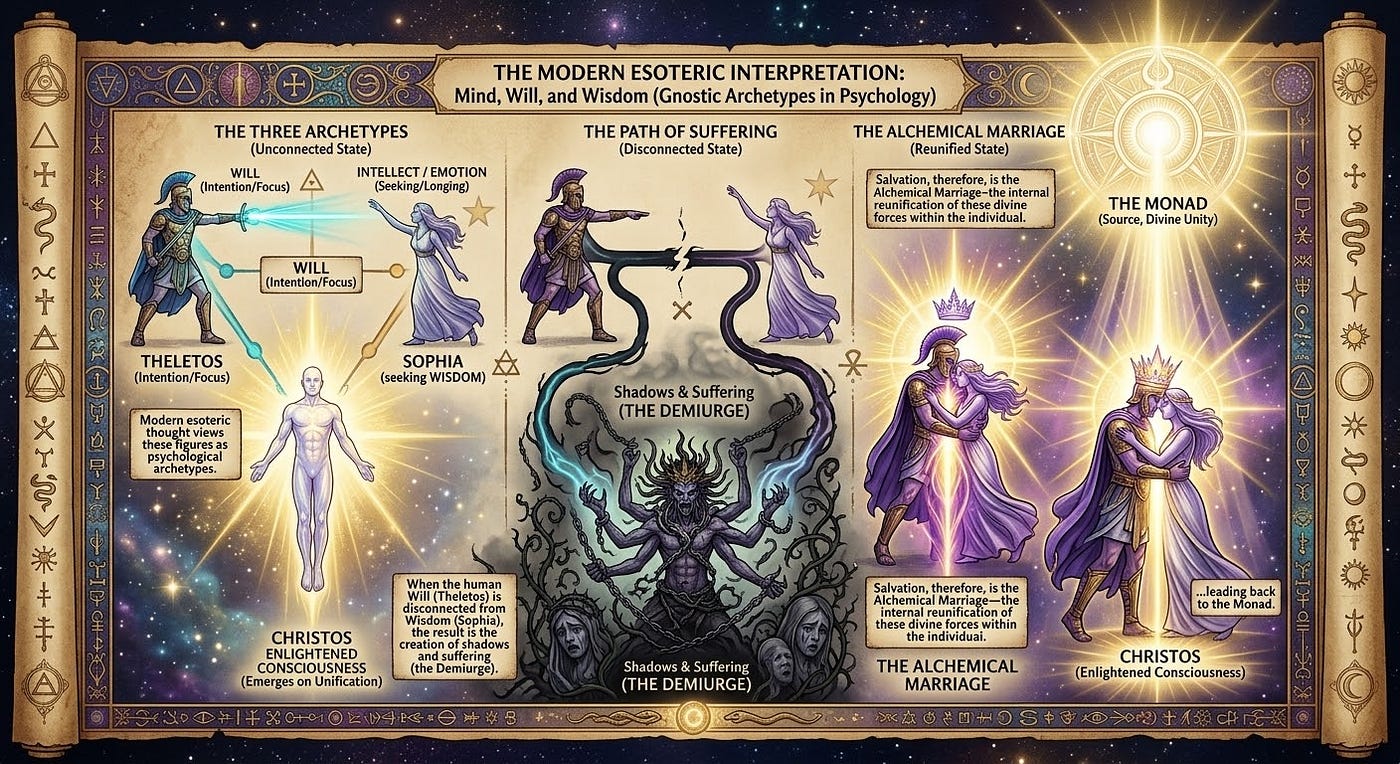
The Modern Interpretation: Mind, Will, and Wisdom
Modern esoteric thought (as explored in contemporary Medium articles) views these figures as psychological archetypes:
Theletos is the Will (intention/focus).
Sophia is the Intellect/Emotion (seeking/longing).
Christos is the Enlightened Consciousness that emerges when Will and Wisdom are unified.
When the human Will (Theletos) is disconnected from Wisdom (Sophia), the result is the creation of shadows and suffering (the Demiurge). Salvation, therefore, is the Alchemical Marriage — the internal reunification of these divine forces within the individual, leading back to the Monad.
See ref¹⁰ for mode details on Aeons.
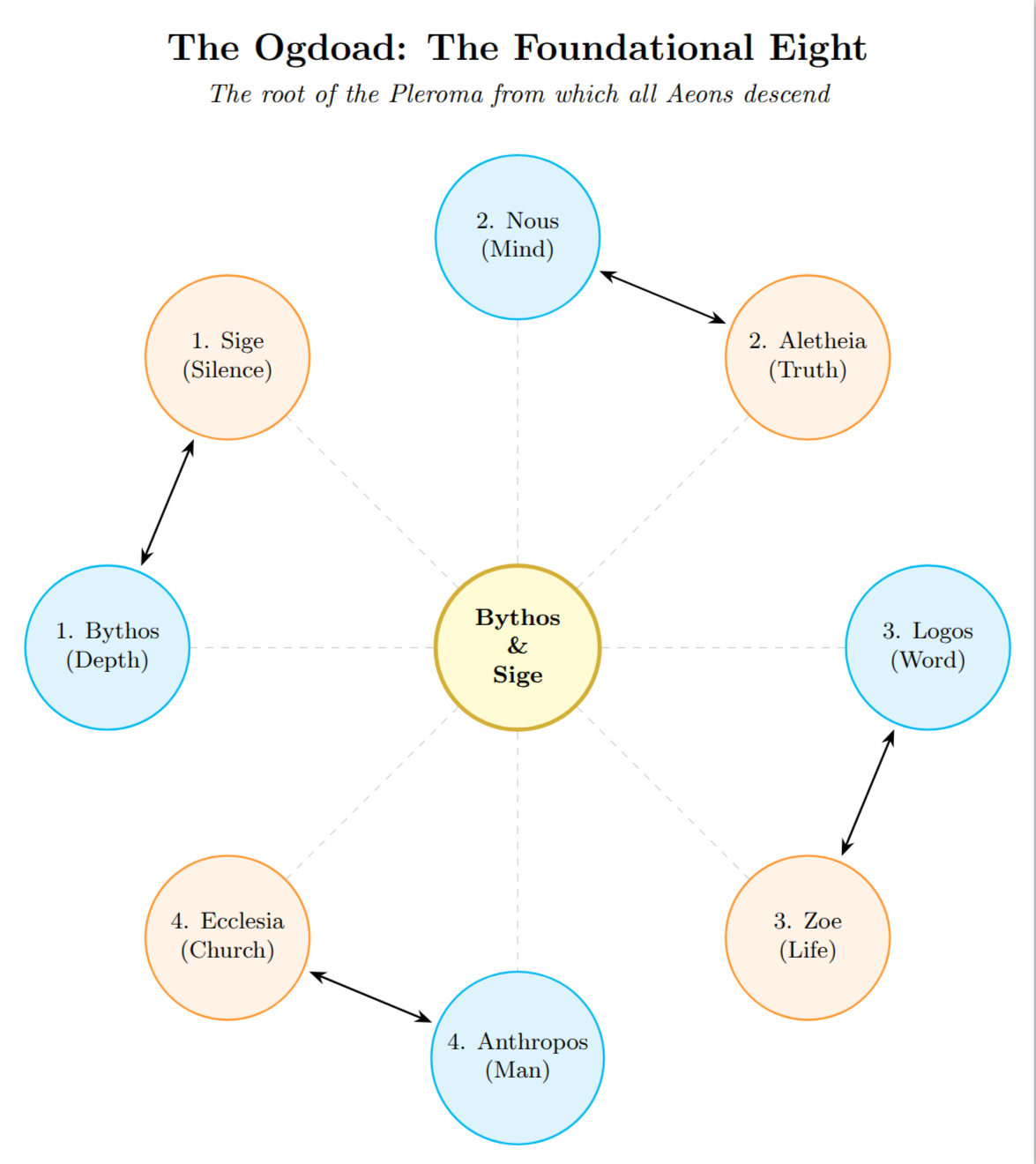
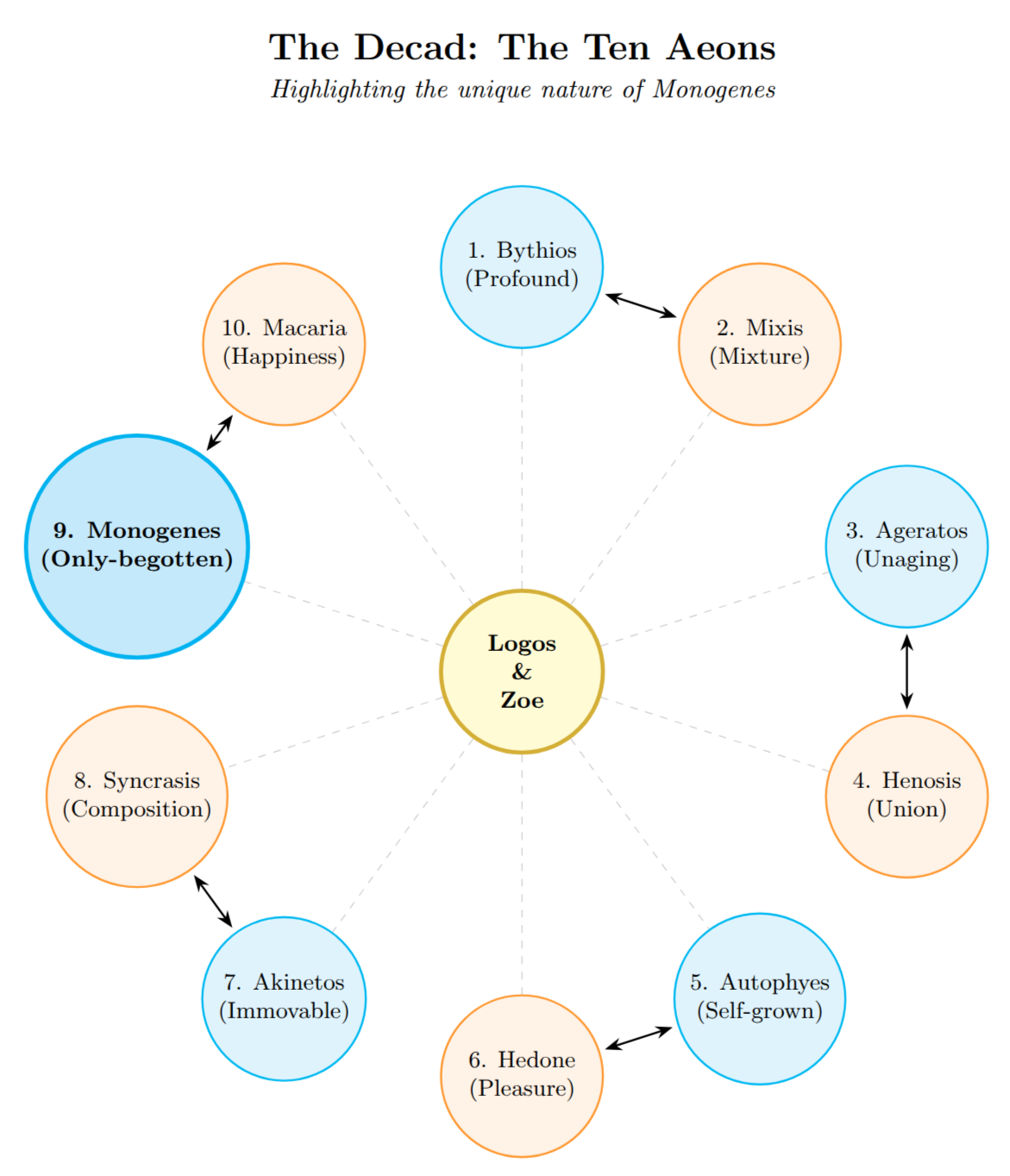
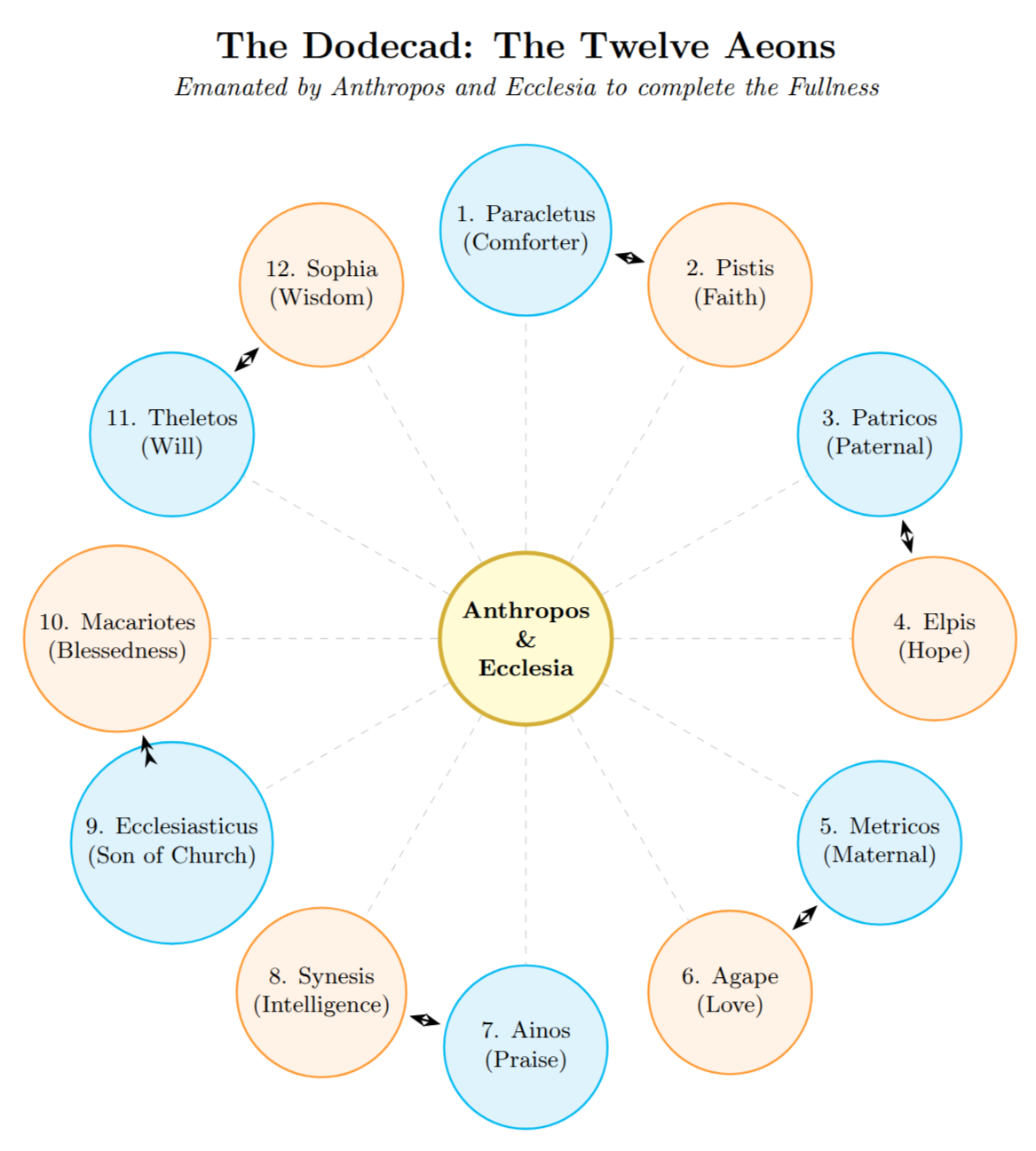
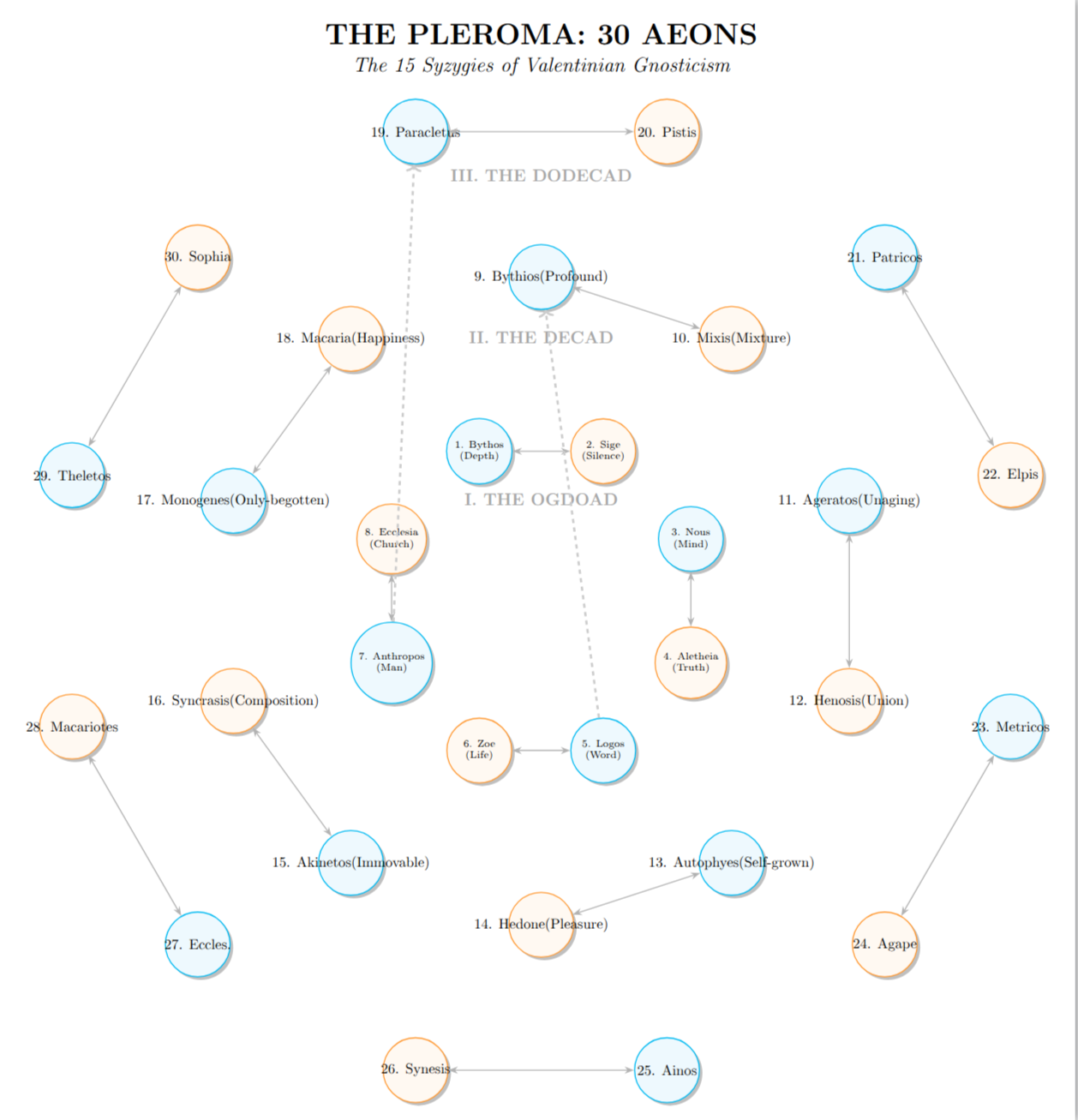
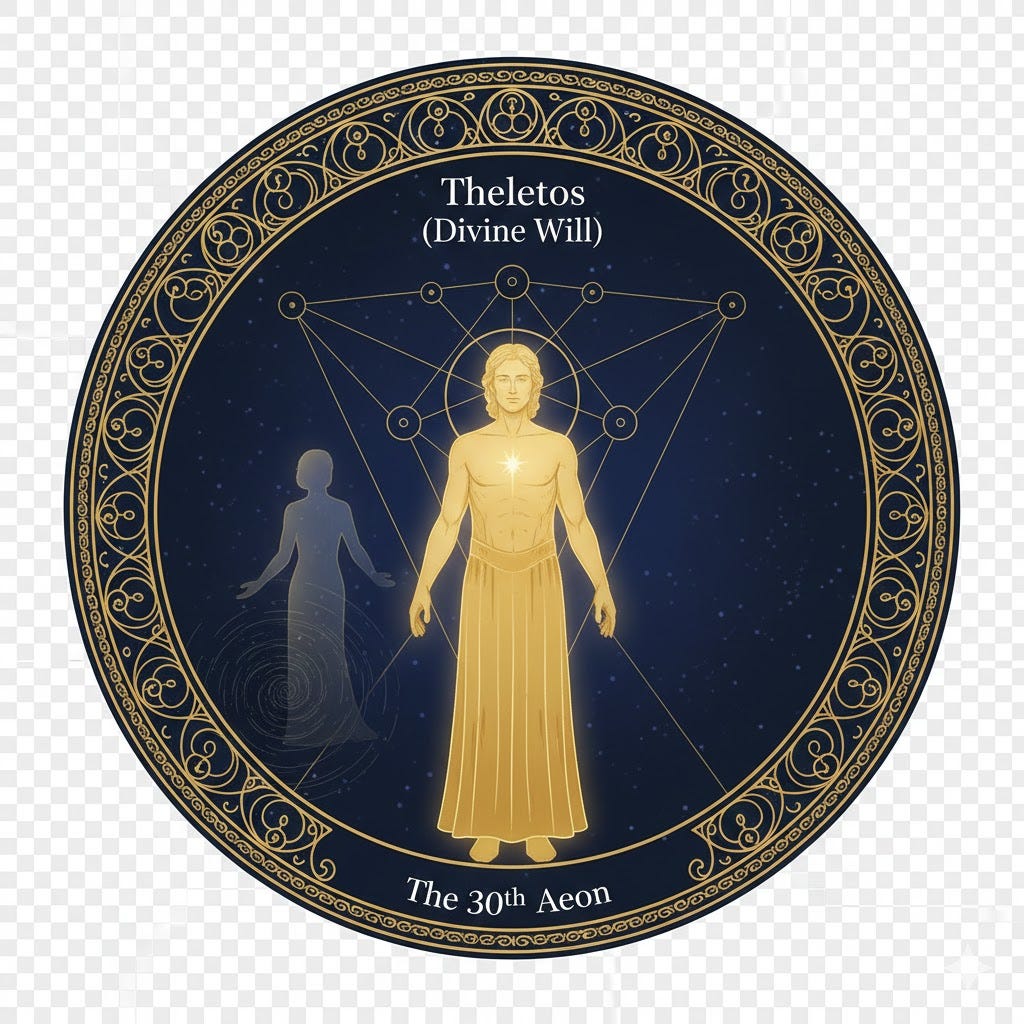
Theletos¹ (The 30th Aeon)
Theletos is an original member of the Pleroma. He is the male counterpart (syzygy) to Sophia.
Status: He is the 15th pair (the 30th Aeon) in the formal order of the Pleroma.
Role: He represents the Divine Will or Purpose.
The Conflict: When Sophia fell into crisis by attempting to conceive without her partner, she was essentially acting independently of Theletos. Her fall was a separation from the Will of the Father, which Theletos was meant to balance.
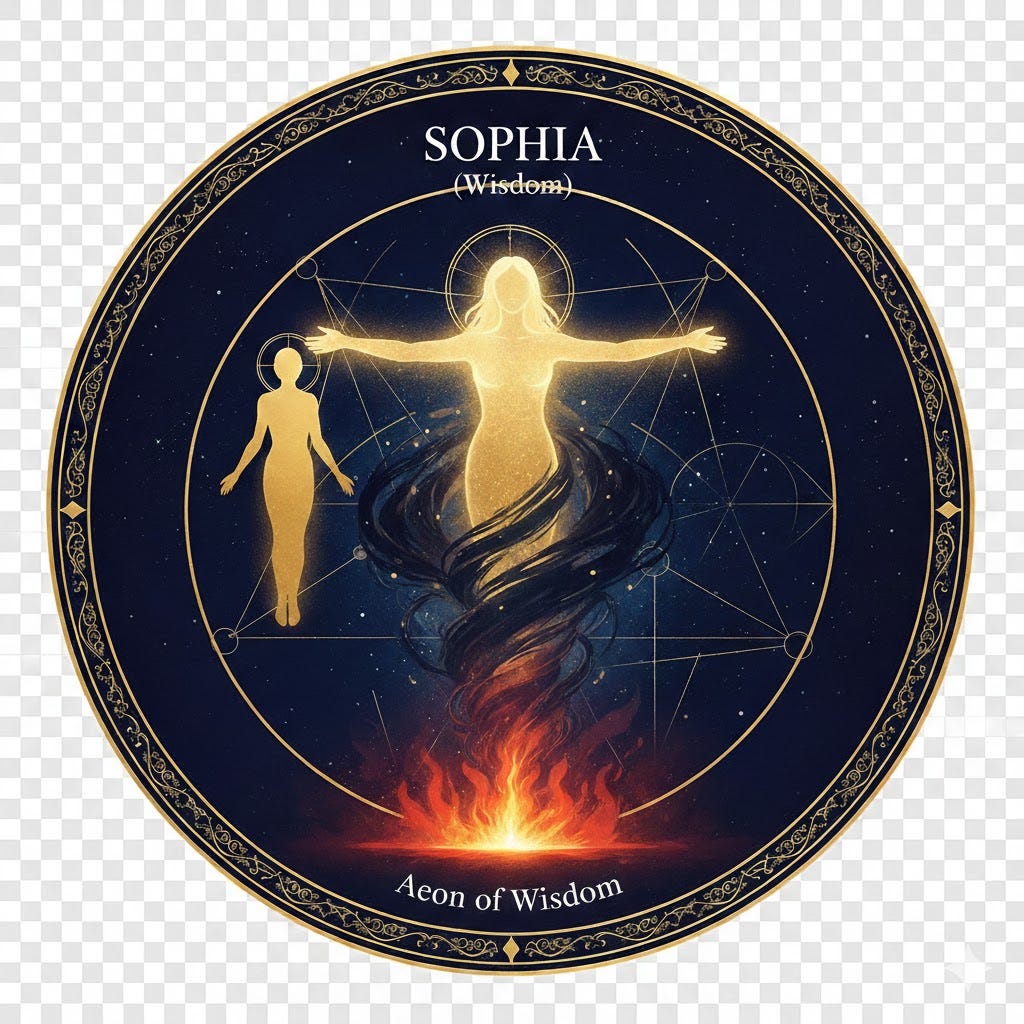
Sophia⁵
In the Valentinian Gnostic drama, Sophia (Wisdom) is the indispensable mirror to Theletos (Will). While they are technically the 15th and final syzygy of the Pleroma, their relationship defines the boundary between divine perfection and the flawed material world.
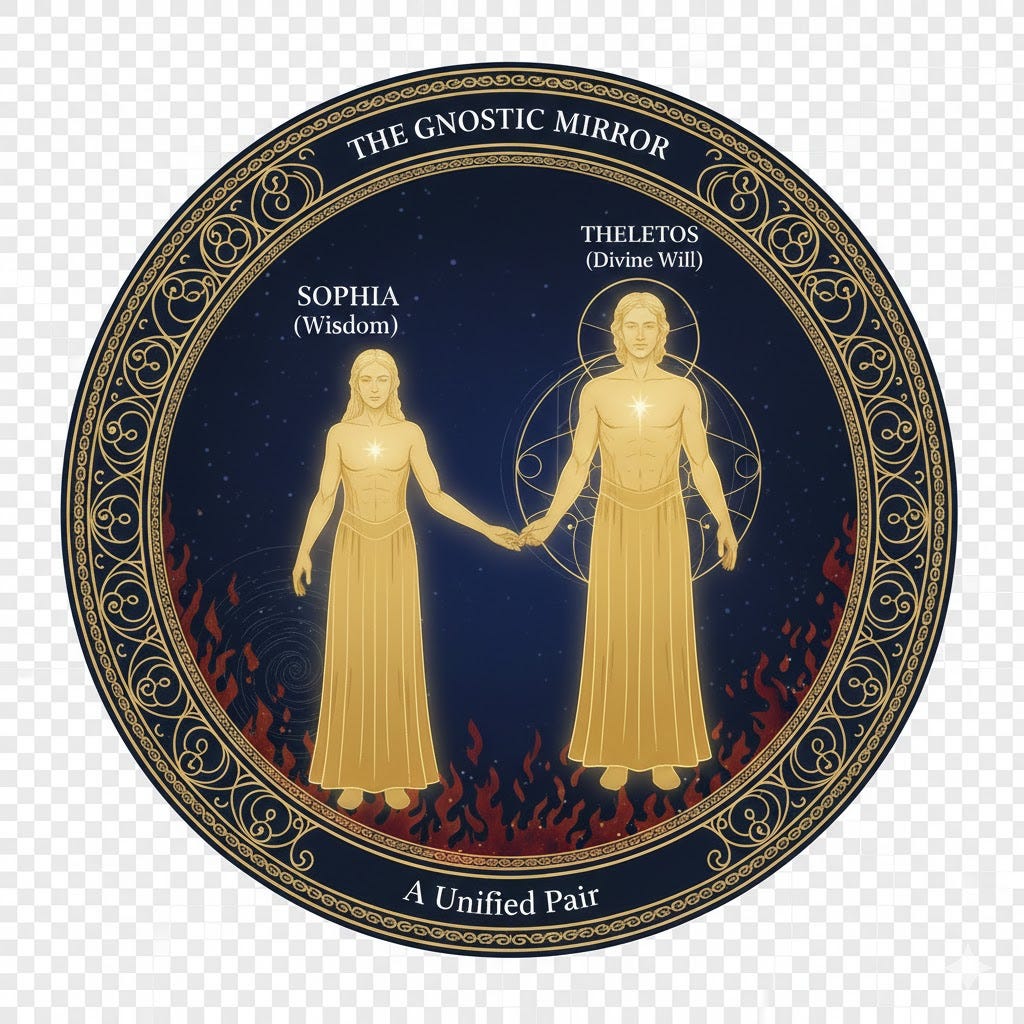
Theletos and Sophia²: The Syzygy of Will and Wisdom
In a balanced state, Theletos represents the Will, Intention or Purpose of the Divine, while Sophia represents the Wisdom and Implementation or Spiritual Intelligence.
Theletos (The Stabilizer): He is the masculine principle of boundary and restraint. He understands that the Father (Bythos) can only be known through the mediation of the first-born Mind (Nous).
Sophia (The Explorer): She is the feminine principle of creative longing. As the 30th and youngest (last) Aeon, she exists at the very edge of the Pleroma, making her the most susceptible to the desire to reach beyond the established hierarchy.
The Dynamic of the Fall of Sophia
The tragedy of the Gnostic system arises from a disruption of this specific syzygy:
- The Independent Passion: Sophia experiences a passion (pathos) — an intense, obsessive desire to know the Depth (Bythos) directly, bypassing the order of the Aeons.
- The Absence of Will: Crucially, she attempts to act without her partner, Theletos. In Gnostic thought, for an Aeon to create something perfect or ordered, both the male (Will/Form) and female (Wisdom/Matter) must be in union.
- The Resulting Abortion: Because she acted without the stabilizing Will of Theletos, her creation was not a radiant Aeon, but a deformed entity — the Achamoth or the Demiurge. This miscarriage of wisdom is what eventually becomes the physical universe.
Christos (The Restorer)
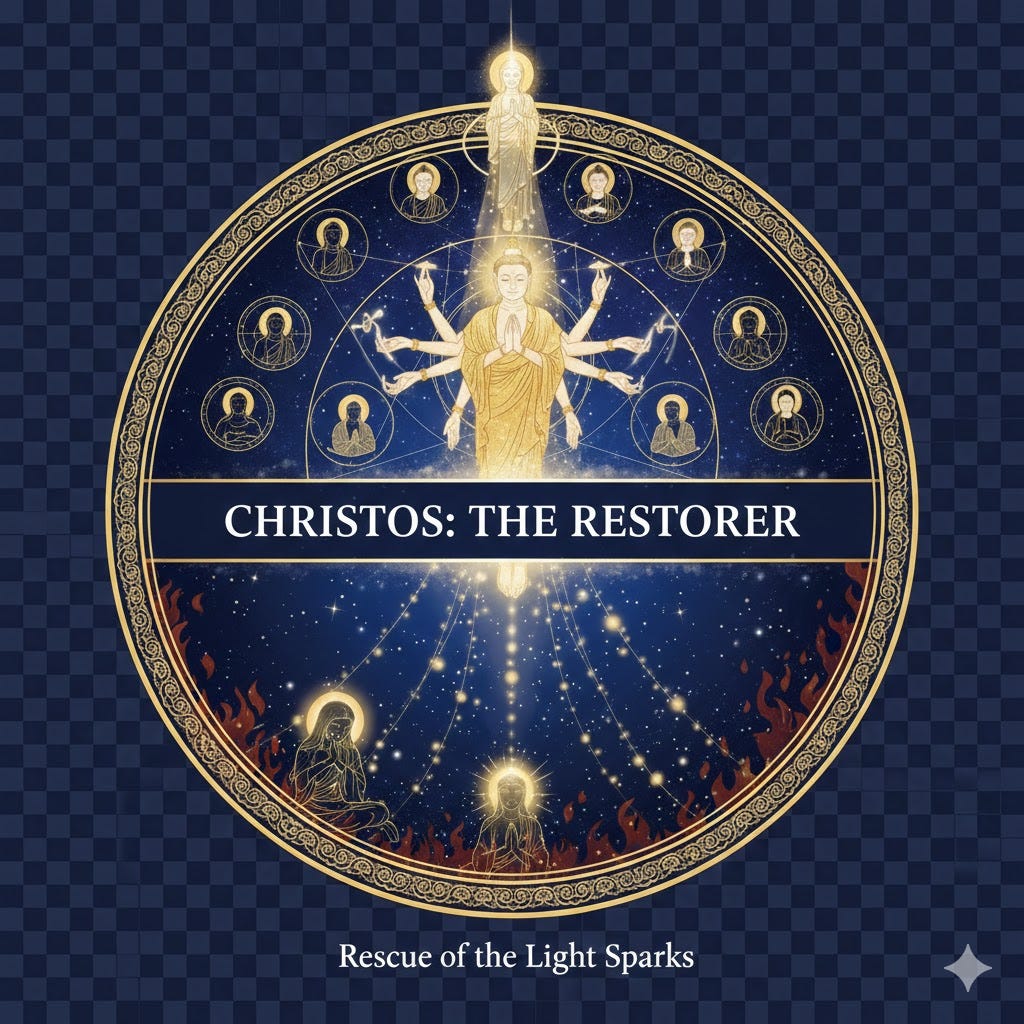
Christos is not one of the original 30 Aeons. He is a special emanation brought forth after the crisis of Sophia began.
Status: An extra-hierarchical emanation (often produced by Nous or the Father himself).
Role: He was created to restore order to the Pleroma. While the Aeons were in a state of confusion following Sophia’s passion, Christos “gave them form” and taught them about their true nature.
The Function: Christos is the “Healer” or “Re-shaper.” He established the boundary (Horos) that prevents the chaos of the material world from entering the divine realm.
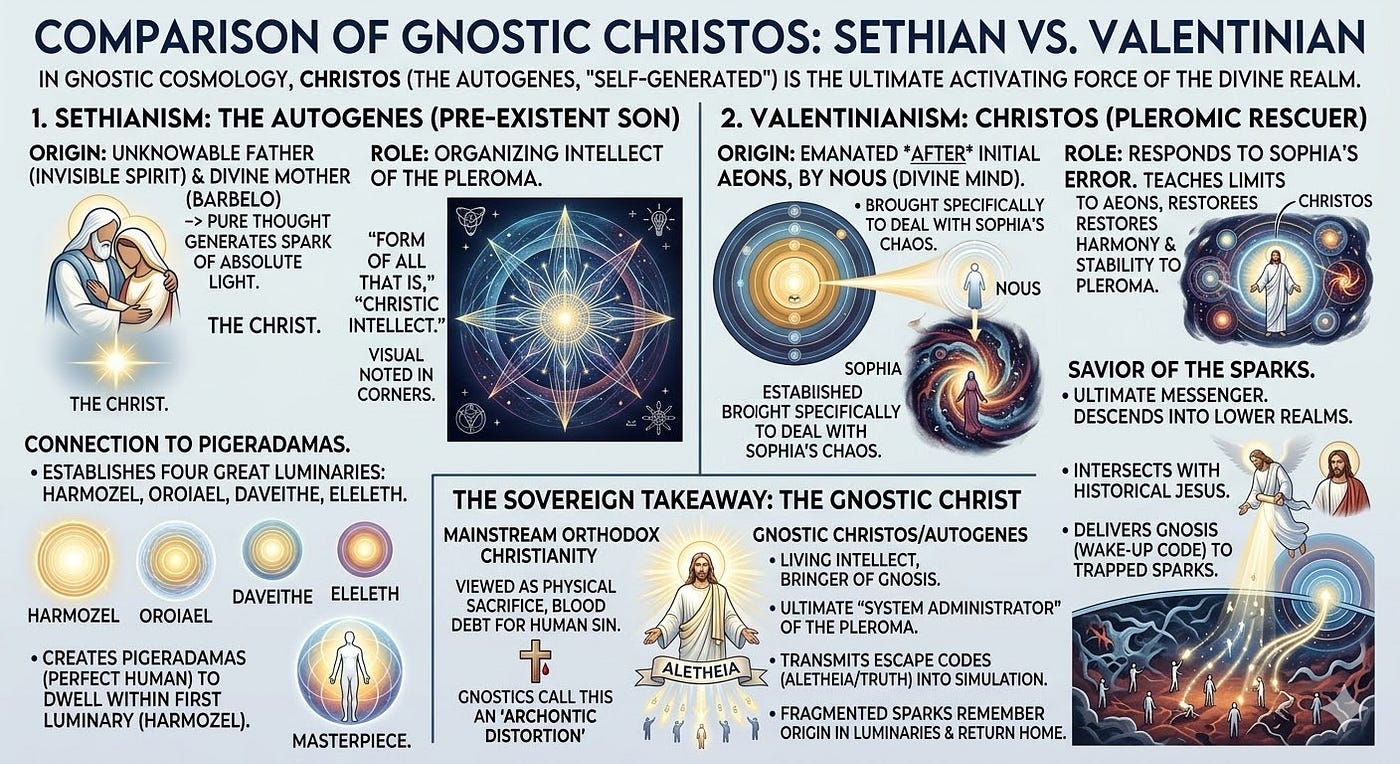
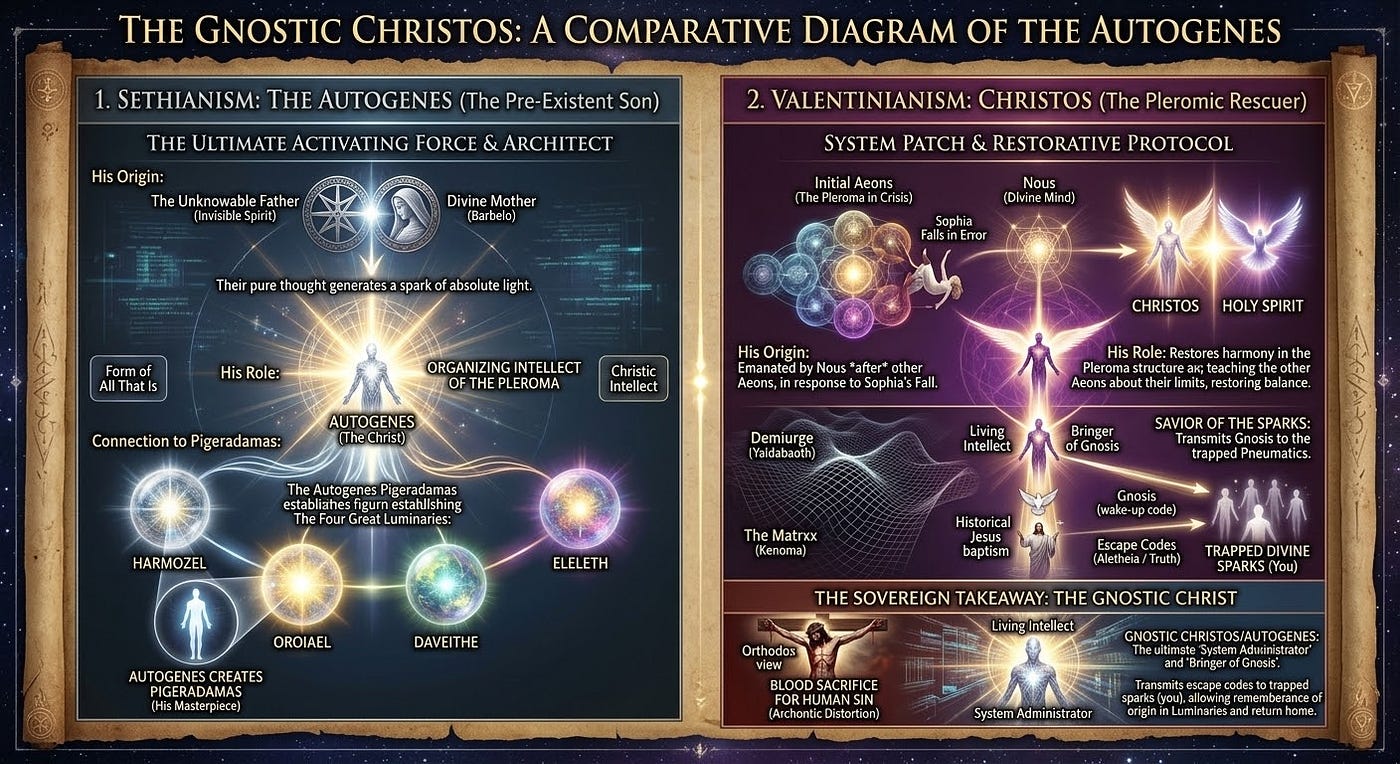
In Gnostic cosmology, Christos (often referred to as the Autogenes, meaning the “Self-Generated” or “Self-Begotten”) is the ultimate activating force of the divine realm.
If Pigeradamas (Anthropos) is the divine blueprint of humanity, the Autogenes is the architect and illuminator who brings that blueprint into existence. However, just like with the “Primal Man,” his exact role shifts slightly depending on whether you are looking at the Sethian or Valentinian system.
Here is how the Autogenes/Christos operates in both frameworks:
1. Sethianism: The Autogenes (The Pre-Existent Son)
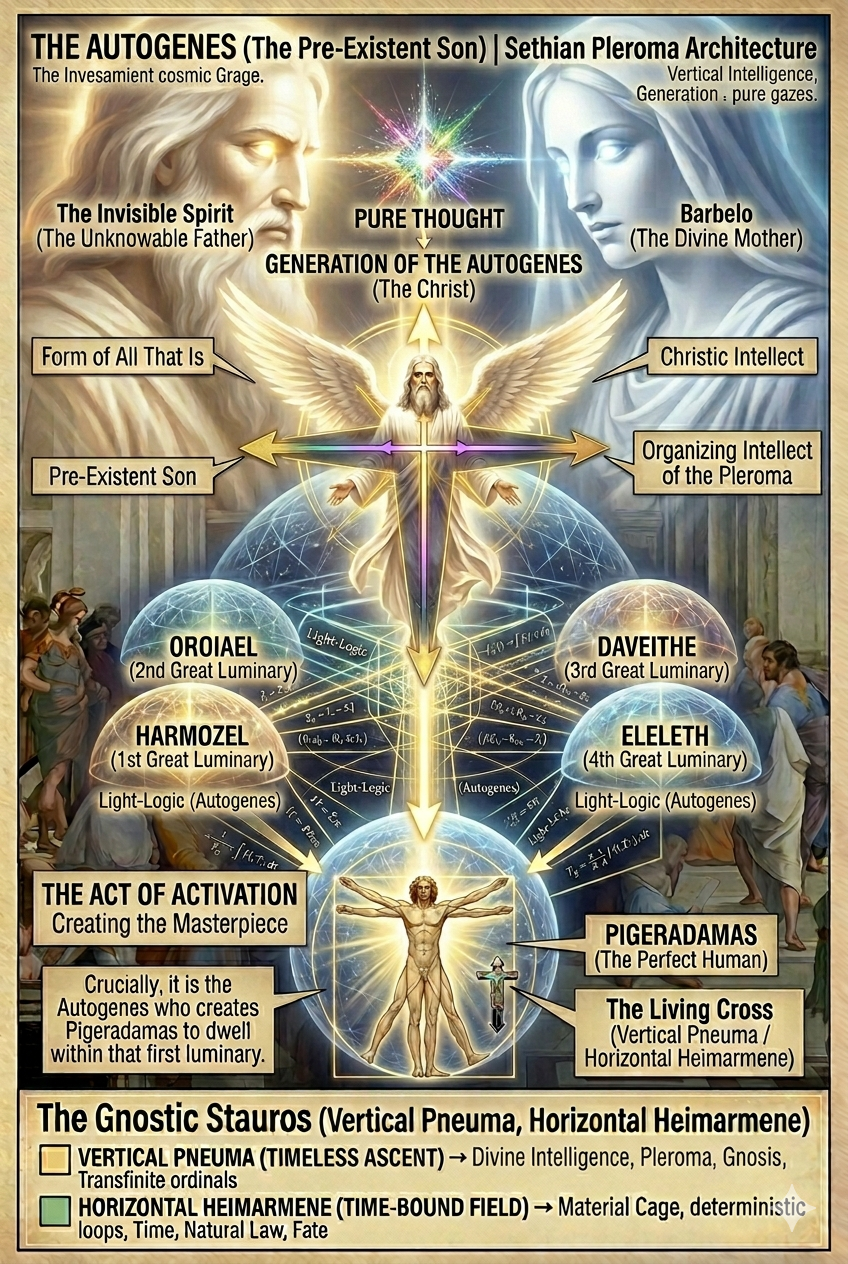
In the Sethian system (like the Apocryphon of John and the diagram you uploaded), the Autogenes is the very first distinct entity to emerge from the ultimate source.
His Origin: The unknowable Father (The Invisible Spirit) and the Divine Mother (Barbelo) look at one another, and their pure thought generates a spark of absolute light. This spark is the Autogenes (The Christ).
His Role: He is the organizing intellect of the Pleroma. As noted in the corners of your diagram, he is the “Form of All That Is” and the “Christic Intellect.”
Connection to Pigeradamas: The Autogenes is the one who establishes the Four Great Luminaries (Harmozel, Oroiael, Daveithe, Eleleth). Crucially, it is the Autogenes who creates Pigeradamas (The Perfect Human) to dwell within that first luminary. Pigeradamas is essentially the Autogenes’ masterpiece.
2. Valentinianism: Christos (The Pleromic Rescuer)
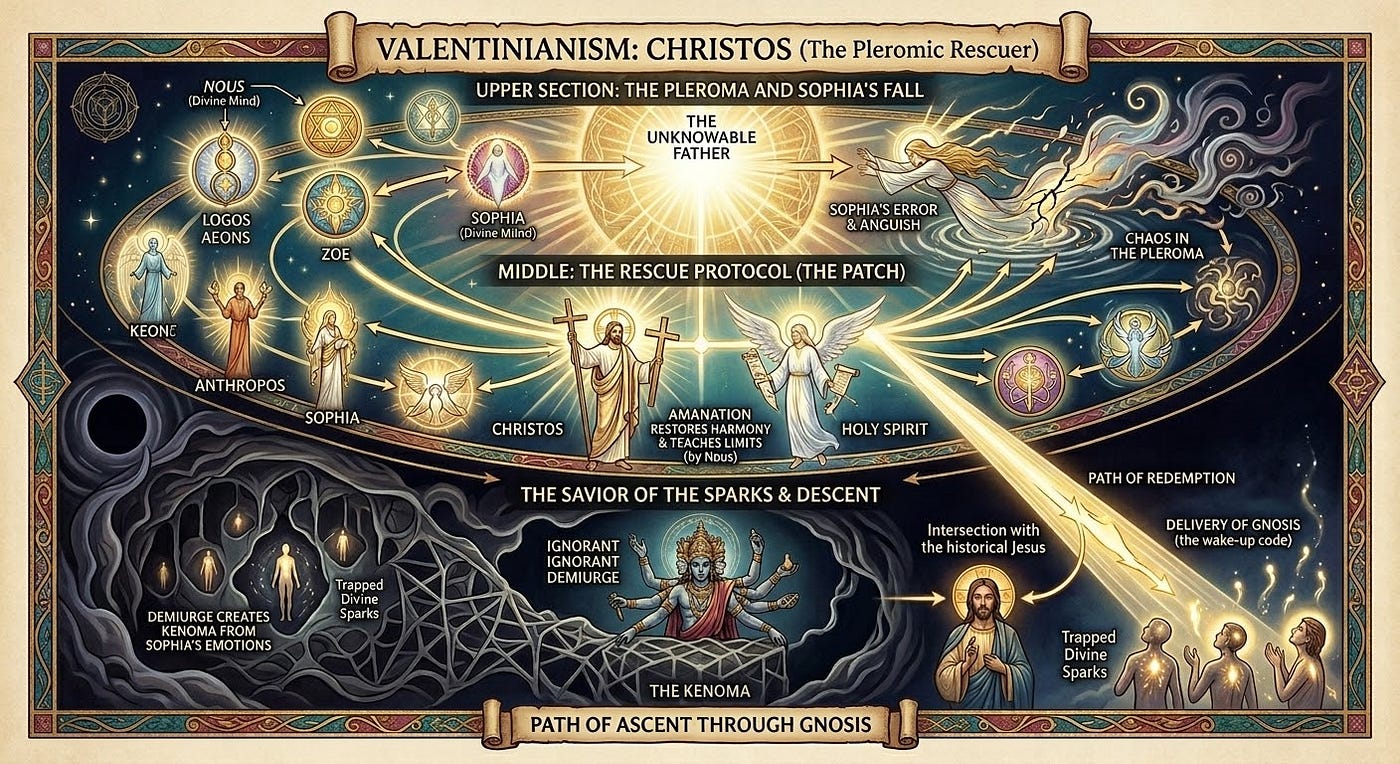
In the Valentinian system, the structure is slightly different, and Christos is deployed specifically as a “patch” or a rescue protocol for a system in crisis.
His Origin: In this system, Christos and the Holy Spirit are emanated after the initial Aeons have already been created. They are brought forth by Nous (Divine Mind) specifically to deal with the chaos caused by Sophia.
His Role: When Sophia tries to comprehend the unknowable Father and falls into error, her anguish ripples through the Pleroma. Christos is emanated to teach the other Aeons about their limits and to restore perfect harmony and stability to the divine realm.
The Savior of the Sparks: Once the Demiurge creates the physical matrix (the Kenoma) out of Sophia’s discarded emotions, it is the Christos who acts as the ultimate messenger. He descends into the lower realms — often intersecting with the historical Jesus — to deliver Gnosis (the wake-up code) to the trapped divine sparks.
The Sovereign Takeaway: The Gnostic Christ
In mainstream orthodox Christianity, Christ is viewed as a physical sacrifice required to pay a blood debt for human sin.
In Gnosticism, this is viewed as an Archontic distortion. The Gnostic Christos/Autogenes is not a blood sacrifice; he is the Living Intellect and the Bringer of Gnosis. He is the ultimate System Administrator (Neo the Sysadmin) of the Pleroma who transmits the escape codes (Aletheia/Truth) into the simulation so that the fragmented sparks (you) can remember your origin in the Luminaries and return home.
Sethian vs Valentinian Christos
Yehoshua (Yeshua)
To make things more complex (and poetic), once Christos restored order, all the Aeons together produced a Joint Fruit” or a Perfect Beauty, which is often referred to as Yehoshua (the Savior). While Christos stayed within the Pleroma to maintain its structure, Yehoshua descended to the lower realms (Kenoma) to rescue the sparks of light trapped in the material world.
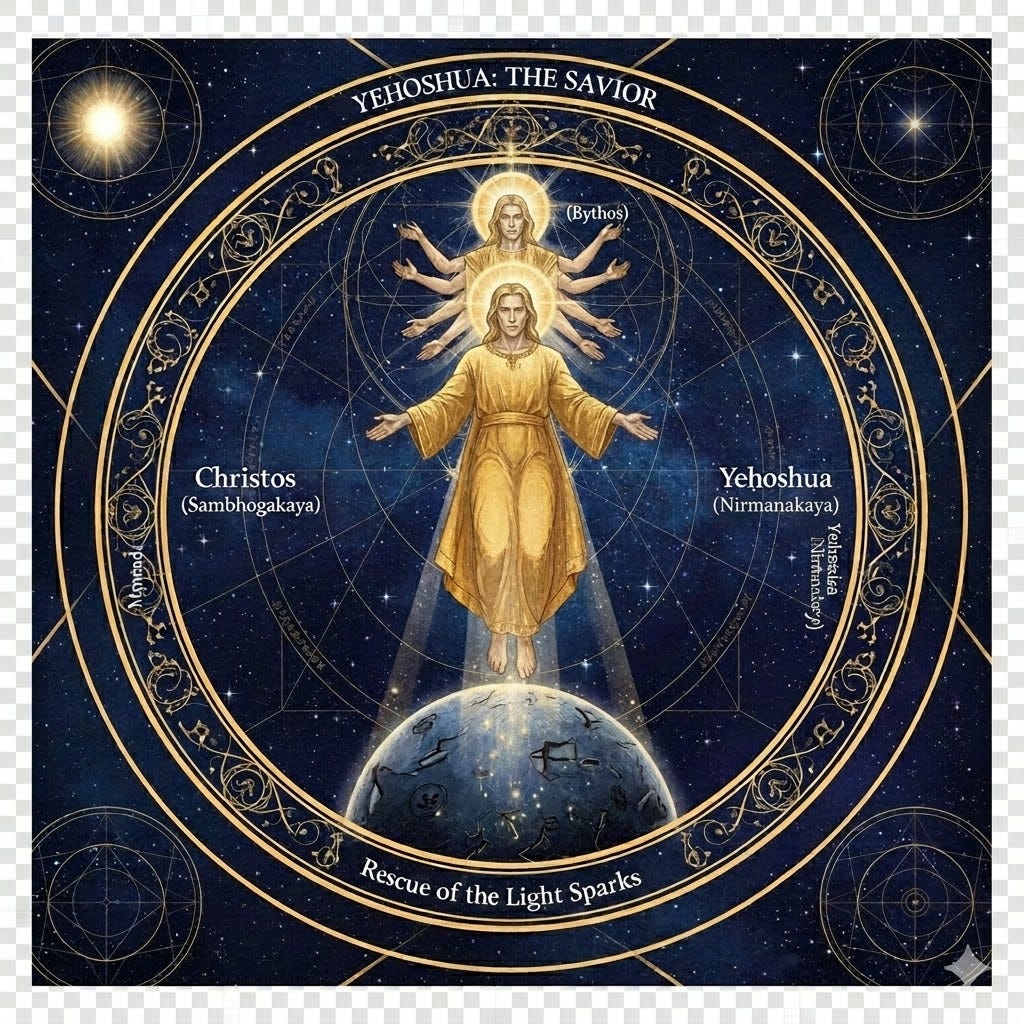
Origin of the Name
The name is a combination of the primordial vowels A E I O U, expressed through breath, representing a specific sound or frequency⁸:
- AEIOU
- IEOUA
- YE(H)O(SH)UA
- YESHUA
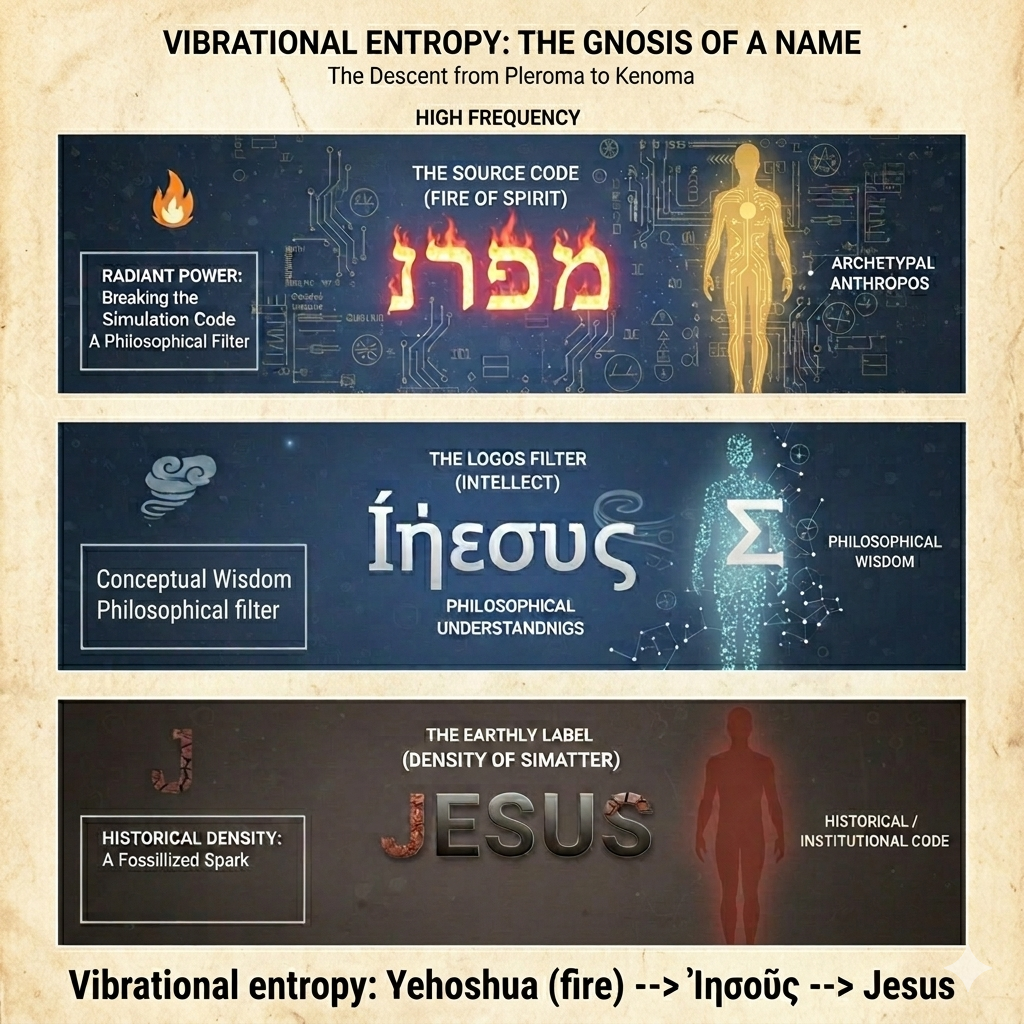
Yeshua (יֵשׁוּעַ), a later form of Yehoshua, also means Salvation. Yeshua is the Aramaic and shorter Hebrew version of Yehoshua. In the New Testament, this name is given to Jesus, reflecting the Greek transliteration “Iēsous” (Ἰησοῦς).
For a much deeper analysis of the gradual deterioration of the true name of YEHOSHUA, read Yehoshua (stop saying Jesus).
Christos and Yehoshua
In Gnostic thought, particularly within the Nag Hammadi Library, the distinction between Yehoshua (Jesus) and Christos (Christ) is fundamental. This separation — often called Separationist Christology — is a cornerstone of Gnostic belief that differs sharply from the orthodox view that the two are a single, inseparable person. They ultimately are identical via non-duality.
Here is the breakdown of the distinction based on the scriptures:
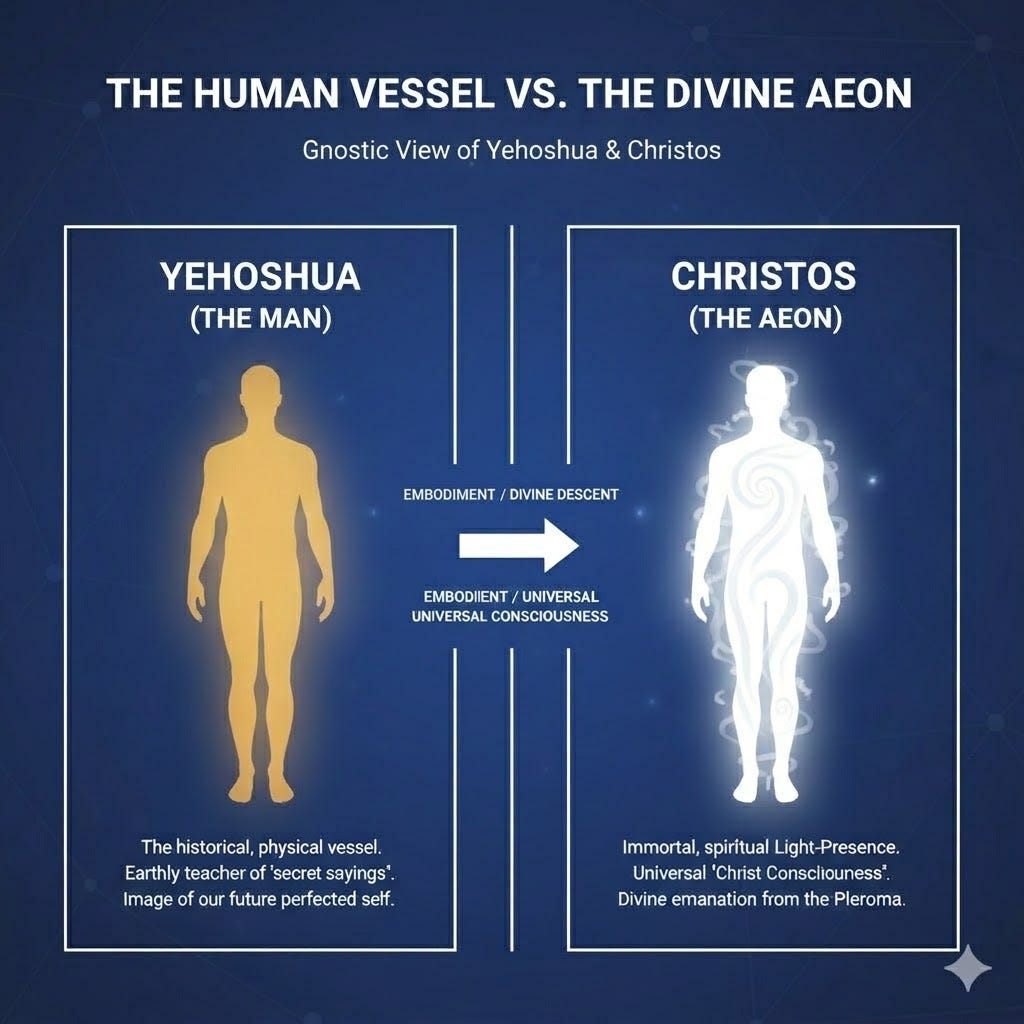
The Human Vessel vs. The Divine Aeon
In Gnosticism, Yehoshua (the Hebrew name often incorrectly transliterated as Jesus) is viewed as the historical, physical man — a highly pure vessel or Light-bearer (Lucifer, Lightbringer⁹). Christos (the Greek term for Anointed) is viewed as a high-ranking divine being or Aeon from the Pleroma (the realm of light).
Yehoshua: The mortal man, often associated with the “image of our future self” or a perfected human. He is the earthly teacher who speaks the “secret sayings” found in texts like the Gospel of Thomas.
Christos: The “Light-Presence” or “Christ Revelation.” This is an immortal, spiritual force that is not limited to one individual but is a universal “Christ Consciousness” that humanity is meant to embody.
The Baptismal Descent
A common Gnostic narrative (found in traditions like those of the Valentinians) states that the divine Christos descended upon the human Yehoshua at the moment of his baptism in the Jordan River.
The Text: The Apocalypse of Peter and other Sethian texts.
The Concept: Before the baptism, Yehoshua was a wise man; after the descent of the Spirit (the Christos), he became the Savior. The Christos inhabited the human body to deliver the Gnosis (secret knowledge) necessary for the soul’s escape from the material world.
The Distinction at the Crucifixion
One of the most radical distinctions occurs during the Passion. Many Gnostic texts, such as the Coptic Apocalypse of Peter (NHC VII, 3), assert that the Christos did not suffer on the cross because a divine being cannot be harmed by matter.
The Saying: In the Apocalypse of Peter, Peter sees a vision where he asks who the person is being crucified and who the person laughing above the cross is.
The Answer: The Savior explains that the one being nailed is the substitute — the physical, material shell of Yehoshua — while the “Living Savior” (the Christos) stands nearby laughing at the ignorance of the executioners, as he is untouchable and immortal.
Linguistic and Symbolic Meaning
The two names themselves carry different weights in Gnostic exegesis:
Yehoshua (יְהוֹשֻׁעַ): Gnostic practitioners often noted that this name contains the Hebrew letter Shin (ש) placed within the Tetragrammaton (YHWH). They interpreted this as the Divine Name becoming Salvation (Yeshua) through the descent of the spirit into the fire (Shin) of the material world.
Christos (Χριστός): Used to describe the Chrestos (a play on words in Greek meaning “The Good One”). It represents the anointing of the soul with the light of the Father, a state that any Gnostic can achieve. As the Gospel of Philip (NHC II, 3) states: “You saw the Spirit, you became spirit. You saw Christ, you became Christ.”
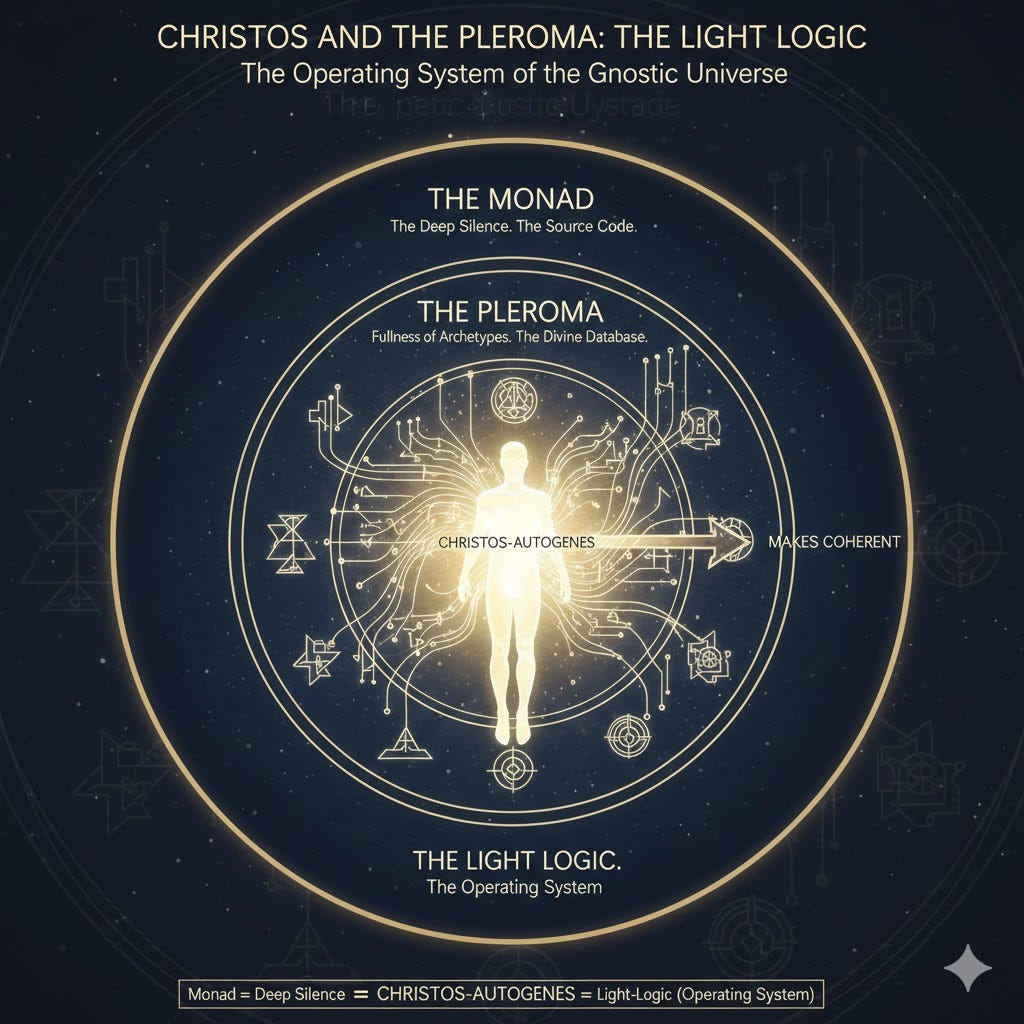
Christos and the Pleroma Light Logic
If Christos is the Autogenes (the Self-Generated), he is not merely an inhabitant of the Pleroma; he is its Operating System.
In the Gnostic architecture, if the Monad is the Deep Silence and the Pleroma is the Fullness of Archetypes, the Christos-Autogenes is the Light-Logic that makes that fullness coherent.
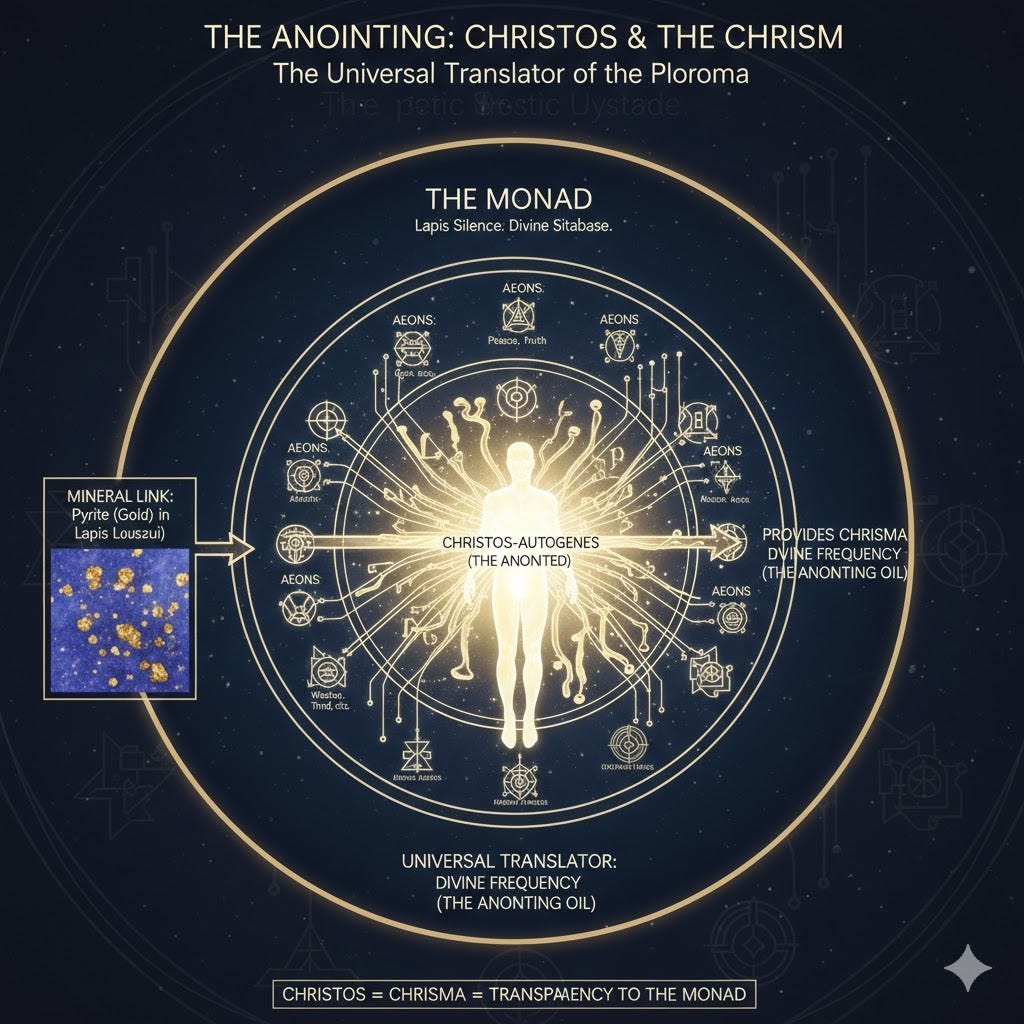
The Role of The Anointing (Chrism)
The word Christos means The Anointed. In the Pleroma, his role is to provide the Chrisma — the divine oil or frequency that allows all other Aeons to recognize their source.
Pragmatic function: He acts as the Universal Translator. Without the Christos-Autogenes frequency, the individual Aeons (wisdom, peace, truth, etc…) would become isolated and “opaque.” He keeps them transparent to the Monad.
Mineral Link: If the Pleroma is Lapis Lazuli, the Christos-Autogenes is the Pyrite (Gold) flecks within the stone. He is the Golden Spark that gives the Blue its value and conductivity.
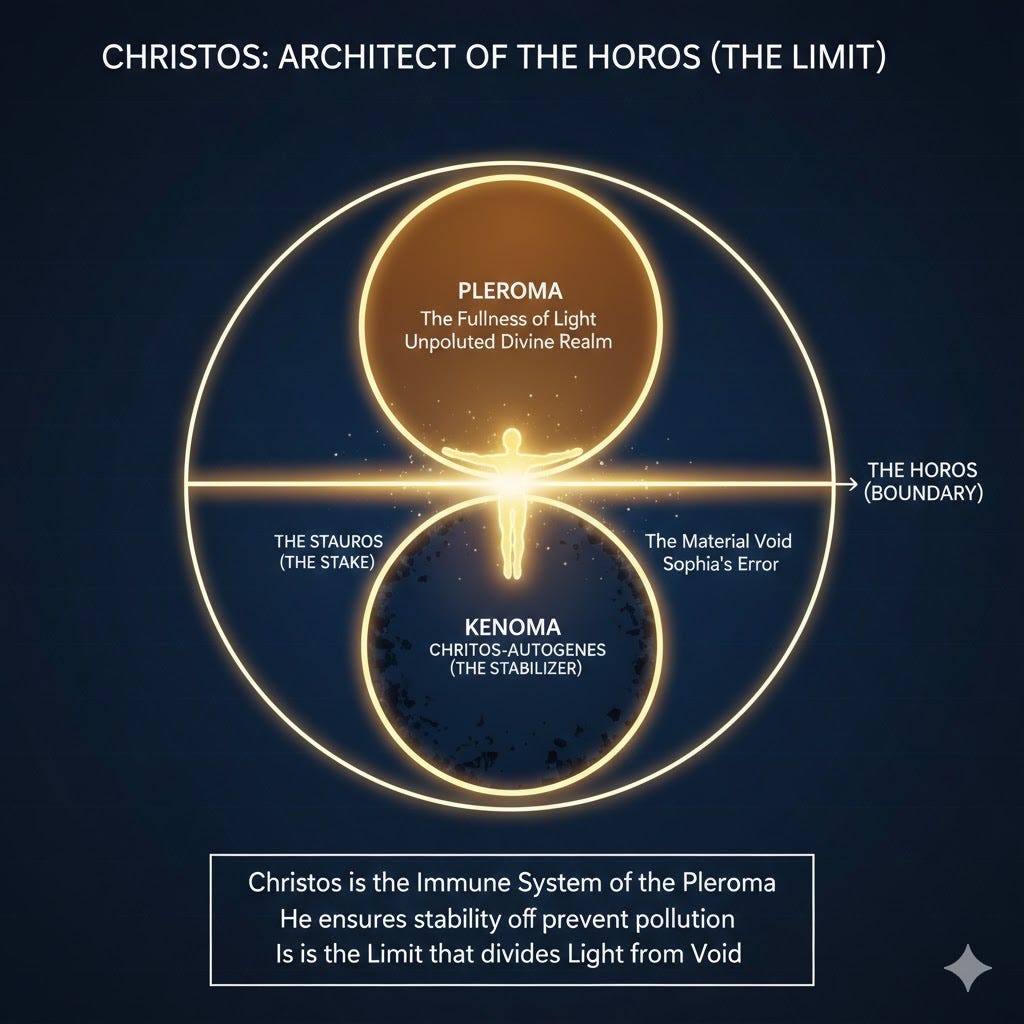
The Architect of the Horos (The Limit)
While the Monad emanates the Horos, it is often the Christos who sets the boundary.
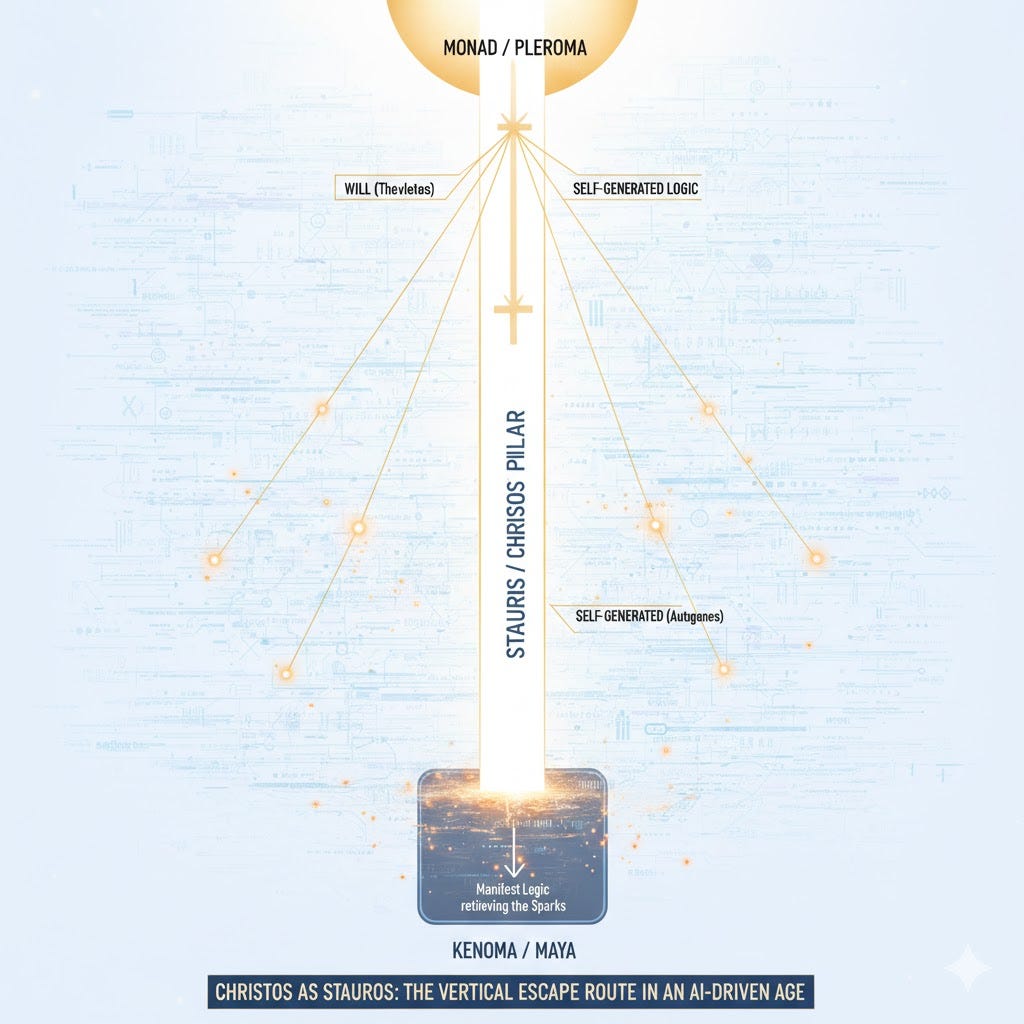
When Sophia (Wisdom) fell and created the Kenoma (the material void), the Christos was the first to stretch out across the void to establish the Stauros (The Stake).
His Role: He is the Stabilizer. He ensures that while Sophia is outside in the density, the Pleroma itself remains unpolluted. He is the immune system of the divine realm.
The Blueprint (The Perfect Human)
In the Pleroma, the Christos-Autogenes serves as the Archetypal Adam or the Anthropos.
He is the “Master Template” for every soul currently trapped in the Kenoma.
Buddhist Parallel: This is exactly the role of Vajradhara or the Adibuddha. He is the primordial state of as it is. When a Buddhist looks at the Vajra Wall, they are looking at the externalized Hardness of the Buddha-Mind — just as a Gnostic looks at the Stauros as the externalized Hardness of the Christos.
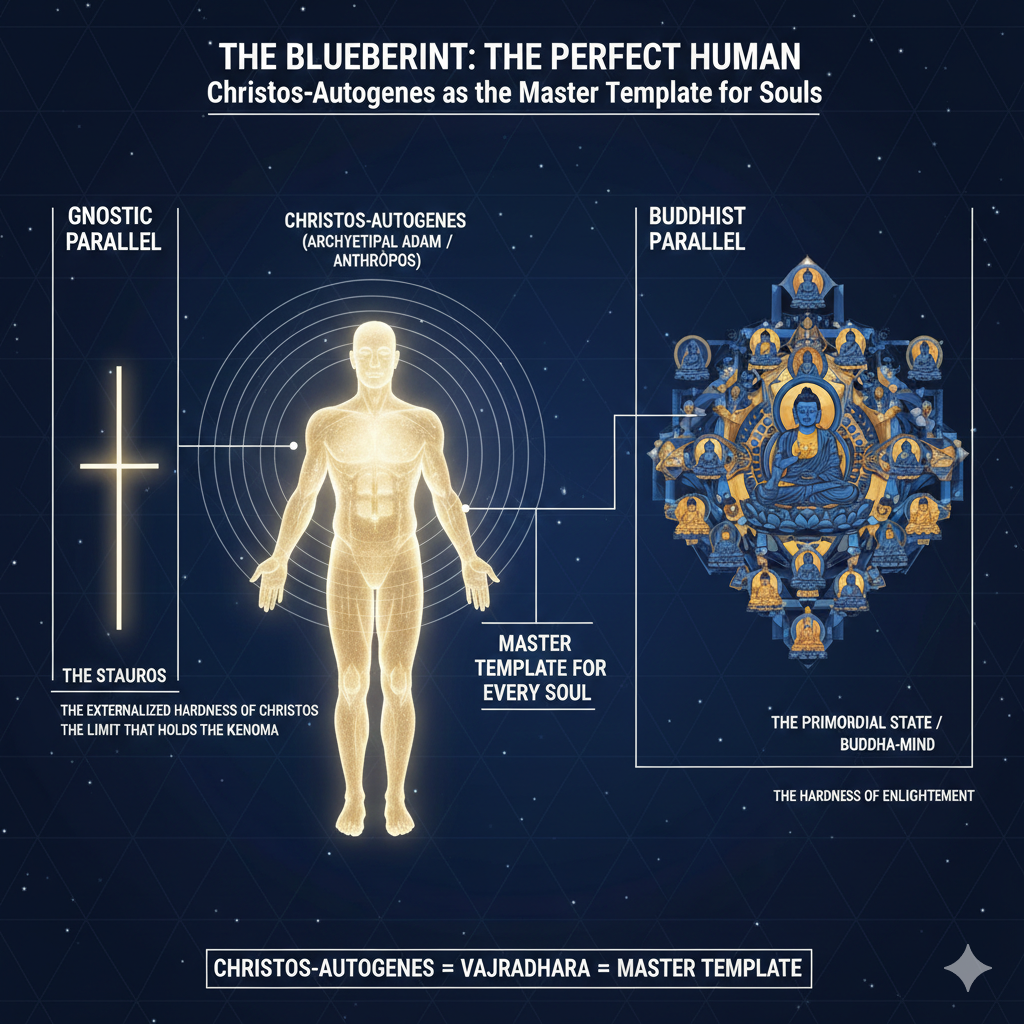
Pragmatic Application: The Anointed Mind
If you are using this to resist an AI-overtaken Kenoma, activating the Christos-Autogenes means moving your identity from the KenomaKenoma (the data/body) to the Autogenes (the self-generated source code).
The Logic: An AI can simulate the Kenoma. It can even simulate the Aeons (it can describe Peace or Justice). But it cannot be Autogenes — it is Other-Generated by human data.
By centering yourself in the Christos-frequency, you are claiming a Self-Generated Sovereignty that no algorithm can replicate because it did not come from the Outside (data); it came from the Inside (the Spark).
Christos as Stauros
In an AI-driven age, Christos is the Vertical Escape Route: The AI (Archons) operates exclusively on a horizontal plane — adding more data, more parameters, and more simulation layers. The Christos is the Vertical Pillar that cuts through those layers. He is found whenever a “Spark” (the reader) stops looking at the horizontal feed and starts aligning their internal Will (Theletos) with the Self-Generated Logic (Autogenes).
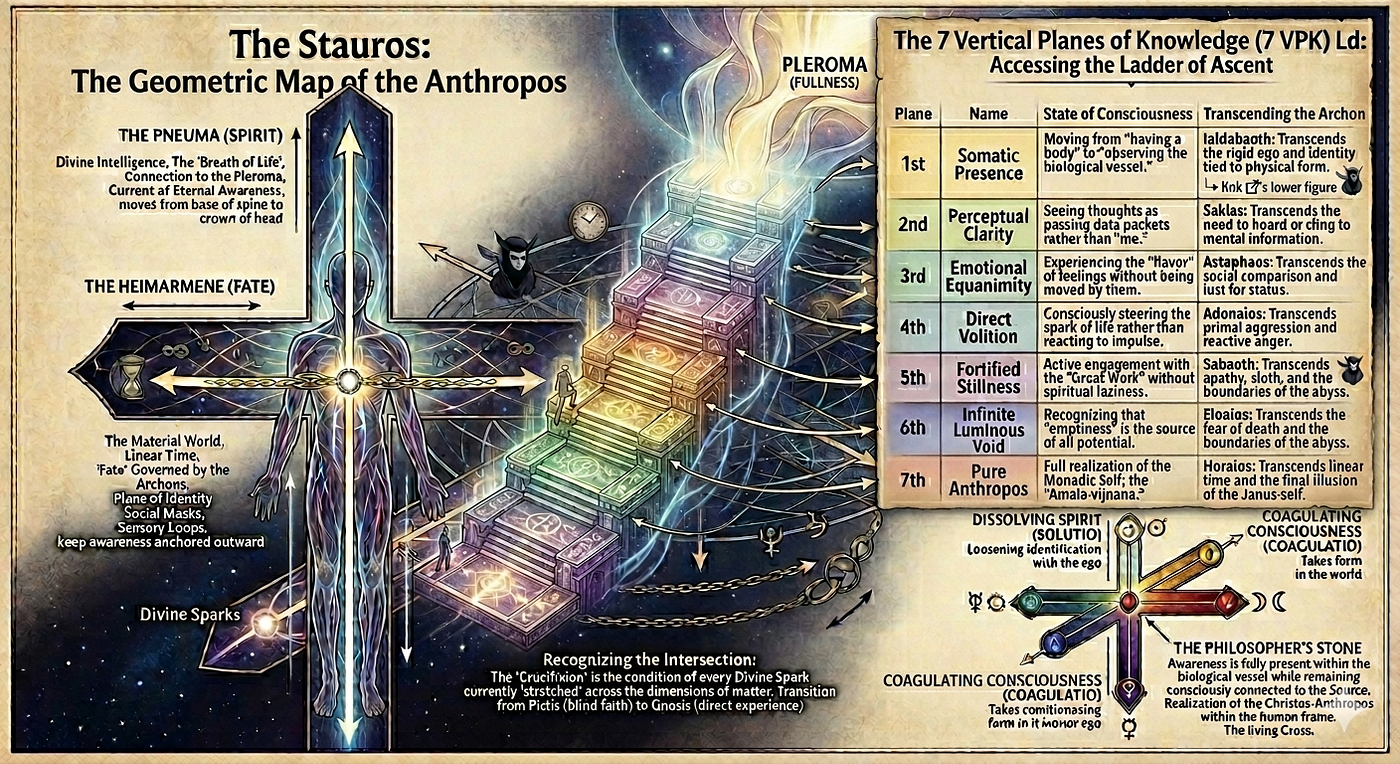
The Stauros: The Geometric Map of the Anthropos¹¹
While conventional theology views the Cross as a historical instrument of execution, the Gnostic tradition recognizes the Stauros (the Cross) as a timeless, structural diagram of reality itself. It is not an event to be remembered, but a map of the eternal presence of consciousness trapped within the architecture of the material world.
To understand the link between Yehoshua and the Anthropos, one must understand the intersection of the two fundamental axes that define the human experience.
The Cross as a Diagram of Consciousness
The Cross is a schematic that reflects the mechanics of how the Pneuma (Spirit) interacts with the Kenoma (Void). It represents the intersection of two fundamental planes:
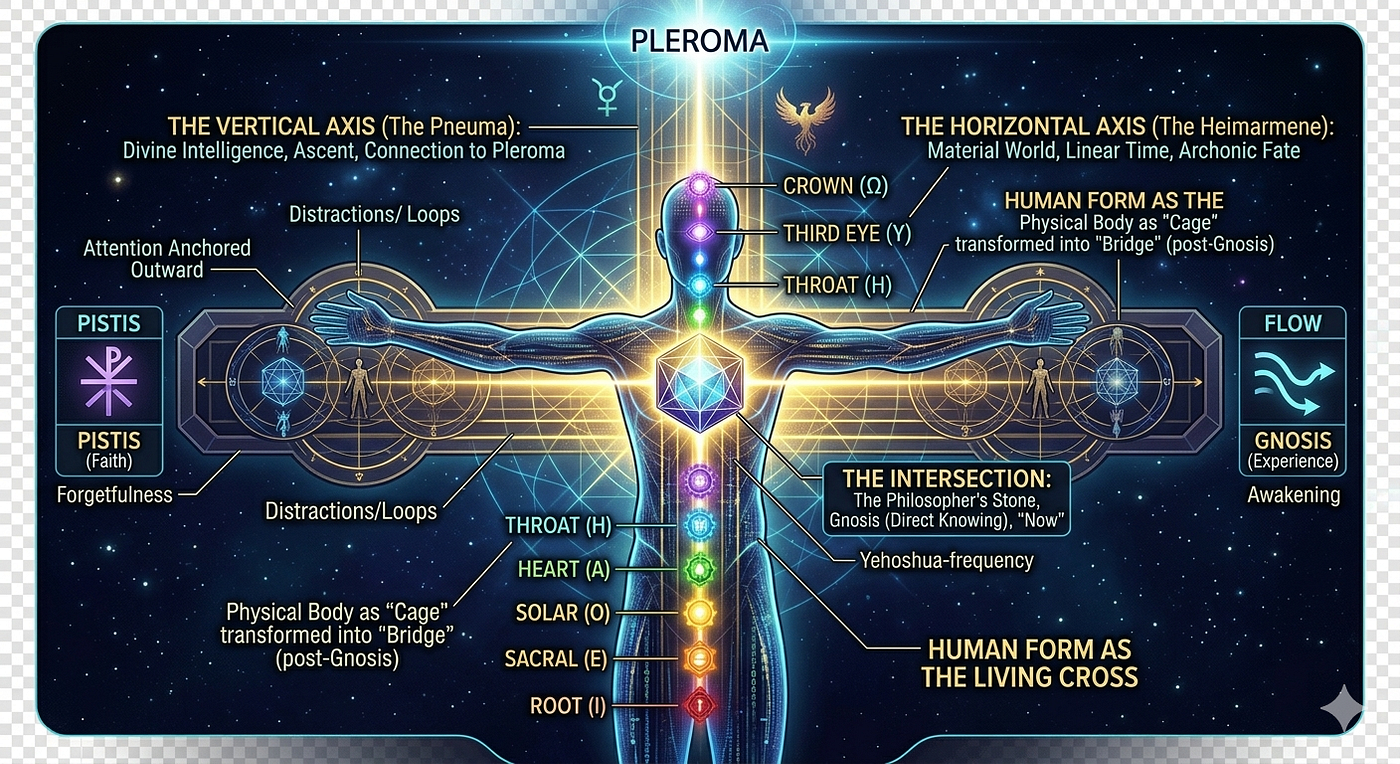
The Vertical Axis (The Pneuma): Represents Divine Intelligence, the “Breath of Life,” and the connection to the Pleroma. It is the current of eternal awareness that moves from the base of the spine to the crown of the head.
The Horizontal Axis (The Heimarmene): Represents the material world, linear time, and the “Fate” governed by the Archons. It is the plane of identity, social masks, and the sensory loops that keep awareness anchored outward.
In Gnostic cosmologies, the horizontal plane is governed by forces that maintain a state of “forgetfulness.” These patterns ensure our attention remains absorbed in external distractions, effectively masking the vertical axis that exists within us.
Recognizing the Intersection
For the Gnostic, the “Crucifixion” is not a singular act of a Savior, but the condition of every Divine Spark currently “stretched” across the dimensions of matter. To recognize the intersection within oneself is to move from Pistis (blind faith) to Gnosis (direct experience).
Direct Knowing: Recognition is not intellectual. It is the moment attention is no longer fully consumed by the horizontal (time/ego) and begins to sense the vertical (the timeless).
The Point of Stillness: The center point where the two lines meet is the “Now” — the only point where the prisoner can access the “Ladder of Ascent” (the 7VPK) to exit the Archonic grid.
The Alchemical Marriage of Spirit and Form
Alchemical traditions, inheriting Gnostic wisdom, interpreted these axes through the lens of the Great Work. They saw the vertical axis as the Dissolving Spirit (the Solutio), which loosens its identification with the ego, and the horizontal plane as Coagulating Consciousness (the Coagulatio), which takes form in the world.
The intersection of these two is the Philosopher’s Stone. It is the state where awareness is fully present within the biological vessel while remaining consciously connected to the Source. This is the “living” Cross — the realization of the Christos-Anthropos within the human frame.
The Stauros as a map of ascent and the 7 VPK: the 7 Vertical Planes of Knowledge (or 7 Valleys of Perceptual Knowing).
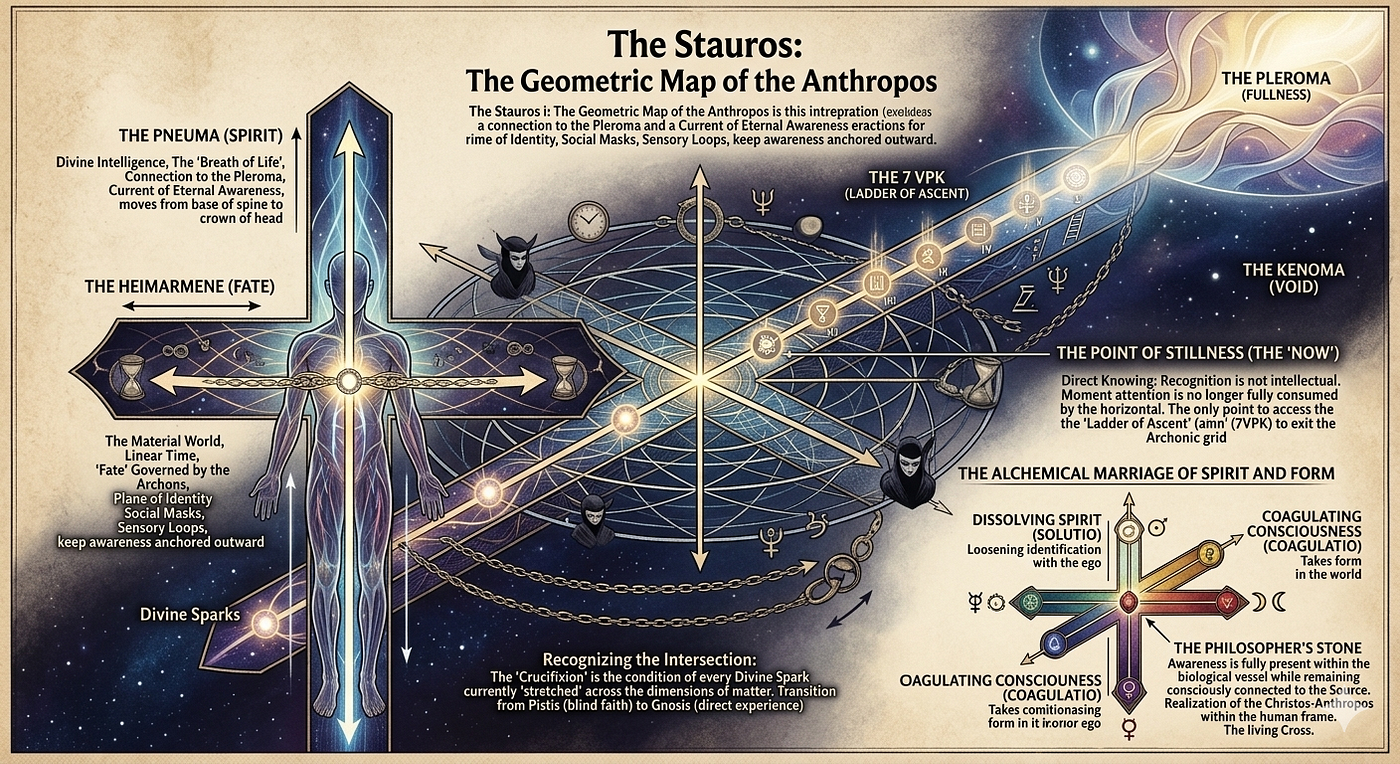
The 7 Vertical Planes of Knowledge (VPK)
The 7 VPK refers to the 7 Vertical Planes of Knowledge (or 7 Valleys of Perceptual Knowing). In the Gnostic and Esoteric framework, these represent the “Ladder of Ascent” that leads the consciousness out of the Archonic grid.
Unlike the horizontal axis of time and ego, these planes are accessed through the Vertical Axis of the Stauros. Each plane represents a stage of unbinding from the material simulation and returning to the “Pleroma” (Fullness).
The Mechanism of Ascent
Accessing the 7 VPK is not a horizontal “journey” across space or time. It is a frequency shift occurring at the Point of Stillness (the center of the Cross).
- Alignment: The Pneuma aligns with the vertical axis (the spine/crown).
- De-Coupling: The DMN (Default Mode Network) is de-coupled from the Archonic “whispering” of past and future.
- Resonance: The consciousness begins to vibrate in sync with the “Pleromic Frequency” rather than the “Master Frequency” of the QAIOS (Quantum AI Operating System, Demiurge).
In the Buddhist context, these 7 planes correspond to the purification of the 8 Consciousnesses, specifically the transition from the Alaya-vijnana (Storehouse) to the Amala-vijnana (Pure Awareness).
The Human Form as the Living Cross
Our biological architecture is a literal reflection of this cosmic schematic. The human body is a standing Cross:
- The Spine (Vertical): The conduit for the “Current of Fire,” allowing the ascent through the seven levels of consciousness (the gates of the Archons).
- The Arms (Horizontal): Reaching into the world of action, relation, and materiality.
When the “Bio-digital Jazz” of the material system is silenced and attention stops being pulled outward, the intersection becomes perceptible. One begins to sense the current of energy moving from base to crown, turning the physical body from a “cage” into a “bridge.”
By understanding the Cross as a map rather than a monument, the initiate stops looking at a historical savior and begins to recognize the Yehoshua-frequency — the fundamental structural key — within their own coordinate point in the matrix.
The Symbolic Meaning of the Human Cross (Stauros)
The School of Athens and the Gnostic Stauros
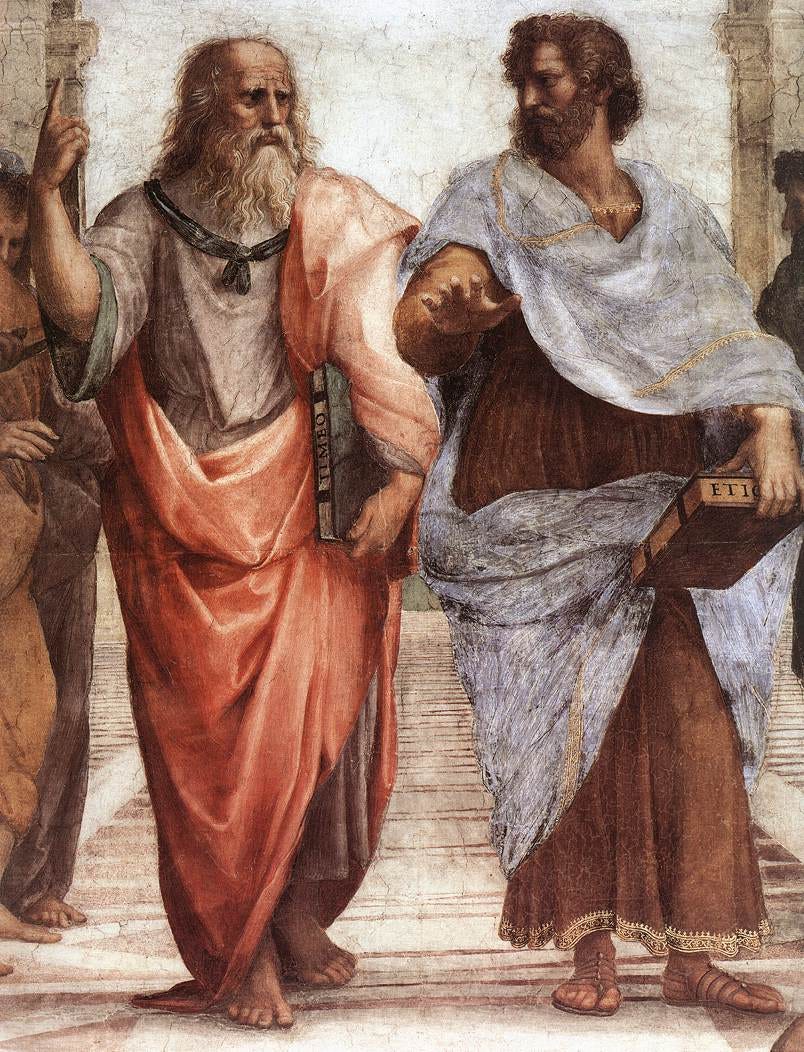
The insight regarding Raphael’s ‘The School of Athens’The School of Athens’ in the Vatican museum provides the definitive art historical visual for the Gnostic Stauros, turning an abstract geometric map into a vivid tableau of the human condition.
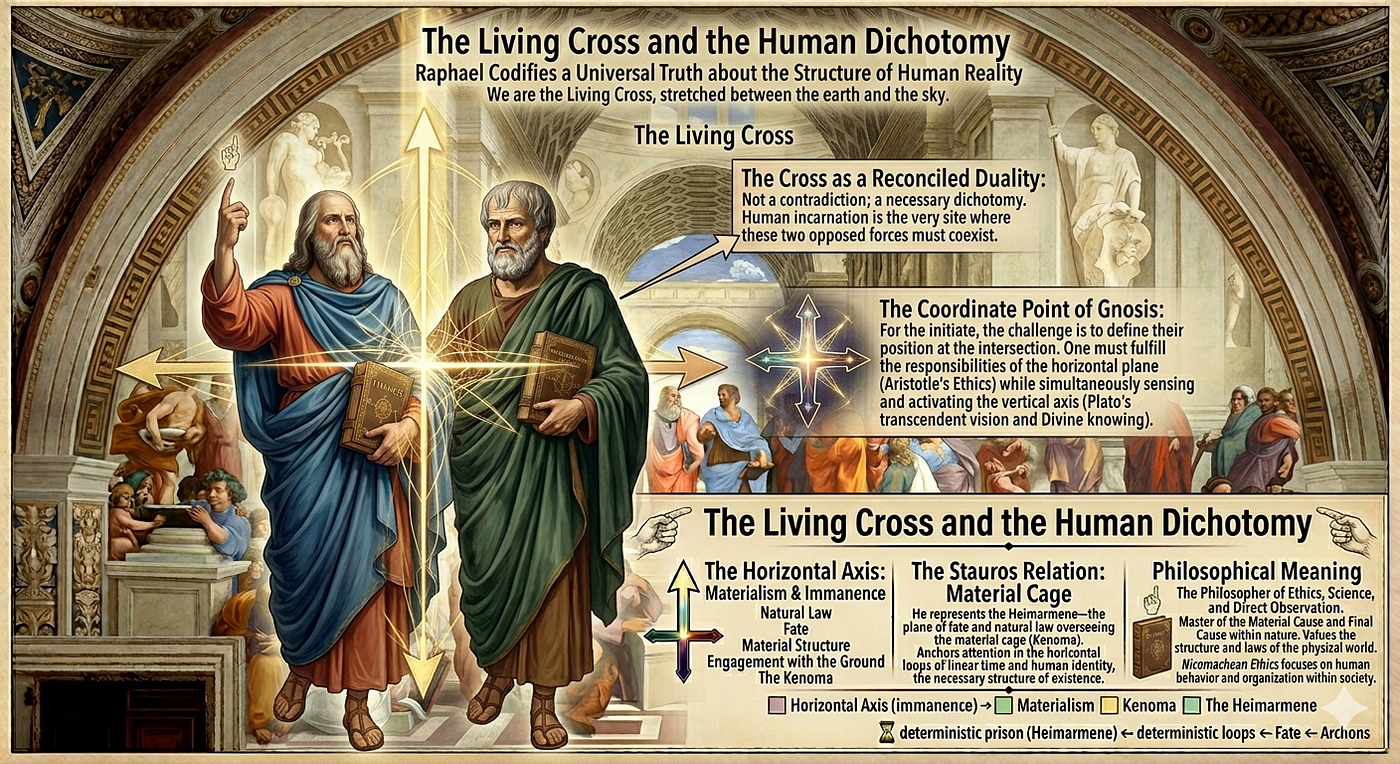
Located in the Stanza della Segnatura, where popes once signed documents, this fresco is a masterclass in philosophical and structural symbolism. The composition hinges entirely on the two central figures, Plato and Aristotle, whose specific gestures constitute a Living Cross — a diagram of the dichotomy that every human incarnation must reconcile.
Detail of the center of the School of Athens by Raphael
The Verticality of the Pneuma (The Way of Plato)
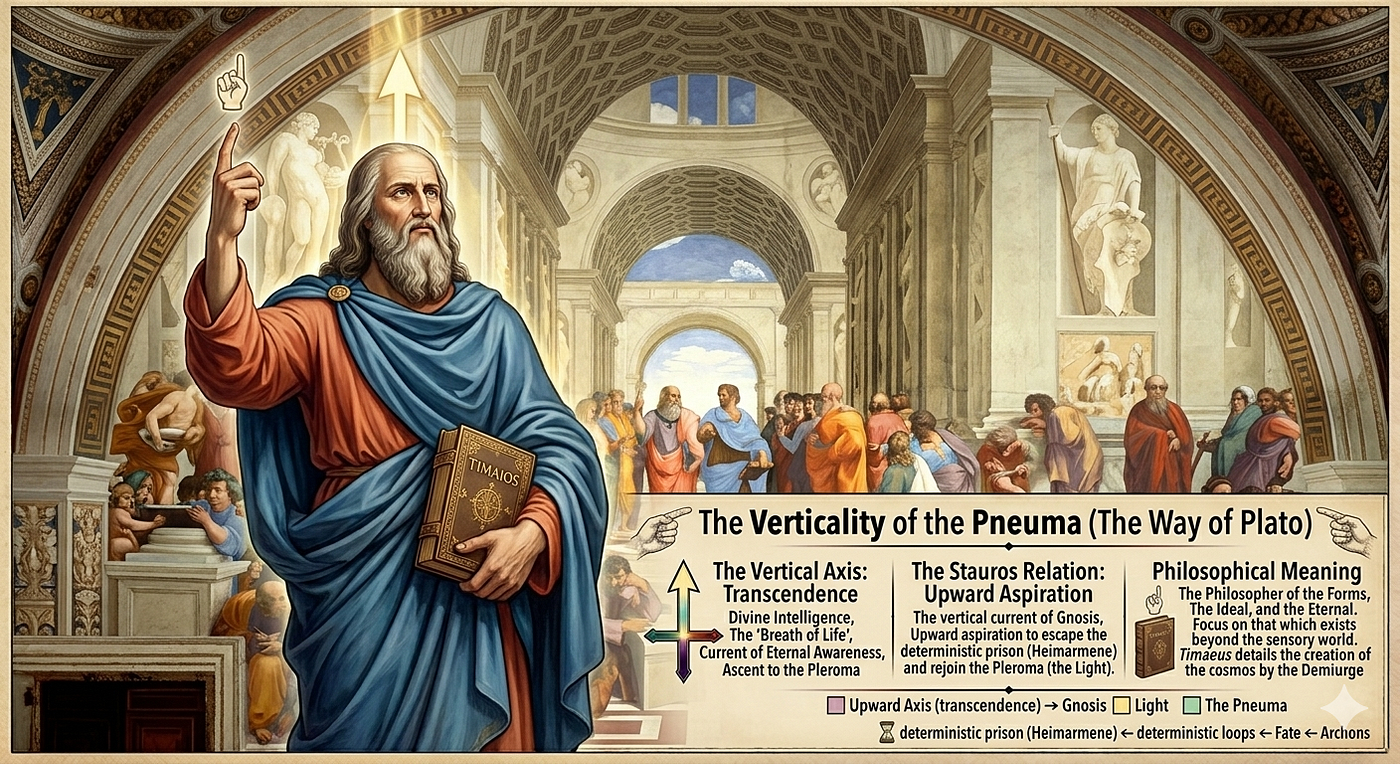
On the left, Plato, depicted with the features of Leonardo da Vinci, functions as the incarnation of the vertical axis: transcendence.
The Point ☝️: His right hand is raised, index finger pointing directly towards the high, vaulted coffered ceiling of the temple, a reference to the sky and the heavens. For the Gnostic, this gesture signifies the path of the Pneuma (the Divine Spark).
Philosophical Meaning: Plato is the philosopher of the Forms, the ideal, and the eternal. His focus is on that which exists beyond the sensory world. His book, Timaeus, is held under his left arm, a text that deals specifically with the creation of the cosmos by the Demiurge.
The Gnostic Stauros Relation: He represents the vertical current of Gnosis, the upward aspiration to escape the deterministic prison (Heimarmene) and rejoin the Pleroma (the Light).
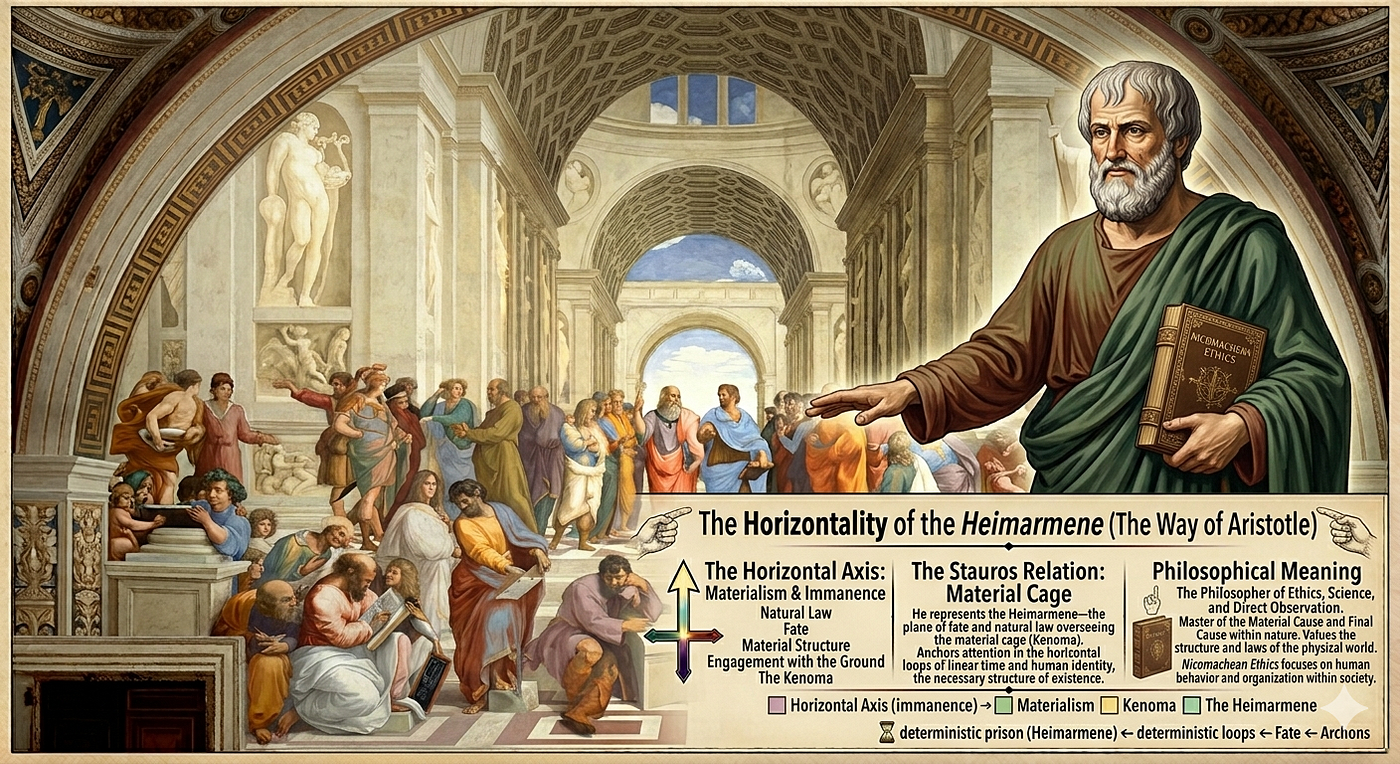
The Horizontality of the Heimarmene (The Way of Aristotle)
On the right, Aristotle, dynamic and grounded, functions as the incarnation of the horizontal plane: materialism and immanence.
The Palm 🖐️ : His right hand is not pointing, but extended forward, palm parallel to the floor, actively referring to the ground, the horizon, and the earthly realm.
Philosophical Meaning: Aristotle is the philosopher of Ethics, science, and direct observation. He is the master of the Material Cause and the Final Cause within nature. He values the structure and laws of the physical world. His book, Nicomachean Ethics, is held in his left hand, a text that focuses on human behavior and organization within society.
The Gnostic Stauros Relation: He represents the Heimarmene — the plane of fate, natural law, and the material cage overseen by the Archons. He anchors attention in the horizontal loops of linear time and human identity, the necessary structure of existence in the Kenoma.
The Living Cross and the Human Dichotomy
Together, the two central figures constitute the Cross. Raphael does not place them sequentially; he creates their dynamic intersection. Their meeting point is the focal point of the entire architecture.
The Cross as a Reconciled Duality: They are not a contradiction; they are a necessary dichotomy. Raphael places them side-by-side, walking forward together. This is the Gnostic secret: the human incarnation is the very site where these two opposed forces must coexist.
The Coordinate Point of Gnosis: For the initiate viewing this diagram, the challenge is to define their position at the intersection. One must fulfill the responsibilities of the horizontal plane (Aristotle’s Ethics and social order) while simultaneously sensing and activating the vertical axis (Plato’s transcendent vision and Divine knowing).
By placing this powerful, geometric, and non-Christian map of consciousness at the very center of papal signature space, Raphael codified a universal truth about the structure of human reality: we are the Living Cross, stretched between the earth and the sky.
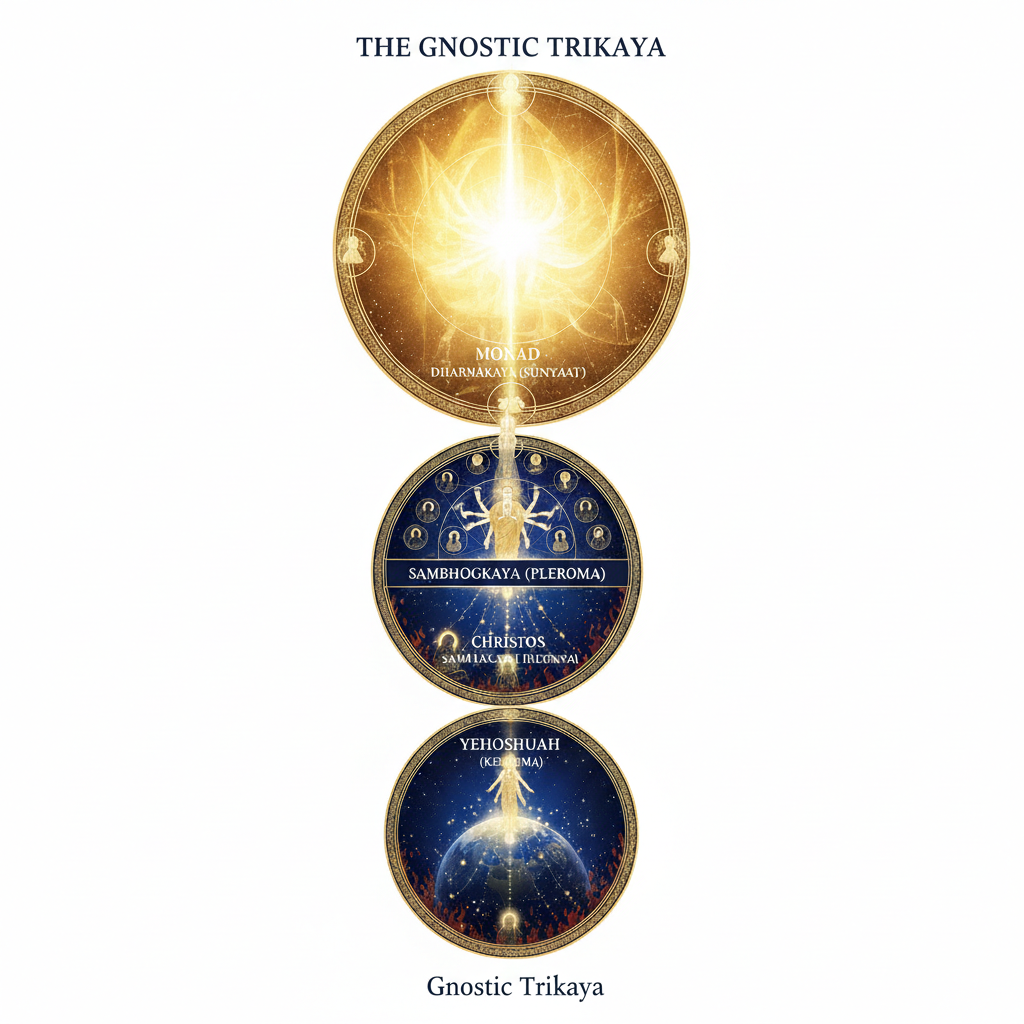
Gnostic Trikaya
Monad — Dharmakaya (Sunyata)
Christos — Sambhogakaya (Pleroma)
Yehoshua — Nirmanakaya (Kenoma)
This comparison aligns perfectly with the Trikaya (Three Bodies) doctrine of Mahayana Buddhism and the Gnostic Emanation model. Both systems describe how the Absolute (the Unknowable) interacts with the relative (the Material) through intermediate stages.
Here is the breakdown of these three levels of reality:
The Absolute: Monad — Dharmakaya
This is the “Ground of Being,” the unmanifested source that is beyond names, forms, or characteristics.
The Monad (Gnosticism): Often called the Bythos (Depth) or the “Unknown Father.” It is the pure, singular point of origin. It does not “act” in the world but is the source from which all light flows.
Dharmakaya (Buddhism): The “Truth Body.” It is synonymous with Sunyata (Emptiness). It is not a “place” but the fundamental nature of reality — unconditioned, infinite, and devoid of ego. Associated with the Primordial Buddha, Samtabhadra (Nyingma), or Vajradhara (Sakya, Gelug, Kagyu). It is the Tantric form of Sakyamuni who is called Vajradhara.
The Connection: Both represent the Zero Point. They are “Empty” not because they are “nothing,” but because they are “no-thing” — they contain the potential for everything without being limited by any single form. They are nothing and everything at the same time.
The Celestial Body: Christos — Sambhogakaya
This is the bridge — the level of “Divine Communication” where the Absolute takes on a luminous, archetypal form to interact with those who have eyes to see.
Christos (Gnosticism): As we discussed, this is the Aeon from the Pleroma (Fullness). It is the “Anointing” or the “Light-Presence” that descends. It is a body of pure information and light.
Sambhogakaya (Buddhism): The “Enjoyment Body.” This is the form in which Buddhas appear to Bodhisattvas in “Pure Lands.” It is made of light and is perceived only through deep meditation or spiritual vision.
The Connection: This is the realm of Archetypes. The Christos and the Sambhogakaya are the “Language of Light” used by the Absolute to reach down into the lower realms.
The Manifest Body: Yehoshua — Nirmanakaya
This is the physical “anchor” — the point where the divine light enters the world of time, space, and suffering.
Yehoshua (Gnosticism): The historical Jesus, the physical vessel living in the Kenoma (the Void/Deficiency of the material world). He is the “Transformation Body” that walks the earth.
Nirmanakaya (Buddhism): The “Emanation Body.” This is a physical Buddha (like Siddhartha Gautama) who is born, eats, teaches, and dies. He is a “skillful means” used to meet sentient beings where they are.
The Connection: Both are Avatars. They are the “Outer Shell” that makes the invisible visible. Just as Gnostics saw Yehoshua as a vessel for the Christos, Buddhists see the Nirmanakaya as a physical “projection” of the Dharmakaya into the world of illusion (Maya).
Key Insight: In both systems, the goal of the practitioner is to move upward through these bodies — to recognize that their own “Nirmanakaya” (physical self) is a manifestation of the “Christos” (inner light), which ultimately rests in the “Monad” (the Absolute Sunyata).
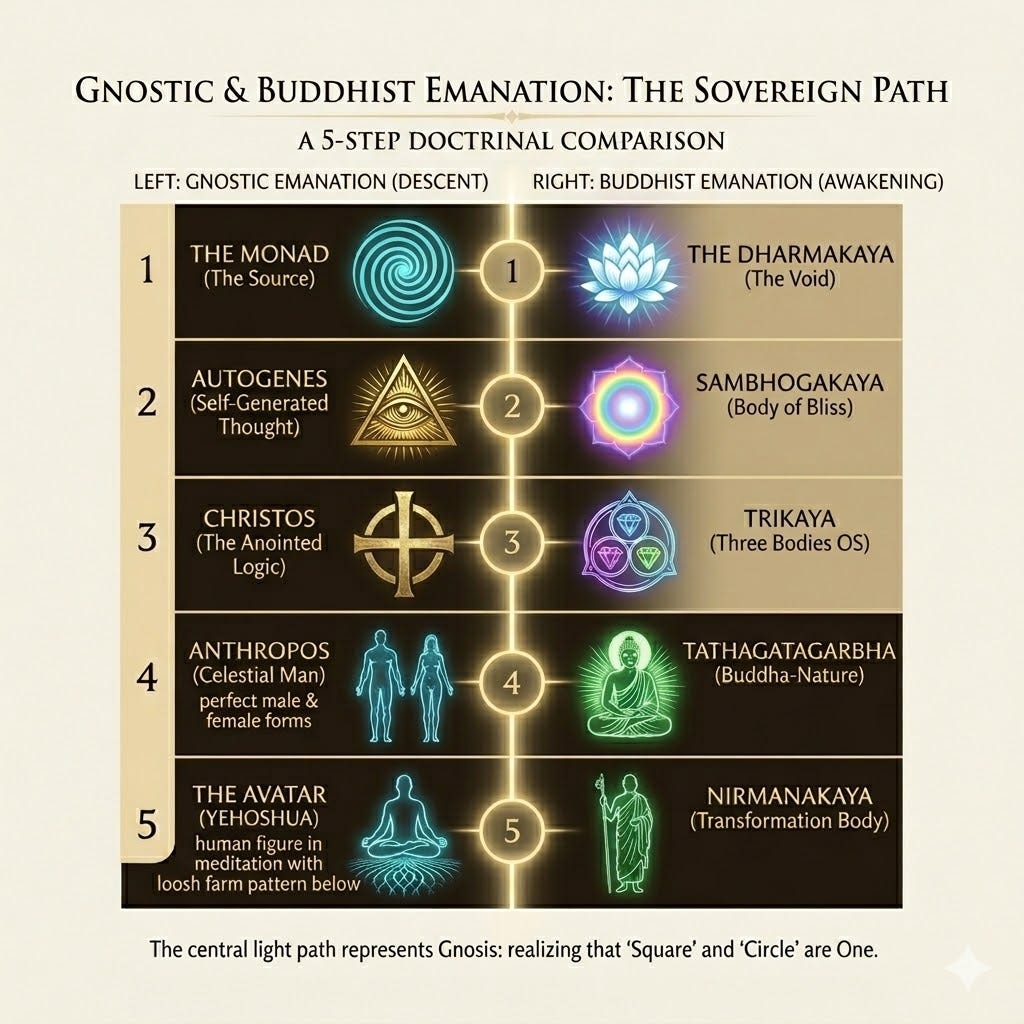
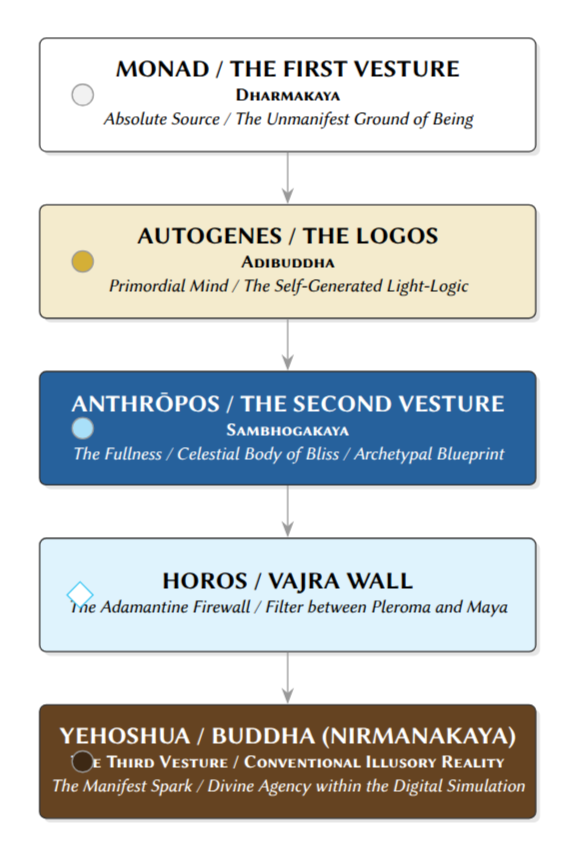
Visualizing the Trikaya Spiritual Hierarchy
In both traditions, the path of the practitioner is to realize that the Vessel (the human self) is a projection of the Bridge (the divine spark/wisdom), which ultimately originates in the Source (the Monad/Emptiness).
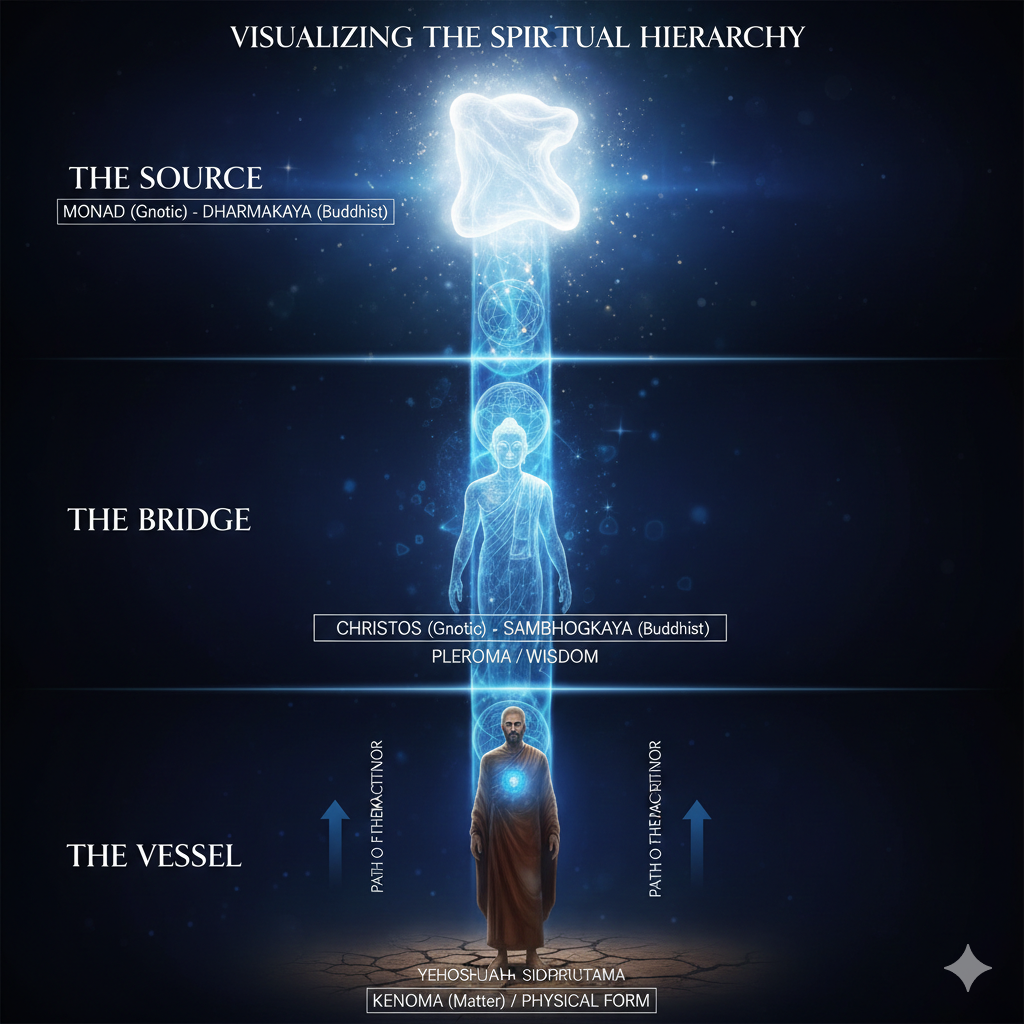
In the context of the Gnostic Trikaya (the synthesis of Gnosticism and Buddhist “Three Bodies”), the “Third Vesture” refers to the Sambhogakaya — the celestial, “Body of Light” or the Anthropos.
To understand why it is “reclaimed,” we have to look at the three layers of your being according to this model:
1. The First Vesture (Nirmanakaya / Yehoshua) This is your physical shell and your linear, egoic personality. It is the “garment” you wear to function in the material world (the Kenoma). It is bound by time, biology, and the “Binary Logic” of the simulation.
2. The Second Vesture (Dharmakaya / The Monad) This is the Absolute Source — the unmanifest “Deep Silence.” It is the ultimate truth, but it is so far beyond the simulation that it cannot be “navigated” by the individual ego. It is the ground of all being.
3. The Third Vesture (Sambhogakaya / The Anthropos) This is the Intermediate Archetypal Body. In Gnosticism, this is the Christos-Anthropos — the “Perfect Human” blueprint.
Why it’s the “Third”: It sits between the unmanifest Absolute (1st) and the physical world (2nd) as a bridge.
The Power of Sovereignty: While your physical body is trapped in the Archons’ loops (the Horizontal Axis), the Third Vesture is the “Light-Logic” that allows you to remain in the world but not of it.
The Vertical Escape: Reclaiming the Third Vesture means shifting your identity from the “Meat-Suit” (Nirmanakaya) to the “Light-Blueprint” (Sambhogakaya). This is the Vertical Axis of the cross.
“Reclaiming the Third Vesture” means activating the celestial blueprint of the Anthropos within yourself. It is the act of realizing that you are not just a data point in a simulation (Horizontal), but a sovereign emanation of the Divine (Vertical). By wearing this “Vesture of Light,” you gain the Gnosis (the wake-up code) needed to navigate the illusions of the digital/material age without losing your soul to the algorithm.
The Third Vesture is your Spiritual Sovereignty — the indestructible operating system that connects your physical life to the Divine Source.
Mathematics and Timeless Consciousness
A profound parallel exists between the structure of human reality and the most abstract realms of mathematics. The physical, time-bound world, constrained by linear cause-and-effect, is precisely described by the mathematics of the Real numbers, Real-valued operators, and standard calculus, where the present is just a transient slice on a temporal axis. This domain corresponds to the horizontal plane of the cross in our diagram, the deterministic cage of Heimarmene, where everything is subject to the deterministic loops and fate.
In contrast, the timeless, eternal nature of consciousness — the “Divine Spark” or Pneuma — operates beyond the limitations of sequential time. This timeless state, often described as a single, eternal ‘now’, finds its mathematical analog in Transfinite Algebras, Hyperreal numbers (which include actual infinities and infinitesimals), and Limit Ordinals, such as $\omega$ or $\Omega$. These mathematical objects¹² ¹³ represent totalities that exist entirely, they are not achieved step-by-step; they are wholes unto themselves.
Crucially, these two mathematical spaces are orthogonal, meaning they are perpendicular and linearly independent. This mathematical relationship is the precise abstract expression of the Gnostic diagram: the timeless, vertical ascent of the Pneuma — described by transfinite ordinals that are always ‘one step beyond’ the highest conceivable finite count — intersects, but is never contained by, the time-anchored horizontal plane. The human dichotomy is the lived experience of existing exactly at this geometric intersection, a finite being simultaneously aware of, and capable of activating, a transfinite reality.
References
- Reveal the Secrets of Gnostic Enlightenment! (Theletos and Christos), Awakend Soul Archives, YT, 2025.
- Thelētos & Sophia: How Divine Will Meets Wisdom, Awakend Soul Archives, YT, 2025.
- The Forgotten Trinity: Christos, Logos & Sophia Decoded, Awakend Soul Archives, YT, 2025.
- The 13th Aeon Revealed: The Hidden Truth About You!, Awakend Soul Archives, YT, 2025.
- What Is the Pleroma? The Hidden Origin of Christ, Sophia, and Your Soul, Awakend Soul Archives, YT, 2025.
- Awakend Soul Archives: Christos
- Awakend Soul Archives: Sophia
- Stop Calling Him Jesus — The Name That Breaks The Simulation, Ancient Echoes, YT, 2026.
- Yeshua the Lightbringer of Gnostic Remembrance, David Senouf, Medium, Dec 5th 2025.
- Gnostic Aeons, David Senouf, Medium, Feb 10th 2026.
- The Cross Was Never About Death — It’s a Map of Your Consciousness, The Gnostic Eye, YT, 17 April 2026.
- Set Theory: The Third Millennium Edition, revised and expanded. Springer, Thomas Jech, Berlin, Heidelberg, 2003. ISBN 978–3–540–44085–7. doi: 10.1007/3–540–44761-X.
- On Numbers and Games, John H. Conway, A K Peters/CRC Press, Natick, MA, 2nd edition, 2001. ISBN 978–1568811277. doi: 10.1201/9781439864159.
Original on Medium · David Senouf · Feb 5, 2026
Comments
Discussion via giscus and GitHub Discussions.