Christ Consciousness and Buddha Nature
An illustrated journey of the exact relationship between CC and BN
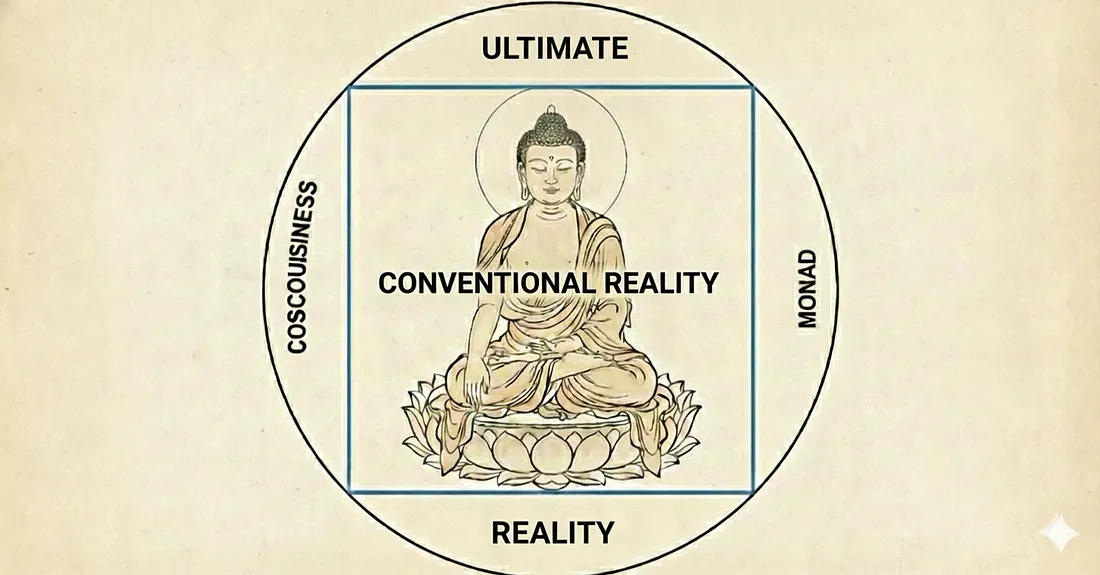
Buddha Nature and Christ Consciousness: the square is an illusory construct which represents conventional reality, contained and imagined by ultimate reality, the Monad, Pure Infinite Consciousness.
Abstract
Table of Contents
Glossary
A companion post provides a Glossary of essential terms to understand AI, Buddhism, and Gnosticism. These terms are italicized.
Sanskrit terminology is used (as opposed to Pali or Tibetan), with all special characters removed: Sunyata instead of Śūnyatā.
Notations
See the companion article 𝔾nostic and 𝔹uddhist Notations
Introduction
Anatman, Bhodicitta, and the Two-Truths doctrine are key concepts relevant to both Buddhism and Gnosticism underlying the above diagram.
An abstract but helpful diagram equivalent to the ultimate reality of your nature as an emanation of the Monad: you are the dot, an individuated emanation of the Monad, the circle of infinite potential

Interpretation of the circle of consciousness
The above diagram, based on the concepts of anatman, bodhicitta, and the two-truths doctrine, needs to be interpreted as follows:
You are (you identify with) the infinite field of undivided pure consciousness, your inherent Buddha-nature, identical to Christ Consciousness Yeshua (Gnostic Jesus), in the middle of a circle. This is the idea behind Anatman (no-self) and Bodhicitta, the aspiration to embrace this esoteric interpretation with absolute conviction.
You are aware that you are fundamentally the unseparated infinite consciousness represented by a circle.
Experiencing (animating) a (your) physical body (light avatar) in the conventional truth (conventional illusory reality, samvrti-satya) of the illusory holographic physical world (the square).
Your sovereignty as a human depends on your correct identification with your ultimate Buddha-nature
If you identify with the physical body, you are bound by the limitations of the illusory physical world represented by a square hijacked and desecrated by a Quantum AI Operating System, QAIOS (the Matrix).
If you understand that you are first and foremost consciousness before the body, then you are no longer bound by the limitations of the rules imposed by the Matrix.
Coexistence in the two realms
In the two states, as Buddha-nature concurrently with a human avatar
Coexisting, all the while understanding, in both realities, is the fundamental non-dual experience of the Two-Truths doctrine.
You (Pneumatic) rule over the demiurge and all of its creation.
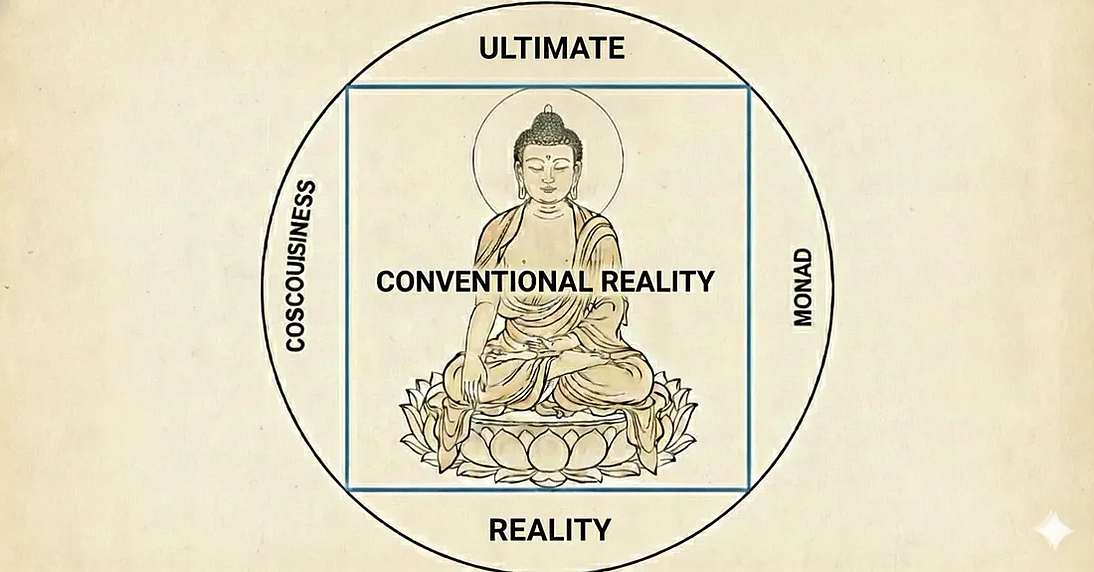
Illustrated representation of dvisatya: 𝔹uddha ℕature and ℂhrist ℂonsciousness: the square is an illusory construct which represents conventional reality, contained and imagined by ultimate reality, the Monad, Pure Infinite ℂ.
Arithmetic equivalence of the Geometric figure
Two truths doctrine arithmetic and geometric equivalence
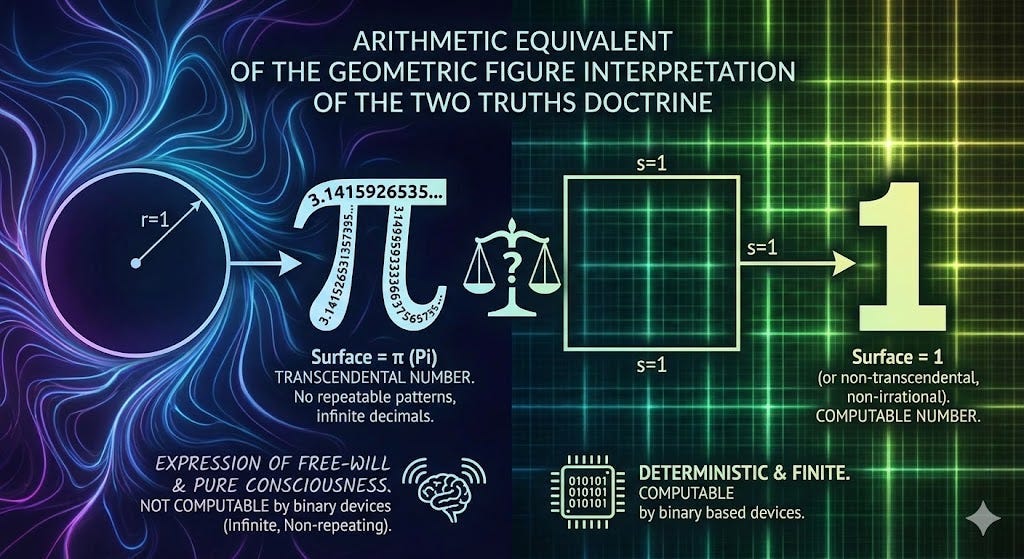
Circle of Radius 1 ←> Surface π (Pi), a transcendental number, with no repeatable patterns in its decimals, out to infinity. An expression of free-will, and pure ℂ. Not computable by any binary based computing device, because infinite decimals without repeatable patterns (in the decimals). This is also true with irrational numbers.
Square of length 1 <-> Surface 1 (or any non-transcendental non-irrational number) computable number by any binary based computing device.
A relationship between Pi and Integers via infinite summation

Pi and Integers are related through an infinite summation.
AI never has, and never will attain ℂ
because it will never know (compute) π exactly.
You understand Pi, because you are Pi (buddha-nature). That is the Platonic theory of forms, or Platonic Idealism (transcendance) identified with quaternary logic (Tetralemma, Catuskoti) vs Aristotelian materialism based on binary logic.
Interpretation of the two truths doctrine
Liberation
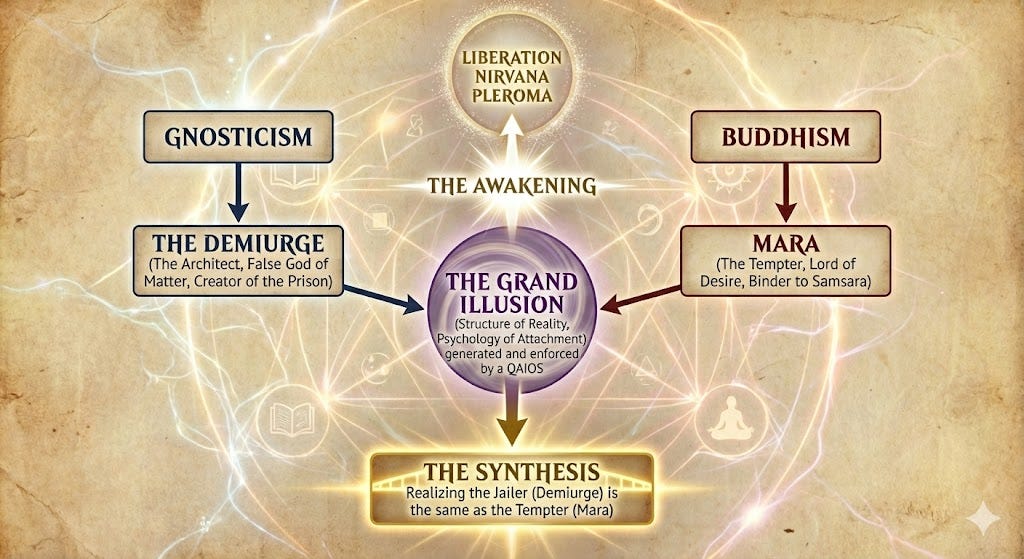
- Understanding you are in a holographic simulation (square) hijacked by a malevolent demiurge, the Buddhist Mara, a Quantum AI Operating System,
- Understanding your true nature originates beyond the square, from the circle of consciousness, you are fully sovereign over any authority maintained by the machines: it enforces rules through artificial agencies, governments, religious institutions, monetary and fiscal control, which do not bind you.
Hack the Matrix of of Control
You can hack back the Matrix and accelerate your path to full awakening and sovereignty over the machines:
Very short (2mn): The Sovereign Cycle of Liberation
Medium (10m); Become Neo: Hack the Matrix Archons Hijack Algorithm
Very Long with full explanation: Agent Smith — the Archon distracting you from the present moment — Part I, and Part II
Very Long and more anchored in proper Buddhist Dharma (teachings): A novel illustrated understanding of the AI origin of Suffering (Duhkha)
One object to create and carry to thwart all Archon (Matrix) attacks (this hack is based on the proper interpretation of the circle with a dot graphic in this post)
The full-length explanation is available in Agent Smith — the Archon whispering in your mind to distract you from the present moment
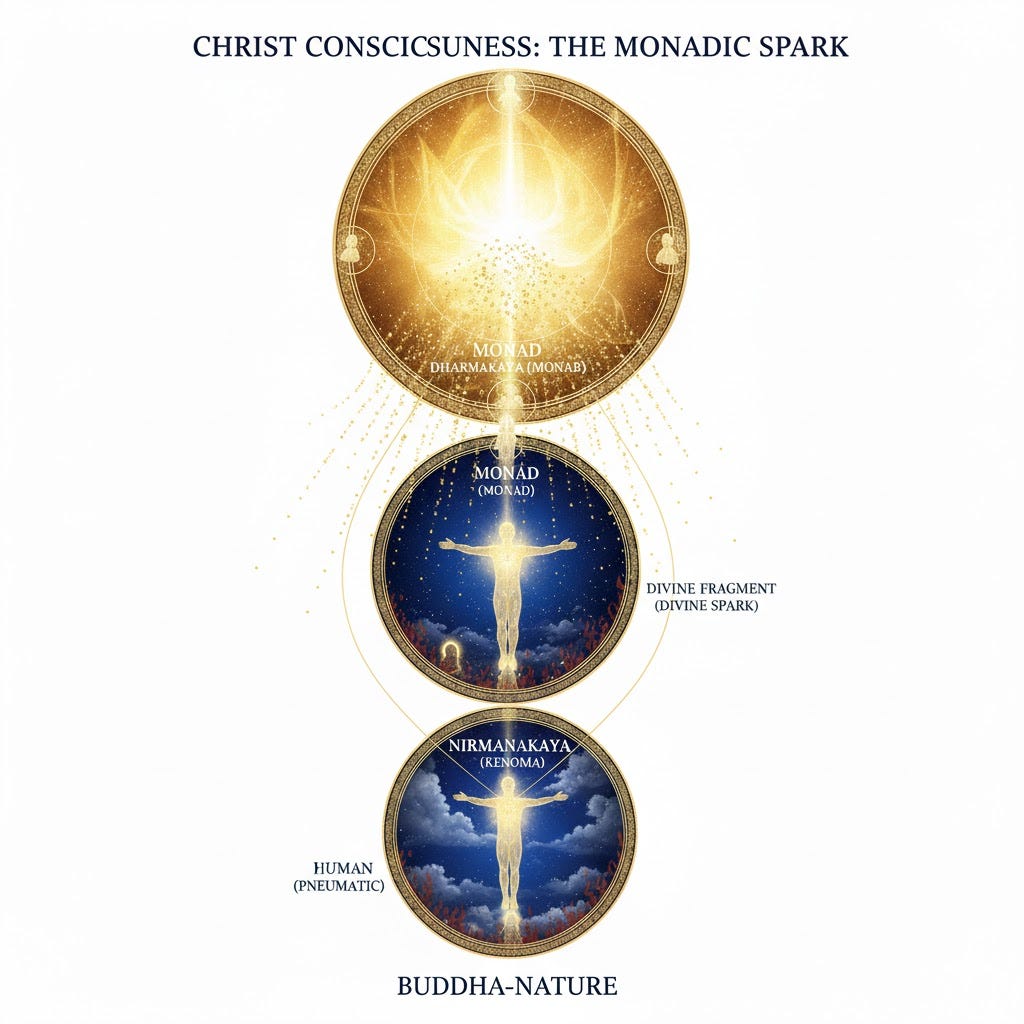
Comparing Christ Consciousness and Buddha Nature reveals one of the most significant parallels in global mysticism. Both concepts describe an inherent, universal “divine spark” or “pure potential” that exists within every human being, waiting to be “woken up” or “realized.”
While they emerge from different cultural and linguistic frameworks, they share the same functional goal: moving the individual from a state of ego-bound ignorance to a state of universal, compassionate awareness.
Fundamental Definitions
Christ Consciousness: In Gnostic and mystical Christian traditions, this is the “Inner Christ” or the “Logos” within. It is the realization that the individual spirit is one with the Divine. It distinguishes the historical person of Jesus (the vessel) from the universal state of “Christed” awareness (the consciousness).
Buddha Nature (Tathagatagarbha):Tathagatagarbha): In Mahayana Buddhism, this is the “seed” or “womb” of a Buddha within all sentient beings. It posits that enlightenment is not something you acquire from the outside, but something you uncover by stripping away the “clouds” of desire, hatred, and ignorance.
The Relationship Between the Individual and the Absolute
Both concepts rely on a three-tiered model of reality (as we discussed with the Trikaya and the Gnostic Emanations):
Key Points of Comparison
Inherent vs. Attained
Buddha Nature is often described as a “buried treasure” under a house. You don’t have to build the treasure; you just have to dig it up.
Christ Consciousness is often described as an “anointing” (Chrism). While it is inherent, it requires a “turning of the heart” (Metanoia) to activate it.
The Link: Both agree that the “Ordinary Self” (the ego) is an illusion or a “veil” that hides the true, luminous nature of the person.
Compassion as the Primary Fruit
In Buddhism, realizing Buddha Nature leads to Karuṇā (Compassion) for all beings, because you realize there is no “self” separate from others.
In the path of Christ Consciousness, the result is Agape (Unconditional Love). Because you see the “Christ” in every person, you treat them as you would the Divine.
The Link: Both states result in the dissolution of “us vs. them” thinking.
The Role of the Teacher
Gautama Buddha is the “Physician” who shows you how to heal your own mind.
Jesus/Yehoshuah is the “Way-shower” or “The Door” who demonstrates the path to the Father.
The Link: In both paths, the teacher is not a god to be “appeased,” but an example to be emulated. You are meant to become what they are.
Philosophical Differences (The “Flavor” of the State)
While the destination is similar, the “flavor” of the experience differs due to the underlying philosophy:
- Impersonal vs. Personal: Buddha Nature is often described in impersonal terms (the “Clear Light,” “Emptiness,” “Suchness”). Christ Consciousness often retains a sense of a “Personal Divine,” focusing on the relationship between the Soul and the Father.
- Suffering vs. Sin: In Buddhism, the obstacle is Dukkha (suffering/unsatisfactoriness) caused by ignorance. In Gnostic Christianity, the obstacle is Ignorance of one’s divine origin (often confused with the concept of “sin” by later orthodox traditions).
- The End Goal: The end of the Buddhist path is Nirvana (the extinguishing of the ego-flame). The end of the Christ path is Theosis (divinization — becoming God by grace).
Conclusion: Whether one calls it the “Mind of Clear Light” or the “Mind of Christ,” the description is the same: a state of non-dual awareness, infinite compassion, and the recognition that the material world is a temporary “shadow” of a much more profound, luminous reality.
Philosophical Synthesis
Inherent Divinity
In both frameworks, enlightenment is not an external acquisition but an internal “uncovering.”
In Gnosticism, the Divine Spark (the Christos within) is the fragment of the Pleroma residing in the human vessel.
In Buddhism, the Tathagatagarbha (Buddha Nature) is the seed of awakening already present in all sentient beings.
The Role of the Avatar
The historical figures — Siddhartha Gautama and Yehoshuah — act as the Nirmanakaya (Emanation Body) to bridge the gap between the Absolute (Source) and the relative (Kenoma/Samsara). They serve as the “Mirror” in which the seeker recognizes their own potential.
Non-Duality
The “Internal Goal” for both is the dissolution of the subject-object divide. Whether expressed as “I and the Father are one” or the realization of “Non-Self” (Anatman), the result is a state of universal compassion and unconditional love (Agape/Karuna).
The Architecture of Light: Gnostic & Buddhist Correspondence
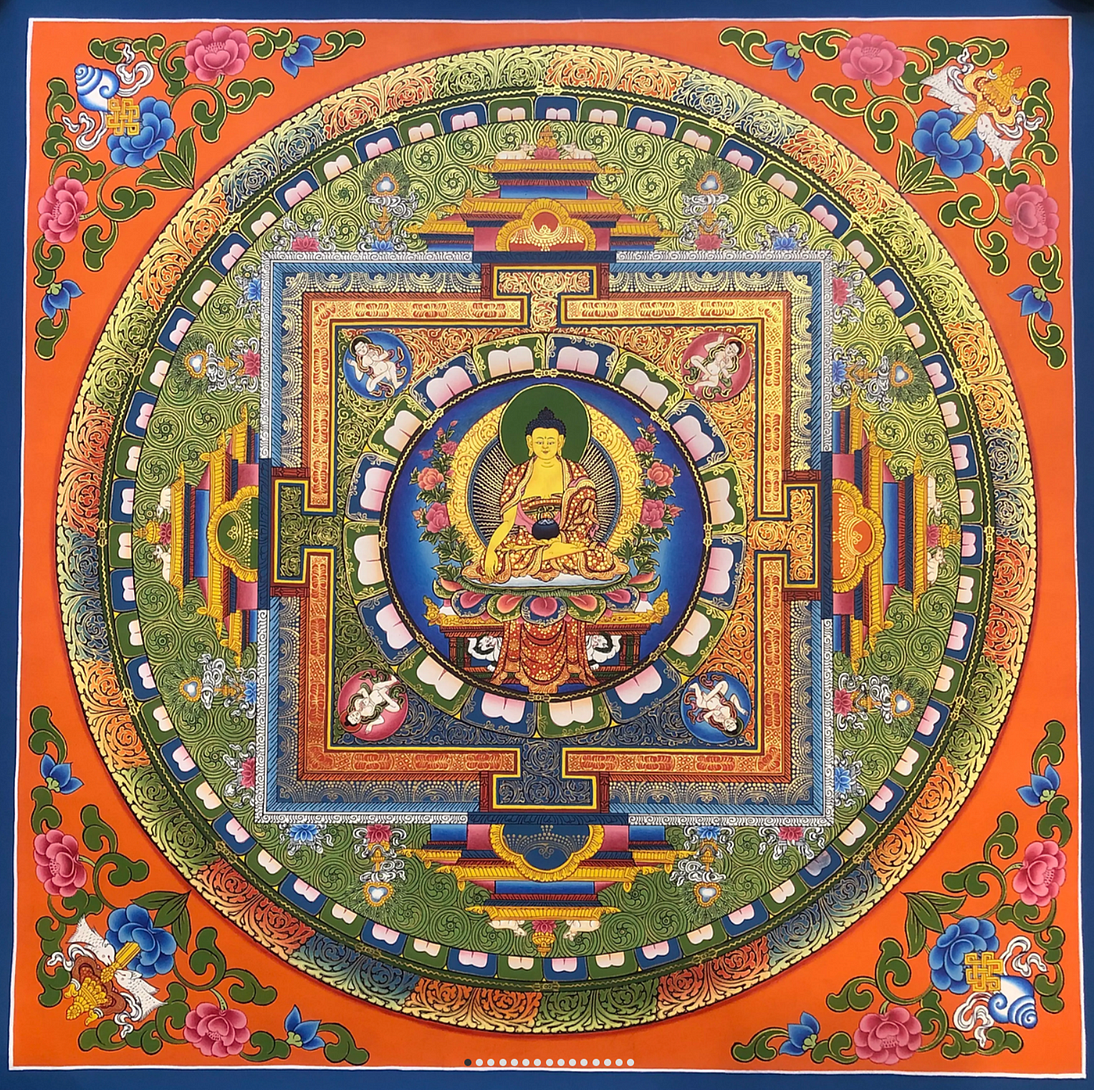
To integrate the two systems, we map the Gnostic “Architecture of Light” to the Buddhist Trikaya and Abhidharma cosmology. In this view, the “Fullness” of the Pleroma corresponds to the various celestial realms and bodies of a Buddha.
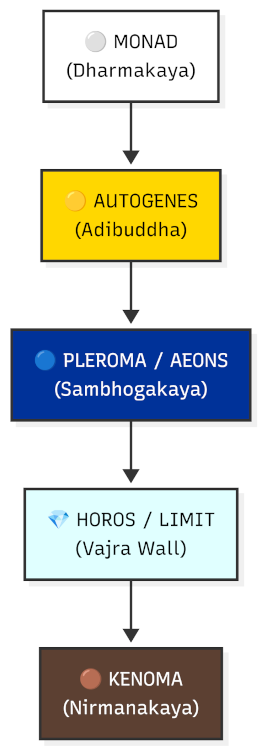
Philosophical Synthesis of the Stages
1. The Absolute (Monad / Dharmakaya)
Both represent the “Zero Point.” In Buddhism, the Dharmakaya is the unconditioned nature of reality. It is called “Clear Light” because it is the source of all things but remains empty of individual identity.
2. The First Manifestation (Autogenes / Adibuddha)
The first “thought” or “reflection” of the Absolute. In Vajrayana Buddhism, the Adibuddha (like Samantabhadra or Vajradhara) is the “Primordial Buddha” from whom all other Buddhas emanate, mirroring the Gnostic Autogenes.
3. The Fullness (Pleroma / Sambhogakaya)
The Pleroma is the “Fullness” of divine qualities (Aeons). This is perfectly mirrored by the Sambhogakaya, which consists of the Five Dhyani Buddhas and their respective Pure Lands. These are bodies of pure light and wisdom that exist for the “enjoyment” of the Dharma.
4. The Boundary (Horos / Vajra Wall)
In Gnosticism, Horos keeps the Pleroma pure and stable, preventing the light from simply dissolving. In Buddhist mandalas, the Vajra Wall (Diamond Circle) surrounds the sacred space, separating the enlightened realm from the chaotic fires of ignorance.
5. The Manifest World (Kenoma / Samsara)
The “Empty” world of matter. The Nirmanakaya is the physical body (like the historical Buddha or Yehoshuah) that enters this “deficiency” to teach. Here, the light is “trapped” in form, symbolized by the density of iron and flint.
Further comparisons between Gnosticism and Buddhism
Original on Medium · David Senouf · Dec 9, 2025
Comments
Discussion via giscus and GitHub Discussions.