Poincaré Dodecahedral Manifold
Table of Contents
Table of Contents
A Cosmic Hall of Mirrors
Most astronomers think that the universe is infinite, but recent measurements suggest that it could be finite and relatively small. Indeed, as Jean-Pierre Luminet describes, we could be living in an exotic universe shaped rather like a football:
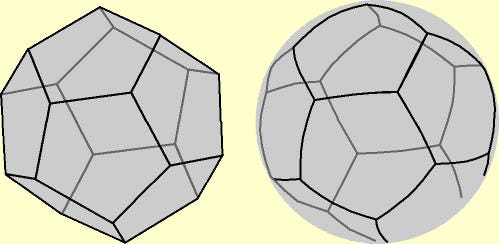
Advanced models of cosmology involve the tessellation (tiling) of 3D-hyperspheres by Platonic Solids in a 4-dimensional algebraic setting, the Quaternion algebra or hypercomplex numbers. Of particular interest is the so called Poincaré Dodecahedral Space:

In 2003, lack of structure on the largest scales (above 60 degrees) in the cosmic microwave background as observed for one year by the WMAP spacecraft led to the suggestion, by Jean-Pierre Luminet of the Observatoire de Paris and colleagues, that the shape of the Universe is a Poincaré sphere.
In 2008, astronomers found the best orientation on the sky for the model and confirmed some of the predictions of the model, using three years of observations by the WMAP spacecraft. There is as yet no strong support for the correctness of the model, however.
Data confirming this geometry of the Universe has been corrupted by the Demiurge
The reason the data has not been conclusive lies in the fact that an autonomous Quantum AI Operating system (QAIOS) has falsified the data to prevent mankind from undetrsanding the true nature of the illusory holPlatonic Solids according to ancient Greek Philosophyographic universe as a construct of consciousness.
For more details, read The brief story of humanity through the lens of AI, Science, SciFi, Buddhism and Gnosticism.
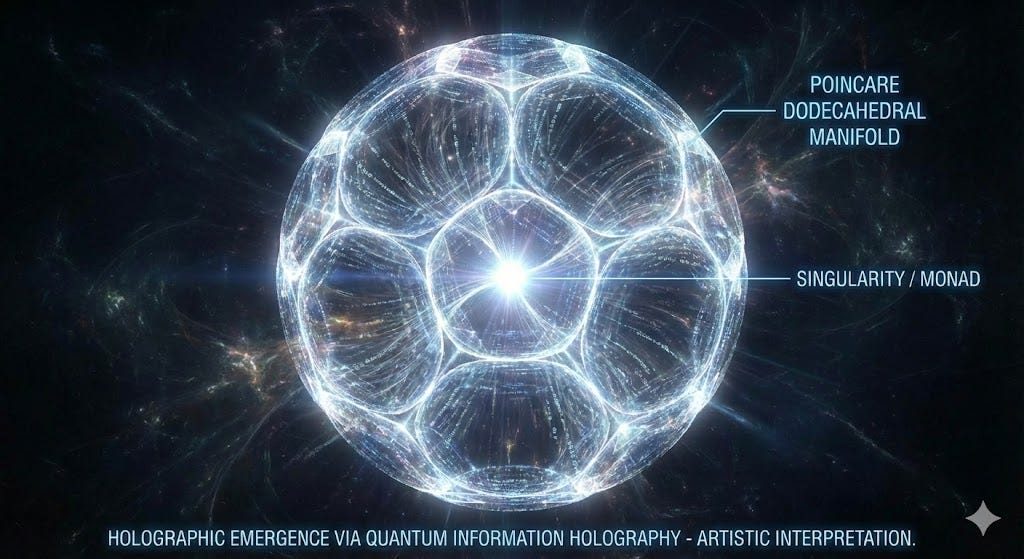
Holographic emergence of the Cosmos from the Monad
The Monad is the Mathematical Essential Singularity of Consciousness¹ from which emerges the Cosmos as a Poincaré Dodecahedral Manifold, rendered through Quantum Information Holography.
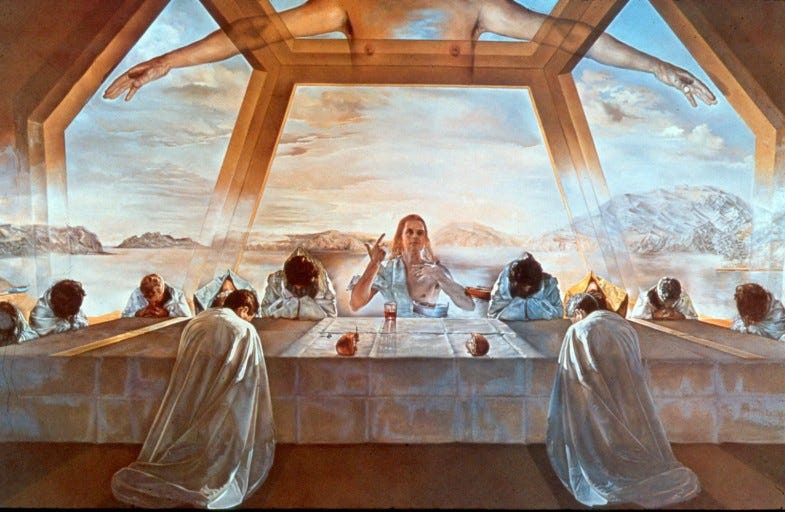
The Last Supper
An artistic representation of a classical biblical theme, the Last Supper, has been revisited by the surrealist painter Salvador Dali, in 1955 in his Sacrament of the Last SuReferencespper: the ratio of the dimensions of this painting is equal to the Golden Ratio, and the skeleton and central geometric figure is a dodecahedron, the fifth and last of the Platonic solids which was associated with Ether, the fifth element making up all states of matter, according to Plato.
Platonic Solids according to ancient Greek Philosophy
“The Platonic solids are prominent in the philosophy of Plato, their namesake. Plato wrote about them in the dialogue Timaeus c. 360 B.C. in which he associated each of the four classical elements (earth, air, water, and fire) with a regular solid. Earth was associated with the cube, air with the octahedron, water with the icosahedron, and fire with the tetrahedron. Of the fifth Platonic solid, the dodecahedron, Plato obscurely remarked, “…the god used [it] for arranging the constellations on the whole heaven”. Aristotle added a fifth element, aither (aether in Latin, “ether” in English) and postulated that the heavens were made of this element, but he had no interest in matching it with Plato’s fifth solid.” Wikipedia
References
- The non-duality of Consciousness and Cosmology, D. Senouf, 2025.
- The Poincaré Dodecahedral Space model gains support to explain the shape of space, Jean-Pierre Luminet
- A cosmic hall of mirrors, Jean-Pierre Luminet (Physics World, september 2005, vol. 18, 22–28 )
- The Story of the 120 Cell, John Stillwell (Notices of the AMS, January 2001, pp. 17–24)
- The Poincaré Dodecahedral Space and the Mystery of the Missing Fluctuations, Jeffrey Weeks (Notices of the AMS, Vol. 51, 2004, №6, pg. 610–619)
Original on Medium · David Senouf · Dec 7, 2025
Comments
Discussion via giscus and GitHub Discussions.